Large financial companies are still monopolizing the earnings news. Bank of America BAC, Wells Fargo WFC, Morgan Stanley MS, Citigroup C, and U.S. Bancorp USB all beat earnings and revenue expectations. The Financial sector has benefitted from rising interest rates. Despite the 10-year Treasury Yield (TNX) trading slightly lower before the open, rates may continue to rise as the Fed moves closer to tapering.
Wells Fargo, Morgan Stanley, and Bank of America also announced that they are releasing reserved cash that had been set aside for pandemic-related defaults. These actions suggest a vote of confidence that the U.S. is heading back to normal. The positive gesture is helping to push stocks higher before the open and the Volatility Index (VIX) AKA fear index has fallen 8% before the open.
A couple of health care stocks also reported Thursday morning. Despite the fallout around the COVID-19 delta wave, UnitedHealth (UNH) was trading 2.74% higher before the open in reaction to the company reporting better-than-expected earnings and revenue. Additionally, UnitedHealth raised its forward guidance.
Walgreens Boots WBA also beat EPS and revenue expectations prompting a premarket rally of 1.35%. Pharmacy sales rose 8.1% in its U.S. operations and 11.4% in its U.K. operations. On top of pharmacy sales, the company increased retail sales by 8.9% in the U.S. and 15% in the U.K.
With the global supply chain suffering from congestion, the microchip shortage has been a major bottleneck. Therefore, Taiwan Semiconductor TSM earnings are also attracting attention. The company reported higher-than-expected earnings despite lower-than-expected revenue. The stock was trading more than 3.8% higher in premarket trading. Taiwan Semi increased its gross margin from 51% to 53% on strong demand that Chief Financial Officer Wendell Huang projects will remain high.
The global supply chain has been one of the causes of rising inflation. The Producer Price Index (PPI) measures inflation at the wholesale level. However, the PPI came in lower than expected which means inflation at this level isn’t growing as fast as analysts projected.
Gold futures (/GC) climbed almost 2% on Wednesday in reaction to the Consumer Price Index (CPI) measuring consumer inflation growth in line with projections. Precious metals like gold are often seen as a hedge against inflation, but gold has trended down since August of 2020. On Thursday, traders appear to be following through with Wednesday’s rally. Gold bugs may be looking for more signs of inflation in today’s crude oil inventories. Crude oil (/CL) was trading more than 1.25% higher before the open.
Higher energy prices appear to be helping solar stocks. This week SolarEdge SEDG, SunRun RUN, SunPower SPWR, and Daqo DQ all rallied 15%, 13%, 17%, and 15% respectively after Wednesday’s close. In the past, these companies have also benefited from green legislation. With the debt ceiling pushed back to December, some investors may be looking for President Biden’s infrastructure bill to finally build momentum.
Some light was also shed on what Fed members are thinking. The FOMC Meeting Minutes were released Wednesday afternoon and confirmed what most already suspected—that the Fed could start tapering as soon as November. The discussion was around the current pace of buying securities. The plan appears to be reducing the amount of buying by $15 billion per month in Treasuries and mortgage-backed securities.
Today's Best Finance Deals
Chips and Dip
Earlier, I talked about how Taiwan Semi is projecting higher demand going forward because of the semiconductor shortage. The shortage has hurt many industries including electronics, computers, phones, cars, and much more. Semiconductors can be divided up into microprocessors, memory chips, commodity integrated circuits, and complex circuits. While consumers are used to buying the end products, they may not be aware of the various companies involved in manufacturing these chips.
So, what are some of these chipmakers? They include Intel INTC, Taiwan Semiconductor TSM, Qualcomm QCOM, Broadcom AVGO, Micron MU, and Texas Instruments TXN. Some of these companies offer more than one type of semiconductor, whereas others may specialize. When these companies can’t deliver, it can hurt other companies. Recently, Apple (APPL) lowered its iPhone 13 production forecasts because its semiconductor suppliers Skyworks SWKS and Qurvo (NASDAQ: QRVO
) couldn’t keep up with demand due to issues related to the pandemic.
Some companies are tangential to semiconductor production but aid in getting them to market. For example, ASE Technology ASX performs semiconductor testing, assembly, and packaging.
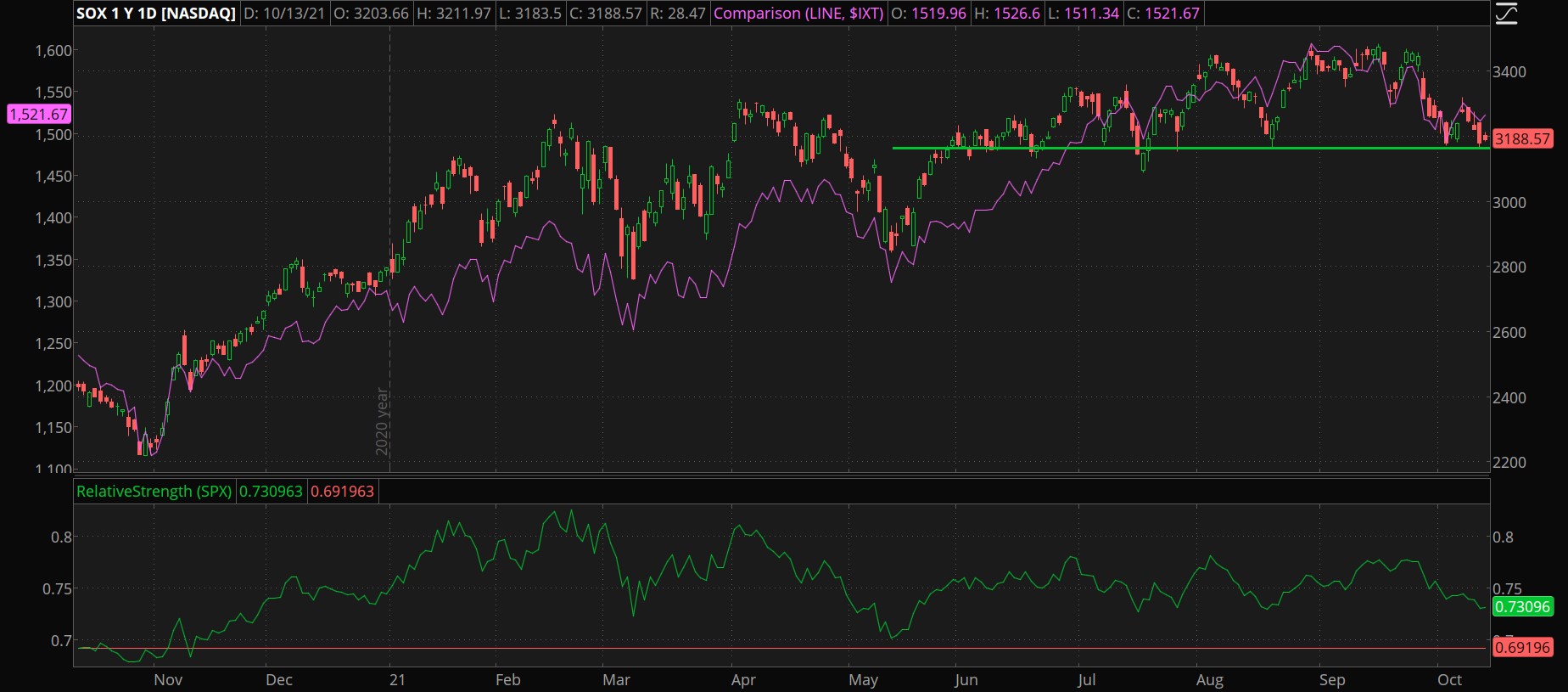
CHART OF THE DAY: PULLING UP THE SOX. The PHLX Semiconductor Index (SOX—candlestick) has moved generally higher over the last year and until recently was outpacing the S&P Technology Select Sector Index ($IXT—pink line). Compared to the S&P 500 using relative strength (green line), the SOX has also kept pace with the benchmark index. Data Sources: ICE, S&P Dow Jones Indices. Chart source: The thinkorswim® platform. For illustrative purposes only. Past performance does not guarantee future results.
South Side Sox: While my Chicago White Sox cruised to a division title only to be knocked out in the first round of the playoffs, the SOX or PHLX Semiconductor Index appears to be finding support near the 3160 level. In the previous few months, the SOX has bounced off this level a few times, which my chartist friends tell me suggests that there’s demand for the industry group.
Because the SOX has pretty much moved with its sector and with the S&P 500 (SPX) since May, the question is, “Can the group breakout?” The answer to this rests with the ability of the group to meet the high demand.
Chipping In: Mobile-phone semiconductor maker Qualcomm QCOM saw its board of directors approve a $10 billion stock buyback plan. A stock buyback plan, or stock repurchase plan, is when a company uses its cash to buy its own shares on the open market. The buyback plan usually defines how much will be spent and over what time frame. Qualcomm’s plan starts immediately with no expiration date.
Stock buybacks are popular. In the last month, some companies like Keurig Dr Pepper KDP, Dollar Tree DLTR, Lockheed Martin LMT, Accenture ACN, Cracker Barrel CBRL, Microsoft MSFT, and Campbell Soup CPB have announced buybacks.
Chips or Wafers: There are several materials that go into making semiconductor chips, but one that is commonly associated with semiconductors is silicon carbide. This is because it’s used in creating silicon wafers that are then used in semiconductor circuits. Higher demand for wafers means higher demand for silicon. Top silicon miners include U.S. Silica SLCA, Ferroglobe GSM, and U.S. Steel X. Once the silicon is harvested, it goes to wafer manufacturers like Applied Materials AMAT.
By tracing the division of labor, we can see the demand for one product can influence the demand for other products.
TD Ameritrade® commentary for educational purposes only. Member SIPC.
Image Sourced from Pixabay
Edge Rankings
Price Trend
© 2025 Benzinga.com. Benzinga does not provide investment advice. All rights reserved.
Trade confidently with insights and alerts from analyst ratings, free reports and breaking news that affects the stocks you care about.