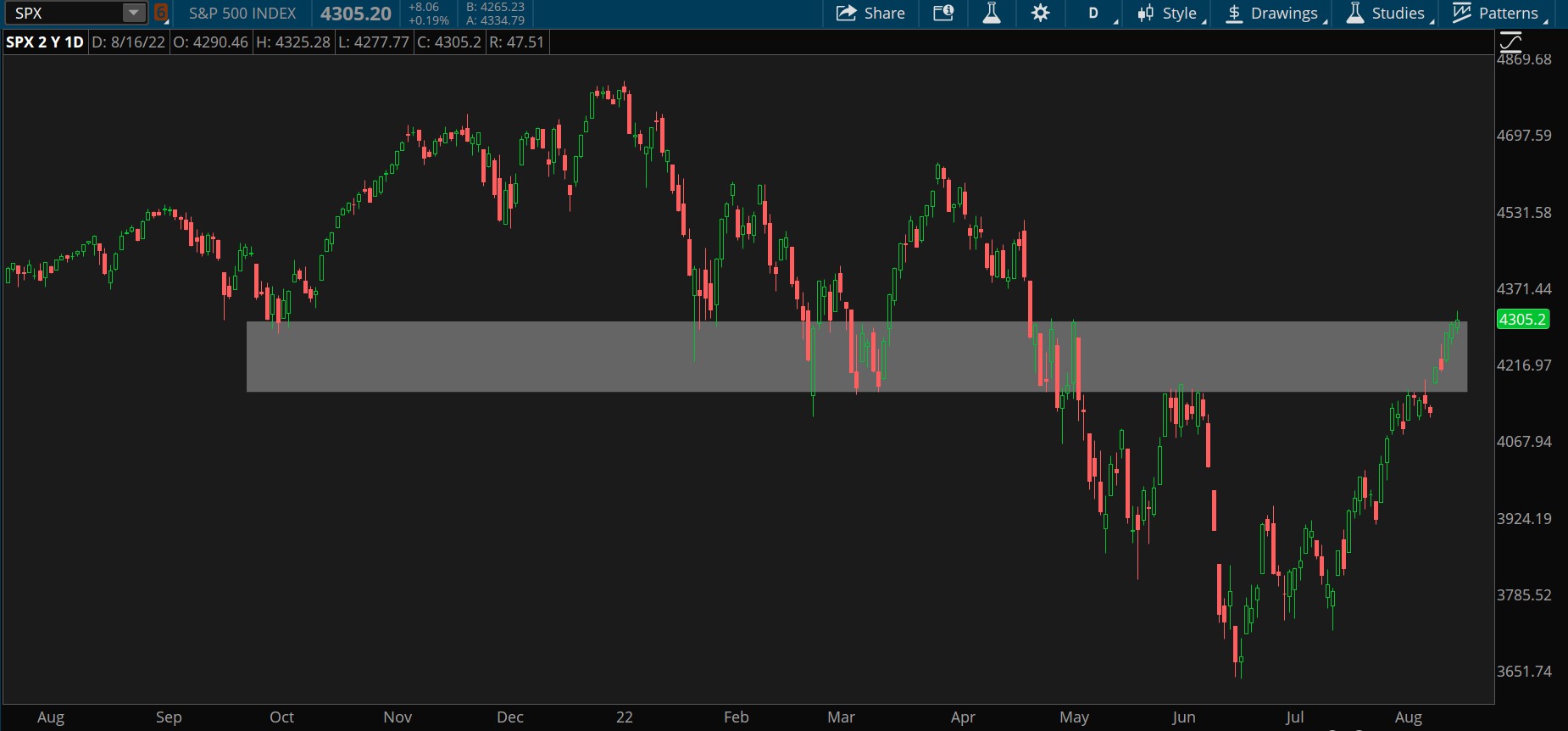
(Wednesday Market Open Investors may be ready to take some profits today after the S&P 500® index (SPX) has now rallied more than 22% from June lows. In premarket action, S&P 500 futures were already down 0.84%.
Potential Market Movers
But today’s activity may not be all about profit-taking. Investors seemed spooked by the latest U.K. inflation numbers that topped 10%. Britain’s Consumer Price Index (CPI) grew at 10.1% year-over-year which above the 9.8% forecast. It’s news that could make today’s FOMC meeting minutes release a little more interesting as investors could finally be willing to take Fed members’ recent hawkish comments a little more seriously.
Despite so many similarities with the U.S. economy, the U.K. is facing somewhat different inflationary pressures. While both countries are dealing with a lack of supply for many products and backed-up supply chains, Britain is facing a steep energy crisis due to the Russian-Ukraine war that the U.S. is not.
Nonetheless, U.S. Treasury yields were higher before the opening bell. The 2-year Treasury yield rose 10 basis points to 3.34% and the 10-year Treasury yield (TNX) jumped 8 basis points to 2.89% suggesting that there might be something to the market’s inflation concerns.
The U.S. retail sales report also came out this morning showing that July sales didn’t grow at all with a print of 0.0%. Analysts had forecasted growth of 0.1%. However, there are layers to this report that provide a clearer picture. Core retail sales that exclude automobiles rose 0.4%, well above the forecast of -0.1%. Further, the control group number that excludes automobiles, gasoline, and home improvement grew 0.8%, topping the forecasted 0.6%.
Meanwhile, a big retail earnings week continues. Lowe’s (NYSE:LOW) beat earnings estimates despite missing revenues and then warned that future sales estimates would likely be at the bottom end of its range. However, the stock rallied more than 3% in premarket trading.
Target (NYSE:TGT) missed on top and bottom-line numbers due to the need to unload excess inventory at sale prices. The company said that it still has more inventory it will need to discount, but it’s now a short-term problem and Target slightly raised its longer-term forecast. However, investors appeared unconvinced as TGT’s shares were down 2.66% premarket.
TJX Companies (NYSE:TJX) topped earnings estimates despite missing on revenues, but sales fell more than expected. The company attributed its lower revenues to inflation cutting into customer buying habits. TJX fell 1.58% ahead of the opening bell.
Moving over to technology, chip maker Analog Devices (NASDAQ:ADI) beat on top- and bottom-line numbers but fell 1.98% in the premarket session. The company reported strong demand but hedged by expressing concern that macroeconomic uncertainty has begun to cut into orders, but its order backlog is still growing.
After the market close, tech bellwether Cisco (NASDAQ:CSCO) reports earnings.
Reviewing the Market Minutes
After failing to maintain a break above the 4,300 level, the S&P 500® index (SPX) ticked 0.01% lower by the close. The Nasdaq ($COMP) decreased 0.43% after finding resistance around the 13,100 mark. The Dow Jones Industrial Average ($DJI) was the only major index to close higher—rising 0.62%.
July housing starts and building permits continued to contract in July reflecting ongoing weakness in the housing market. However, the PHLX Housing Sector Index (HGX) rose 0.30% despite the news.
Three Things to Watch
With the bond market losing a big buyer, there’s concern that yields will go even higher next month, but nobody really knows what’s going to happen. The U.S. Treasury will have to rely on the money markets to find bond buyers, and bond buyers may demand more for their money, causing yields to rise.
Additionally, the Treasury plans to reduce $1 billion in both the new and reopened 10-year note auction sizes and to new and reopened 30-year bond auction sizes starting this month.
Finally, the new and reopened 20-year bond auction sizes will be reduced by $2 billion each.
The reduction in the size of these auctions should help rates remain relatively stable as supply falls to meet lower demand from the Fed.
STRETCHED TIGHT: According to Edmunds, the average monthly car payment is now $702—the highest on record. That number doesn’t account for insurance, gas, maintenance, repairs, or parking. The average term of a car loan is 70.4 months, just two months shy of six years.
The reason for the rise in the payment is that the average cost for a new car in July was $45,869 according to J.D. Power/LMC Automotive. While that’s lower than the previous record of $45,988 set in June, higher lending rates are increasing the size of car payments. Edmunds says the average car loan rate is 5.5% compared to the previous year of 4.5%.
Notable Calendar Items
Aug 19: Earnings from Deere (NYSE:DE), Foot Locker (NYSE:FL), and Buckle (NYSE:BKE)
Aug 22: Earnings from Palo Alto Networks (NASDAQ:PANW)
Image sourced from Shutterstock
This post contains sponsored advertising content. This content is for informational purposes only and not intended to be investing advice.
© 2026 Benzinga.com. Benzinga does not provide investment advice. All rights reserved.
To add Benzinga News as your preferred source on Google, click here.