A ramp-up in new Covid cases is bringing fear that we may take a step backward here, weighing on stocks to start the week. Wall Street continues to show signs of tracking the bond market, and bond yields posted fresh five-month lows this morning.
Daily cases have tripled from a month ago in the U.S., and travel stocks are taking it on the chin today in pre-market trading. Airlines, hotels, casinos, and restaurants all could receive the brunt of the blow if Covid worries keep growing. Other companies aren’t immune. The outbreak is generally worse overseas, which could threaten business for multinational U.S. firms. Caterpillar CAT and General Motors GM both slid ahead of the bell.
As Covid concerns return to Page 1 of the morning news, we might see the return of one of last year’s trends, where markets settle down during the middle of the week but fear creeps in by the end of the week and into the weekend. On Friday the major indices closed on their lows—typically a bad sign from a technical standpoint—and like many weeks during the height of the pandemic, Friday’s weakness carried over into the new week.



Eyeing The Horsemen Of Risk
The 10-year Treasury yield fell below 1.25% to new five-month lows early Monday. Crude fell below $70 a barrel for the first time since June 11. Part of the crude weakness might reflect the OPEC+ deal reached over the weekend, but it also could suggest fears of a slowing economy if the pandemic stays front and center.
Keep an eye on volatility, too. The Cboe Volatility Index (VIX) put on some steam late last week and that spilled over into Monday. It’s back above 21 this morning, a move that’s probably going to get some notice. A higher VIX often can signal people taking protection against possible market turbulence.
Weirdly, the dollar is rising here even as bond yields fall. This could reflect people thinking the U.S. is being hit less hard by this fresh Covid outbreak.
As Monday continues, we’ll see if the market action here is one of those things where weekend fears lead to an initial reaction and then cooler heads prevail, or if concerns continue to weigh. The “buy the dip” mentality has been so strong lately, it’s hard to believe it would suddenly fade. The question is, at what level does it happen? The 4280 level in the S&P 500 Index (SPX) could be an important one to watch.
What’s On The Earnings Tap?
Oddly, earnings seem almost like a second-tier story today even though we’re heading into the thick of the season with 76 S&P 500 companies reporting. Things kick off with Big Blue, IBM IBM expected to report this afternoon.
A host of other big names step to the plate this week including Netflix NFLX, American Express AXP, Johnson & Johnson JNJ, Twitter TWTR, United Airlines UAL, AT&T T, Verizon VZ, American Airlines AAL, and Coca-Cola KO.
Something to consider as these companies report is the impact of rising producer prices, and whether this could be clipping margins or causing them to pass along costs to consumers. Reopening is also in focus, so listen for executives’ thoughts on how that’s going.
With NFLX in particular, investors will likely focus on membership growth. That metric was far below what Wall Street had expected in Q1 and even missed the typically conservative mark offered by the company’s own C-suite. It rolled in at 3.98 million—the softest showing since 2013 when only three million customers joined the club.
NFLX execs told investors then to brace for the worst as the challenges ahead amid vaccinations and the economic reopening would be heady. They forecast new membership would inch up only one million in Q2, a fraction of the 4.44 million Wall Street was anticipating. Shares of NFLX popped up a bit recently but are pretty much flat year-to-date. The company is expected to report after the close tomorrow.
In the tech arena, keep an eye out for the first major chip firms to report, with Intel INTC and Texas Instruments TXN on this week’s schedule.
Season Starts With A Bang
It’s still early, but initial earnings season numbers look pretty good overall. About 8% of S&P 500 companies have reported, and 85% of those reported a positive earnings surprise while 90% surprised to the upside on revenue, FactSet reported.\
FactSet now expects a pretty amazing 69.3% growth for Q2 S&P 500 earnings, up from its previous 63.9%. It expects average revenue to rise more than 20%.
This is all positive, but it does mean investors begin earnings season with extremely big expectations. So it’s a high bar for companies reporting, and if they don’t clear it they could get punished. The biggest Tech stocks like Apple AAPL, Microsoft MSFT, and Amazon AMZN begin reporting soon, and all of them set new all-time highs recently. This could reflect earnings optimism, but at these levels, it will probably take some very strong balance sheets to avoid seeing the momentum slow.
Beyond Earnings: Watching Crude, Housing Starts As Week Continues
Last week saw Wall Street step back from recent record highs as major indices fell in part on inflation and Covid worries. Both the June consumer and producer price indexes came in hotter than expected.
Many people are struggling with, ’My day-to-day life is telling me that prices are higher, but the Fed chairman is telling me that it’s not going to last.” On the other hand, the bond market seems to think inflation isn’t here to stay, judging from low recent yields. If inflation is going to last, we certainly have priced rates pretty low. It’s a situation of we’re going to have to be shown that it’s transitory.
One thing that could take some of the starch out of inflation is if crude has another week like last one. The Energy sector is getting crushed lately, helping pressure the Russell 2000 (RUT) small-cap index.
On the data front, investors get a look at real estate tomorrow with housing starts and building permits for June. Housing starts rose faster than expected last time out but building permits decreased, so we’ll see if that continued in June. Otherwise, key numbers are a bit sparse in the coming days, and the Fed will soon go into its “quiet period” ahead of the Federal Open Market Committee (FOMC) meeting scheduled for later this month. All this could mean an intense focus on earnings reports without much distraction.
The Capitol watch is also back on this week as Congress keeps wrestling with the infrastructure bill. Progress there could potentially provide a lift. Or should we say a forklift?
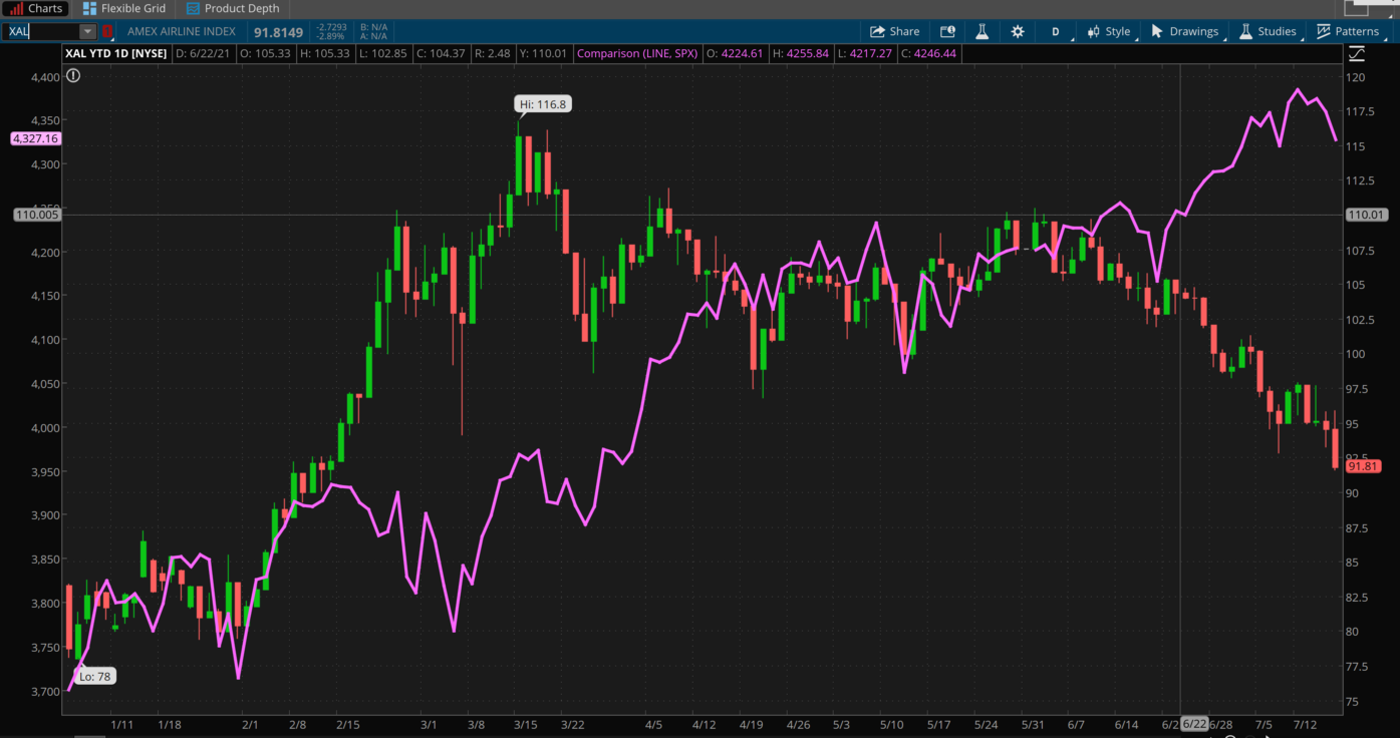
CHART OF THE DAY: LOSING ALTITUDE. As some of the biggest U.S. airlines prepare to report this week, the NYSE Arca Airline Index (XAL—candlestick) is on a sharp losing streak and getting easily outpaced by the S&P 500 Index (SPX—purple line). Higher fuel costs and Covid concerns have made it a tough last month for airline investors after a big jump earlier this year. Data Sources: NYSE, S&P Dow Jones Indices. Chart source: The thinkorswim® platform. For illustrative purposes only. Past performance does not guarantee future results.
How Strong Were Retail Sales, Really? Investors received a couple of conflicting data points going into the weekend that are still being digested and debated as the new week starts. Retail sales for June were off the charts, rising 1.3% excluding autos, compared with consensus expectations of 0.3%. This appeared to point toward consumers getting out and spending last month as the economy opened, though if you’re a glass-half-empty type you might point out that a chunk of the retail sales strength reflected higher prices due to inflation, rather than volume of sales.
Though retail sales shined, consumer sentiment didn’t paint such a pretty picture. The University of Michigan’s consumer sentiment data for early July, also released Friday, showed a drop to 80.8 in the headline figure from above 85 in June. Analysts had expected 86.3, according to research firm Briefing.com.From a historic perspective, 80.8 isn’t a horrible number. It was the lowest since February, however, and down from nearly 100 at one point this year. What’s sapping sentiment? Inflation, possibly. As Barron’s pointed out, after the impact of higher prices, real hourly earnings are down 1.7% from a year ago. This might explain why nine million jobs are unfilled despite continued high unemployment.
Boss, I Need A Raise: Last week, Fed Chairman Jerome Powell told Congress it’s important to keep inflation expectations from getting out of hand. The Fed’s longstanding target is 2%, and the central bank is comfortable allowing inflation to run above that for a while here as the economy reopens. Powell expects elevated inflation to moderate.
But if expectations for inflation continue to look this strong, it could cause wage demands to rise, putting pressure on companies to pay more, and maybe raise prices to cover the costs. That’s the kind of thing that set off a “wage-price spiral” in the 1970s that the Fed eventually had to pop with extremely high rates. No one’s saying that’s going to happen again, and we’re only talking about one sentiment report here. Still, those inflation expectations bear further watching when the next sentiment data hit the tape July 30.
Bond Market May Signal 2022 Headwinds: At recent lows, the closely followed U.S. 10-year Treasury yield sank to between 1.25% and 1.3%, falling to 1.29% at the end of last week. There’s growing concern that these weak levels could indicate worries about U.S. economic growth going into 2022, and that’s certainly worth thinking about. After all, in 2022 the government’s fiscal stimulus could be ebbing, the Fed might be beginning to taper its bond-buying, and earnings will have a huge mountain to climb if they’re going to match this year’s amazing post-Covid growth. FactSet said analysts expect only 11% S&P 500 earnings growth in 2022 vs. 36.7% in 2021.
In other words, there could be a lot of headwinds both on Wall Street and in the broader economy next year, and it’s possible that’s what the bond market is telling us with the recent yield downtrend from the peak above 1.75% in March. One analyst told CNBC on Friday that it’s important for the 10-year yield to hold onto recent lows, or the stock market could lose any momentum it still has. Another concern is that some of the mega-cap Techs AAPL, AMZN, and MSFT weren’t able to add on to recent gains. If their momentum is slowing, the rest of the market could lose that particular crutch, too.
TD Ameritrade® commentary for educational purposes only. Member SIPC.
Image by Free-Photos from Pixabay
Edge Rankings
Price Trend
© 2025 Benzinga.com. Benzinga does not provide investment advice. All rights reserved.
Trade confidently with insights and alerts from analyst ratings, free reports and breaking news that affects the stocks you care about.