


Did Goldilocks find the right bed with the July Labor Department’s strong jobs report?
Fed Chairman Powell has said in the past that the Fed will need to see solid jobs growth before it starts to taper. Although we won’t know what the Fed might be thinking, this month’s jobs report will be an important one to watch after last month’s solid report. Yesterday, the market closed higher across the board, the only day so far this week the market was not choppy, as it continued to digest strong earnings while awaiting the July jobs report Friday morning from the U.S. Labor Department. Nine of the S&P 500’s 11 sectors rallied Thursday, with only the Health Care and Materials groups finishing lower.
A Deeper Dive Into Jobs Report
The July nonfarm payrolls added 943,000, above analyst estimate and higher than the 850,000 in June, according to Briefing.com. The unemployment rate came in at 5.4%, better than the expected 5.7% and hourly wages were up 0.4%.
Drilling down, industries that added the most jobs included leisure and hospitality, which increased by 380,000 jobs. Two-thirds of those job gains were in food services and drinking places, accounting for 253,000 jobs. However, despite this recent growth, employment in leisure and hospitality is down by 1.7 million, or 10.3 percent, from its level in February 2020. Health care added 37,000 jobs in July.
Employment in manufacturing increased by 27,000 in July, largely in durable goods. But again, manufacturing employment is 433,000 below its February 2020 level, or before the pandemic took hold. Construction jobs, a key indicator of economic activity, didn’t change much. Health Care added 37,000, which is good to see given that this industry was severely impacted by the pandemic.
In the education space, employment rose by 221,000 in local government education and 40,000 in private education. Usually, we’d see a sizable drop in the education component but this time it may be different because of the seasonal adjustment we see at the end of the school year. Keep in mind, schools are gearing up for the new school year so this could only last a month or so.
Some things to keep in mind as we look ahead: the report is based on surveys conducted before some employers reimposed mask mandates and other restrictions in response to the Delta variant. How employees will react to employers’ requirements to mask up, be vaccinated, or get regularly tested remains to be seen. Also, when children go back to school in the fall as expected, that could further add momentum to future jobs reports. And let’s not forget that the government’s pandemic unemployment assistance program is scheduled to come to an end in September when people consider gifts and travel for the upcoming winter holidays.
Equity futures picked up a bit after the release but didn’t react too much. However, the 10-year Treasury yield did jump up to the 1.28 level.
Beyond The Jobs Report
The theme on Thursday was risk on trades—investors are willing to accept risk and be long stocks, and not stay with the safety of Treasuries. The expected earnings growth rate for S&P 500 companies is tracking toward 85.1%, which would be the biggest jump since the fourth quarter of 2009, according to FactSet.
The bond yield curves continued to get squished, flattening again on Thursday. The 10-year yield briefly reached the lowest level in six months at under 1.13% but settled back to 1.20. There have been pockets of vocal concerns that a hawkish Fed may want to take action if the jobs report showed growth deemed so strong that it stoked inflation fears. However, the Fed has reiterated multiple times that it intends to keep rates steady until 2023.
The Cboe Volatility Index (VIX), dialed back to below 17 today, ahead of the open.
Before this morning’s payrolls report, the S&P 500 Index (SPX) hit a new record close, the Dow Jones Industrial Average ($DJI) rose 0.8%, and the Nasdaq Composite GIDS also closed at a record high. We saw strength in reopening stocks, with travel stocks seeing a bounce. Airlines have struggled with staffing shortages as leisure travelers resurfaced and have had to cancel flights. The CEO of Spirit Airlines SAVE apologized for canceled flights after the budget carrier canceled over 1,700 flights since Sunday, including over half of its schedule for Thursday. But we might see a turnaround in the fall. Some airlines are preparing for an increase in business travel, and as a result, plan to add flights to specific hubs.
Expedia EXPE reported earnings after Thursday’s close that missed estimates, surprising investors who were bullish on airlines and travel on Thursday with business and leisure travel picking up as workers returned to the skies for work and vacations. Travel giant Booking Holdings BKNG rose by $122.07, or about 5.9%, to $2,207.71, after its quarterly revenue more than tripled. But Covid concerns are still around, as evidenced by the announcement by Amazon AMZN that it was postponing its planned fall return to the office until next year.
Stay Tuned
Investors are likely to be closely watching the progress of the bipartisan infrastructure bill, which is still being debated. Will the bill get through the chamber prior to the recess that’s scheduled to start on Monday? The infrastructure package could impact yields so a lot depends on how things go. This may be something to keep an eye on over the weekend.
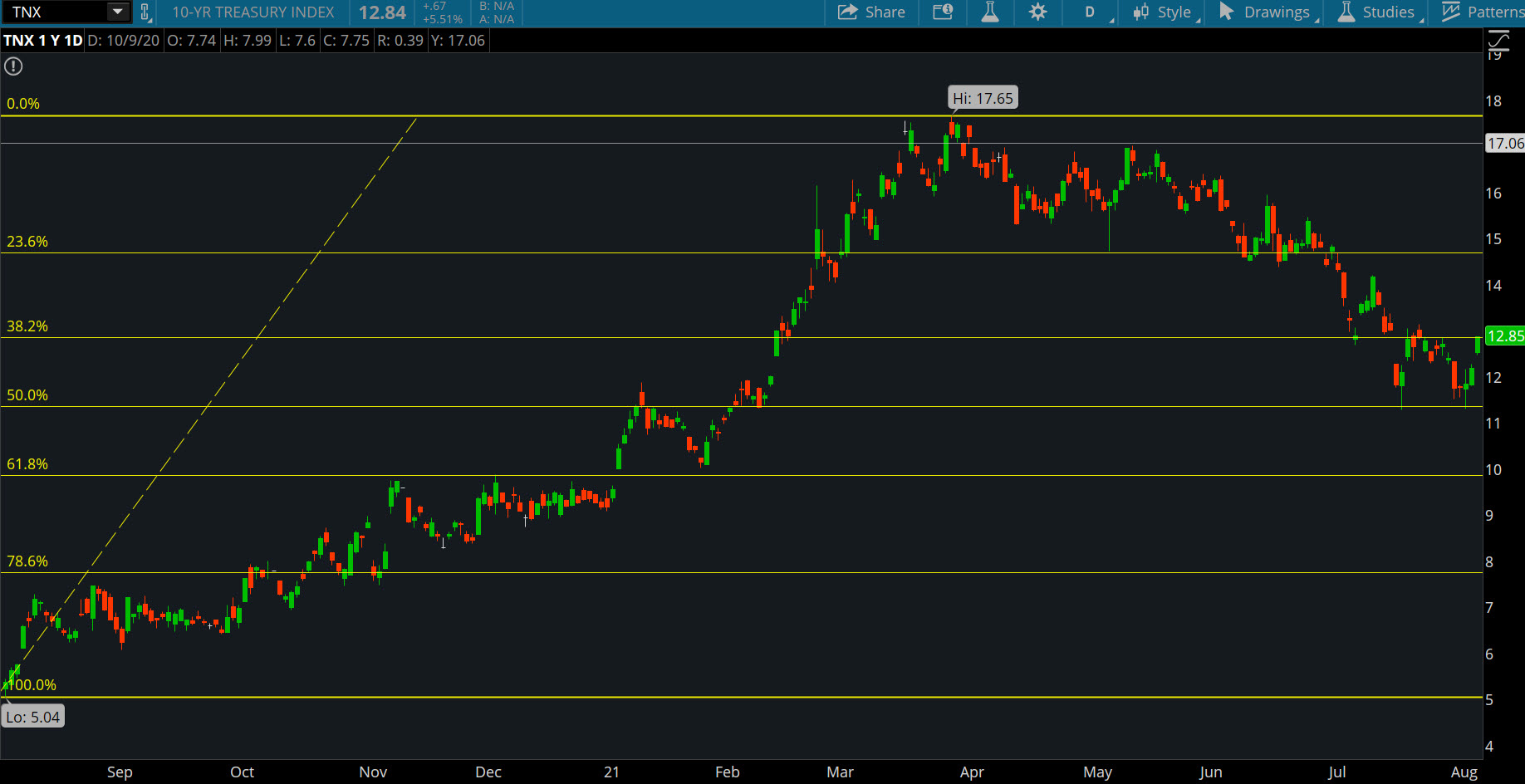
CHART OF THE DAY:YIELDS SEE A BOUNCE. After falling for most of the week, the 10-year Treasury yield (TNX—candlestick) bounced off its 50% Fibonacci retracement level (yellow horizontal lines) yesterday. But this morning, after the jobs report, TNX moved up to the 1.28 level, the 38.2% Fibonacci retracement level. Data source: Cboe Global Markets. Chart source: The thinkorswim® platform. For illustrative purposes only. Past performance does not guarantee future results.
Is Tech About To Bookend The Pandemic Boom? There’s no doubt that the Tech sector boomed as everyone was forced to hunker down during the Covid Year of 2020. The words “at-home” won the suffix of the year award. It was attached to just about everything: work, school, happy hour, shopping, entertainment, and even long-distance (virtual) travel. The digital tech realm became the center of the universe, as it allowed all of the above to happen. Naturally, businesses like Amazon AMZN, Zoom ZM, Apple AAPL, Roku ROKU, and Alphabet GOOGL to name a few boomed, some of them with eye-popping and back-to-back earnings surprises.
But what comes up can eventually go down, and some may fall harder than others. As people get vaccinated and re-enter the real world, the party may not be completely over, but it isn’t going to be quite the hypergrowth rave it was a year ago. For ROKU, it’s a drop in streaming; ZM, despite blowout earnings, warned of a slowdown; for AAPL, the chip shortage is still weighing it down; and AMZN had a rare revenue miss amid a blowout earnings beat. GOOGL was the exception, and perhaps we can say the same as other mega-tech companies with a more widely diversified portfolio of products and services. We’ll see in the coming months, especially in the wake of the delta variant, what fate has in store for tech, and the rest of the world.
EV Production Could Notch Up: The Biden administration announced their EV goal: 50% of all vehicle sales will be electric by 2030. And that includes the battery, plug-in hybrid, and fuel cell EVs. Besides automakers—EV manufacturers such as Tesla TSLA and traditional auto manufacturers who are making the shift to EVs such as General Motors GM and Ford F—charging companies could also benefit from this move.
One reason consumers may be hesitant to commit to EVs is that there aren’t enough charging stations. That may not be much of a concern when you’re driving short distances, but if you are going on a road trip, access to charging stations is important. Charging companies such as Plug Power PLUG, EVgo EVGO, and Chargepoint CHPT might benefit from this EV goal.
One thing to consider: A ramp-up in EV production could mean government support. The infrastructure bill that’s being debated includes funding for these charging points. One more reason to stay tuned to how the infrastructure bill progresses. But a word of caution: these companies aren’t currently profitable, so investing in them is not only risky, but also could require some patience.
It Took 5,000 Years for Interest Rates to Get This Low: The Federal Reserve has been keeping interest rates just above zero for months. Based on the buzz surrounding it, you’re probably wondering what this means in the larger scheme of things. Well, it’s arguably a big deal from a historical perspective.
Have you ever heard of a book titled A History of Interest Rates? Probably not, and why would you? Unless you’re a serious economic history geek or a Ph.D. candidate sweating your dissertation at the last minute, it’s one of those books you pass by with a yawn. But Bank of America BAC has it on its shelf, and apparently, picks it up every now and then. Because according to them, global interest rates haven’t been this low in 5,000 years. The news may sound a bit alarmist, but it’s also true, according to the book. As BofA’s strategist mentioned, “At some point in the next 5,000 years, rates will rise, but there is no fear on Wall Street that this will happen anytime soon.” But how significant will the effects of this minor blip (or dip) in history be on our near-term market environment?
TD Ameritrade® commentary for educational purposes only. Member SIPC.
Edge Rankings
Price Trend
© 2025 Benzinga.com. Benzinga does not provide investment advice. All rights reserved.


