This post contains sponsored advertising content. This content is for informational purposes only and not intended to be investing advice.
(Monday Market Open) Equity index futures are pointing a little higher on Monday morning as oil prices and yields have pulled back slightly in premarket trading. Investors can focus on earnings this week because there are few major economic announcements. Perhaps the biggest news will come Thursday as the Consumer Price Index (CPI) is reported.
However, there’s some corporate news that is making headlines this morning. Spirit Airlines SAVE and Frontier Airlines ULCC have agreed to a $6.6 billion deal where Spirit shareholders will receive cash and stock. SAVE rose 12.66% in premarket trading while ULCC dropped 1.78%. If approved, this merger will create the fifth largest airline. The big four include American AAL, Delta DAL, Southwest LUV, and United UAL.
Peloton PTON was up more than 34% in premarket trading on news that broke Friday afternoon naming Amazon (AMZN), Nike NKE, and Apple AAPL as potential buyout suitors for the troubled company.
According to Barron’s, Softbank is potentially looking to cut its stake in Alibaba BABA pushing the stock 4.38% lower in premarket trading. Softbank is one of BABA’s largest shareholders holding 25% of the company’s outstanding shares. BABA filed with Securities and Exchange Commission to register 1 billion American depository shares.
In earnings news, Tyson Foods TSN reported stronger than expected earnings and revenues prompting a 5.7% rise in premarket trading. TSN soundly beat earnings reporting $2.87 per share compared to the FactSet average estimate of $1.93. The company is benefiting from inflationary pressures and reported a 32% increase in beef prices, a 20% rise in chicken, and a 13% climb in pork.
Additionally, toymaker Hasbro HAS is up 2.2% in premarket trading after beating on top and bottom line numbers. HAS also raised its dividend by 2.9%.
According to Refinitiv, 278 companies in the S&P 500 (SPX) have reported earnings as of Friday; another 82 are expected report this week. Of those that have reported, 78.4% have beat analysts’ estimates, which is above the long-term average of 65.9% but lower than the prior four quarter average of 83.9%. Year-over-year earnings growth are expected increase 27.2%, but when you take out energy, growth is only 18.8%. Energy continues to be the top performing sector followed by materials and utilities.
Working It
Stocks fell Friday morning as the strong Employment Situation report saw better-than-expected jobs growth and wage gains. The good news actually prompted fears of rising interest rate, but as the morning moved on, fear began to subside. The Nasdaq Composite ($COMP) actually closed higher on the day and led the S&P 500 (SPX) higher. The indices rode positive waves from Amazon (AMZN) and Snap (SNAP) earnings reports.
Before Friday’s market open, the Bureau of Labor Statistics (BLS) released its Employment Situation Report that showed the labor market created many more jobs than expected, adding 467,000 jobs, which was well above the estimate of 150,000. More than 444,000 jobs were added in the private labor market alone. Additionally, the BLS adjusted the December payrolls up from 125,000 to 500,000, showing that the market has been stronger than previously reported.
The service sectors saw some of the biggest job gains with the leisure and hospitality group leading by adding 150,000 jobs. The supply chain issues helped professional business services and transportation and warehouse services add more than 500,000 jobs since February 2020. Higher demand for leisure and hospitality means consumers could be changing their focus from consuming products and moving to services. The change in consumption focus should help relieve some pressure on the supply chain that has called for so many truck drivers and warehouse workers.
Oddly, the unemployment rate rose from 3.9% to 4%, but this was because many more people came back into the workforce. The workforce participation rate grew from 61.9% to 62.2%, which suggests the labor market is much more appealing to workers. Higher wages are certainly an attraction, and the average hourly earnings rose 0.7% month over month and 5.7% year over year.
While the jobs number is fantastic news for the economy and workers, it’s likely to give the Federal Reserve more confidence in raising interest rates quicker as concerns over wage inflation will rise. In fact, the 2-year Treasury is now trading above 1.3%, which is the rate that tends to be more correlated with the Fed’s discount rate. This suggests that the Fed may raise rates higher than it had hoped. The 10-year Treasury yield (TNX) shot up nearly 5.65% to 1.93% and appears to be on a trajectory toward 2%.
Rising yields prompted the U.S. Dollar Index to rally, breaking a four-day slide. Yields got another boost from rising oil prices, which rose 2.13% and closed at $93.05 per barrel, resulting in a new seven-year high. If the TNX is on its way to 2%, then oil may be on its way to $100 per barrel.
Despite the pressure on interest rates and the negative effects rising rates have had on valuations for growth stocks, the Nasdaq Composite ($COMP) still led the major indices and closed 1.58% higher. The S&P 500 (SPX) rose 0.52%. However, the Dow Jones Industrial Average ($DJI) closed 0.06% lower on the day.
Earning It
Friday’s rally in the Nasdaq o was led by good earnings announcements from Amazon (AMZN) and Snap (SNAP). The stocks rallied 13.54% and 58.82% respectively. Amazon is among the big-tech stocks that have reported earnings this week, sparking some of the market volatility. Apple (AAPL) set the bar high on the last Friday in January with its excellent earnings announcement. Then Alphabet GOOGL followed up on Tuesday with better-than-expected earnings. However, Meta FB disappointed on earnings, leading to a devastating sell-off on Thursday.
I’ve been making this point for months now; rising interest rates are forcing companies to earn their stock price gains. Higher interest rates change how investors value companies, which means companies have to produce real earnings and not just the promise of future earnings.
It also means that costs count. Company management must be able control costs and expenses because investors are expecting companies to be better managers of their money. Companies that are not able to match these new expectations will likely see investors leave for better prospects.
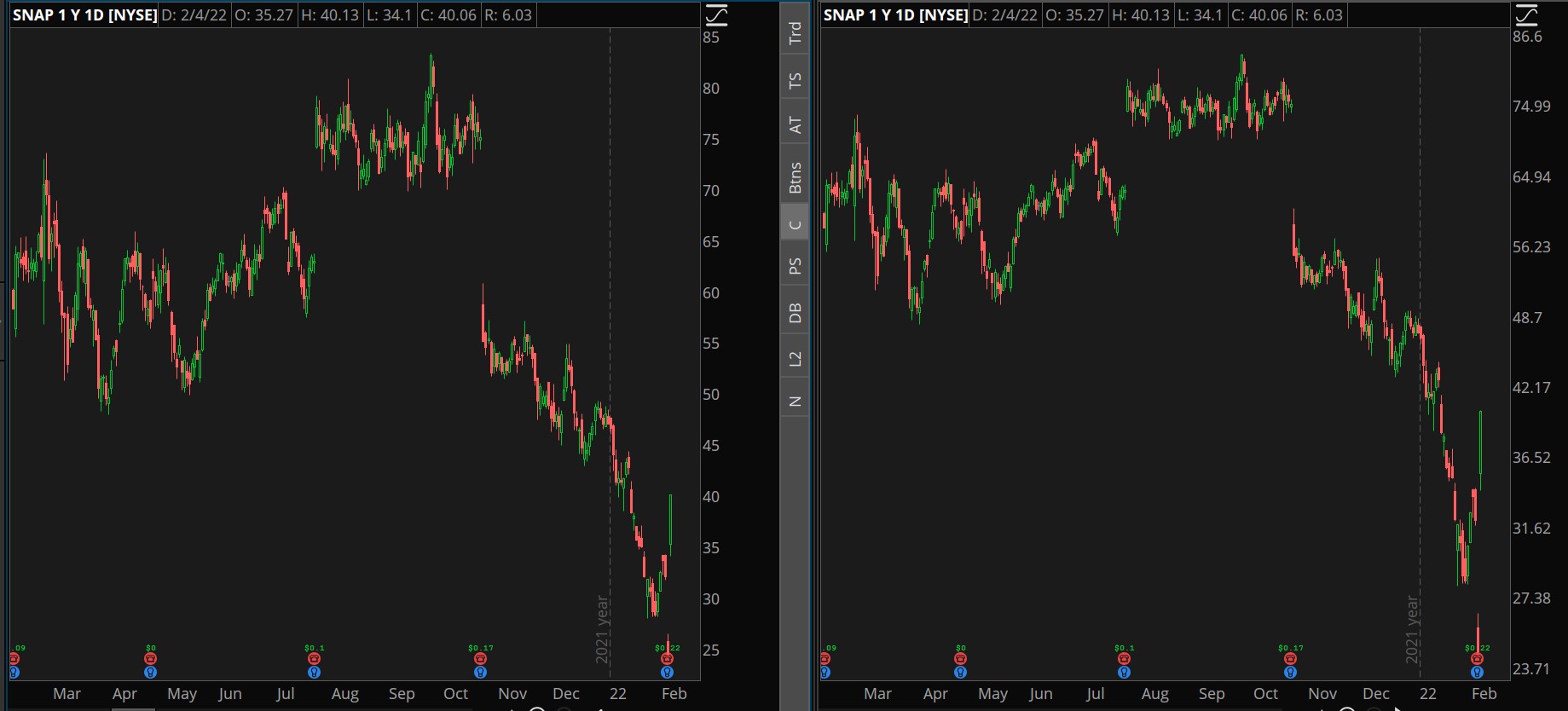
CHART OF THE DAY: LOG ROLLING. Snap (SNAP) has made an impressive rebound by rallying 58% on Friday. However, when you see the rally compared to its downtrend, it doesn’t look as impressive. The rally on a linear chart (left) looks even smaller than a logarithmic chart (right). Generally, a linear chart focuses on price changes, whereas a log chart focuses on percentage changes. Data Sources: ICE, S&P Dow Jones Indices. Chart source: The thinkorswim® platform. For illustrative purposes only. Past performance does not guarantee future results.
Drawdown Paradox: When you hear the news about a stock like Snap (SNAP) that has risen 60%, it’s an impressive move. However, when you look at the chart, the move may not look as impressive. Of course, this all depends on when you purchased the stock. If you’re been holding the stock throughout its previous fall, the rally may seem confusing because you may expect to look at the chart and think you may be closer to even. The problem comes with the drawdown effect.
The drawdown effect is the phenomenon where a stock requires a much bigger increase in price in order to offset a loss. For example, a drawdown of 10% requires a return of about 11% to get back to even. The loss of capital and the required recovery return are not one-to-one. That’s because the initial loss results in a lower starting point from which recovery begins. For example, let’s say you had a loss of 50%. Recovery from this loss requires a 100% return. That’s a big return that might take a very long time to achieve.
Emotional Management: When monitoring a trade, you may find that you run through the entire gambit of emotions. It often starts with optimism. Then, if the stock rises, you may feel excitement and even euphoria.
However, if the trade goes awry, you may feel anxiety, denial, fear, and panic. Often, investors will sell the stock out of fear. It’s not uncommon for inexperienced investors to sell a stock just before it recovers. Other investors become despondent and quit checking their accounts and ignore their account statements. This may not be all bad if the stock recovers, but–as in most situations in life–burying in your head in the sand brings other issues.
If you hang on through the trade that does recover, you may start to feel hope. Hope can turn into relief as your losses shrink. If you get back to breakeven, you may either feel optimism again, or you may hurry and close the position to avoid the possibility of pain returning, which could mean missing out on further gains.
These are all very common and very normal feelings. There’s nothing wrong with you if you’ve felt this way. We all have, but those that experience longer-term success have found ways to mitigate these emotions. This is a normal occurrence for new or unprepared traders and investors.
Planning for Size: First, having a plan can help you manage your emotions because you define from the beginning if you’re short-term trader or long-term investor.
Second, define ahead of time on what conditions you may want to enter or exit. If a company is trying to change to something that it’s not, it could be a reason to sell. For example, if a financial company is trying to become a social media company, this could be a reason to get out.
Third, and arguably the most important, keep position sizes low. If you’re putting 20% or more into one position, you’re more likely to find your emotions getting out of hand. Traditionally, keeping position sizes around 5% to 10% allows investors to have a more diversified portfolio by dividing their capital among 15 to 20 investments. Of course, if you’re newer or don’t have the investment capital, this type of diversification may not be possible. However, keeping your position sizes smaller and more management is achievable at all levels.
Finally, properly diversify. Having 15 to 20 technology or energy stocks isn’t diversified. The S&P 500 stock index is commonly divided into 11 different sectors. A diversified portfolio would draw from many of these sectors.
TD Ameritrade® commentary for educational purposes only. Member SIPC.
Image sourced from Pixabay
This post contains sponsored advertising content. This content is for informational purposes only and not intended to be investing advice.
Edge Rankings
Price Trend
© 2025 Benzinga.com. Benzinga does not provide investment advice. All rights reserved.
Trade confidently with insights and alerts from analyst ratings, free reports and breaking news that affects the stocks you care about.