(Monday market open) Stocks began Monday licking their wounds after the worst week in more than a month. The tech-heavy Nasdaq 100 (NDX) suffered its first losing week since April. Hawkish talk from the Federal Reserve and other central banks, accompanied by worries about the global economy, ganged up on U.S. and other major markets over the last few sessions.
Softer reads on manufacturing proved the dagger Friday as Wall Street wrapped up a week where every S&P 500 sector besides health care sank. Real estate, energy, and utilities formed the back of the pack. Still, the S&P 500® Index (SPX) is down just 2% from the 14-month high recorded June 16 and remains above a key technical support level of 4,325.
It’s possible things just got stretched too far earlier this month and the market is reverting toward a mean. The broad pullback was accompanied by three-year lows in volatility, a reassuring trend. The question is whether “buy the dip” shows up if that 4,325 level is breached—something we may learn soon.
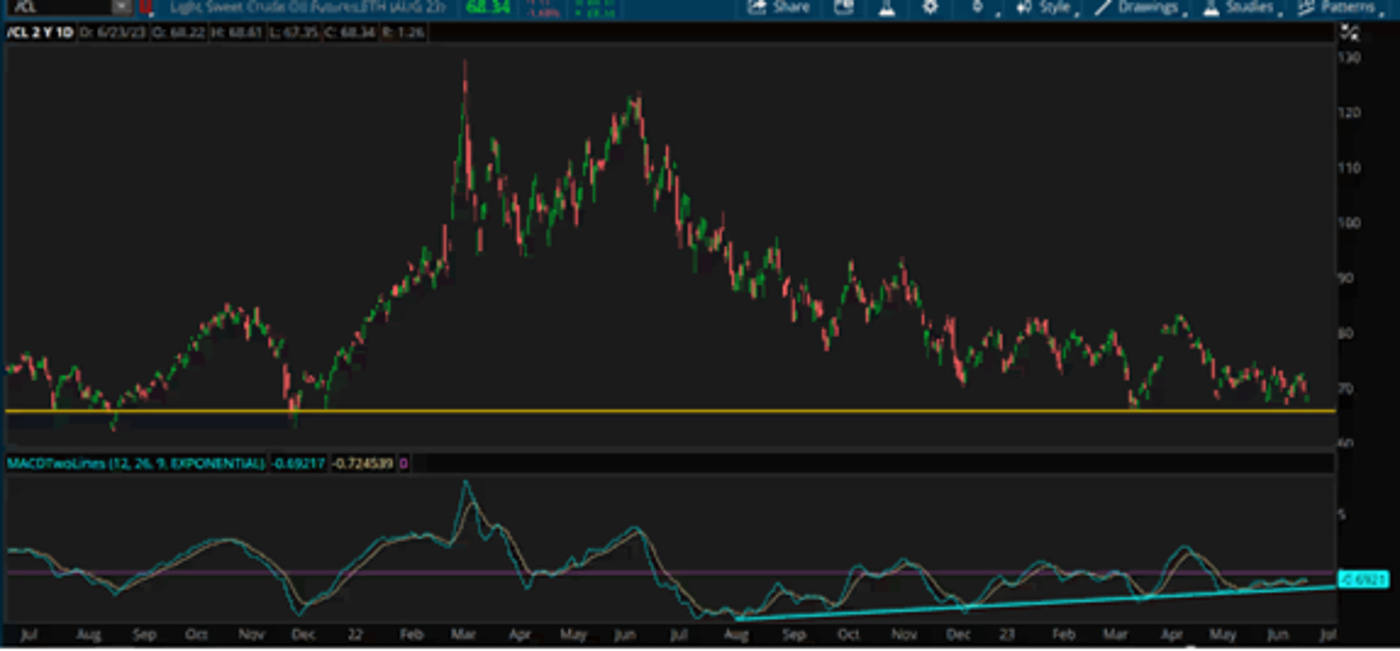
Stocks have a weaker tone heading into Monday’s session after softness overnight in Asian and some European markets. The situation that played out in Russia over the weekend doesn’t appear to be having a major impact on the markets, but if things heat up again there, it could potentially lift crude oil, Russia’s major export.
Morning rush
It’s not breaking news that the Treasury yield curve remains inverted, meaning short-term notes carry higher yields than longer-term ones. That’s been true for many months. What’s new is that the curve is back to 100 basis points after narrowing from more than 100 to around 50 earlier this year.
Ten-year bond yields have been moving sideways lately—caught between signs of slowing growth and the threat of more Fed rate hikes due to “sticky” inflation, observes Kathy Jones, Schwab’s chief fixed income strategist. Meanwhile, short-term rates keep edging higher. As of Friday, the 2-year Treasury note yield traded at 4.77% and the 10-year Treasury note yield stood at 3.74%. (See more below on what this might mean).
Eye on the Fed
Futures trading points to a 72% probability that the Federal Open Market Committee (FOMC) will raise rates 25 basis points at its July meeting, according to the CME FedWatch Tool. On Wednesday morning U.S. time, Fed Chairman Jerome Powell is scheduled to participate in a European Central Bank (ECB) policy panel discussion in Portugal.
It’s arguable that we’re seeing the market’s focus change from inflation risk to economic risk. The softness last week resulted from disappointing manufacturing data from around the globe, not from screaming hot inflation numbers. One thing to note: Recent days of weakness in the stock market accompanied weakness in Treasury yields. However, any rally in Treasuries faces possible resistance from a large influx of new government bonds.
What to Watch
Today’s a light data day, but the Treasury Department has a few auctions scheduled that may be worth watching to assess demand for fixed income, especially as short-term rates have risen over the last week. More auctions take place in coming days.
Stocks in the Spotlight
Earnings alert: Three major firms share quarterly results this week, a reminder that earnings season approaches.
Back in March, Walgreens said it expected strong growth in the second half of the year. One question that may arise tomorrow is the future of Boots, the company’s U.K.-based retail chain. Investors also will probably want to hear about cost-cutting to see if margin pressures ease.
Semiconductor giant Micron (NASDAQ:MU) steps into the batter’s box Wednesday afternoon, offering investors a chance for the latest update on the memory chip market. The company’s previous quarter was tough from a supply chain perspective, so we’ll see if the situation improved.
Brace for banks: Consider watching financial stocks on Wednesday when the Fed shares results of its latest round of “stress tests” on the nation’s largest banks. These annual tests help determine whether banks have the necessary capital cushion in case of a major shock to the system. Results often help determine whether the big Wall Street banks can raise dividends and buy back shares.
Thinking cap
Ideas to mull as you trade or invest
Calendar
June 27: June Consumer Confidence, May New Home Sales, May Durable Orders, and expected earnings from Walgreen’s Boots Alliance (WBA)
June 28: Expected earnings from Micron (MU) and General Mills (GIS)
June 29: Q1 Gross Domestic Product (third estimate), May Pending Home Sales, and expected earnings from Nike (NKE), McCormick (MKC), and Rite Aid (RAD)
June 30: May Personal Consumption Expenditures (PCE) prices, May Personal Income and Personal Spending, and Final June University of Michigan Consumer Sentiment
July 3: June Chicago PMI, June ISM Manufacturing Index, and May Construction Spending
TD Ameritrade® commentary for educational purposes only. Member SIPC.
Image sourced from Shutterstock
This post contains sponsored advertising content. This content is for informational purposes only and not intended to be investing advice.
© 2026 Benzinga.com. Benzinga does not provide investment advice. All rights reserved.
To add Benzinga News as your preferred source on Google, click here.