It looks like the consumer is still king, at least judging from Walmart Inc’s (NYSE:WMT) better than expected earnings and strong holiday guidance Thursday.
Despite that, stocks have a flat to lower tone early on after major indices hit new highs yesterday. There’s not a lot of selling pressure around, but the air does seem a bit thin up here, and that might be limiting buying interest, as well. A few troubling signs are starting to emerge, including firmness in bonds and this morning’s rise in jobless claims.
More about all that below. We’ll start with the good news. WMT’s bottom line easily surpassed third-party consensus even though revenue just missed, and closely watched U.S. same-store sales rose 3.2%. That was better than the previous quarter and back above the 3% mark, a sign that people keep flocking to certain brick-and-mortar stores even in this online age. The company said it continues to see good traffic in its stores, which backs up what industry watchers say about some people wanting to see and feel a product before purchasing it.
That’s not a requirement for everyone, apparently. E-commerce sales rose 41%, which was sequentially higher and above analysts’ estimates. The company said that was driven by online grocery shopping, another key parameter. Shares of WMT rose more than 3% in pre-market trading. Expectations were high going in, and WMT beat them. The better than expected outlook also could be a sign that WMT expects holiday shopping to reflect this consumer strength we’re seeing.
WMT isn’t the only closely-watched firm reporting today. This afternoon brings earnings from Nvidia Corporation (NASDAQ:NVDA), giving investors another look at the semiconductor space. Going back to earlier this earnings season, the chip makers had a mixed set of quarterly reports. Texas Instruments Incorporated (NASDAQ:TXN) saw shares fall when it reported lower-than-expected earnings and an outlook that missed analysts’ expectations. Micron Technology, Inc. (NASDAQ:MU) shares also fell when it reported, again when investors seemed disappointed by the outlook.
Late Wednesday, another Technology bellwether, Cisco Systems, Inc. (NASDAQ:CSCO), failed to impress with its outlook despite beating estimates for the quarter. Shares fell 5% in pre-market trading. Analysts said the company’s guidance was worse than expected, and that weakness in CSCO’s outlook could be negative to electronics manufacturing services companies.
There was fresh data, too, early Thursday, as initial jobless claims of 225,000 came in above expectations. One week isn’t a trend, but if claims do start to climb on a weekly basis from here, that could be a troubling indication. Just something to consider watching, because claims can sometimes be the tip of the iceberg when it comes to the economy.
Pause Button
The market isn’t showing any signs of a major downward turn, but it’s also stopped going up as aggressively as we saw a month ago. The reluctance of sellers to march in could reflect an environment where investors have seen better than expected earnings, Fed rate cuts, hopes for a China deal, and a healthy consumer heading into the holidays.
However, there doesn’t seem to be as much buying interest, either, and that’s understandable with stocks up here near record highs. There may be some lingering concern because the last couple times the S&P 500 Index (SPX) posted new highs—in early 2018 and then again in the fall of 2018—it turned quickly lower and took months to make up the losses and get back to where it was.
Some analysts see signs in the charts that another quick spin lower might be possible, noting the moderate to significant losses seen each time stocks have made new highs recently. Still, those technical arguments have yet to be proven. At this point, the fundamentals seem hard to fight. On a technical basis, support might be at around 3050 and 3020 in the SPX, if it does start moving lower.
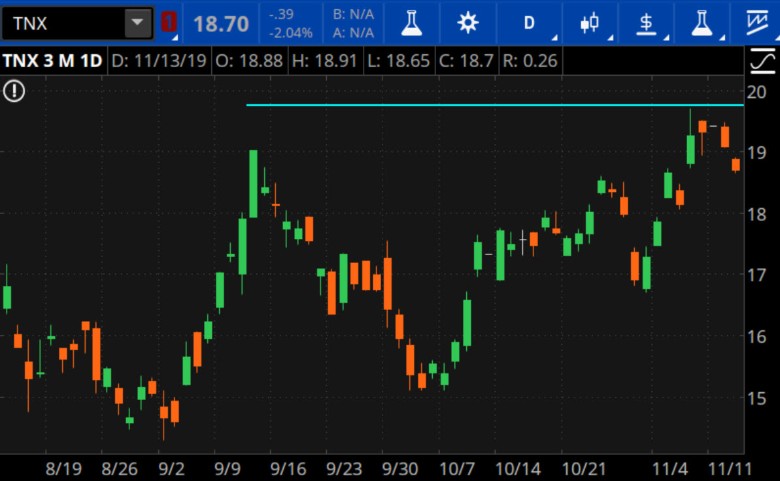
Also, it’s worth noting that the bond market got a little boost here around mid-week, with the 10-year yield pausing in what had looked like it might be a quick elevator ride back to 2%. Instead, it was down below 1.9% again Wednesday and all the way down to 1.84% by early Thursday. Looks like the 2% test got postponed.
Some analysts blamed the yield pause on trade uncertainty as the U.S. and China grapple over tariffs. It might also reflect some perceptions that yields climbed very high, very quickly, and might have gotten a little overheated. The 10-year yield is now trading higher than the Fed funds rate for the first time in a while, and that might be making some investors think twice about selling fixed income (see chart below).
The China issue reared its head again around midday Wednesday when Dow Jones Newswires reported that the two countries ran into disagreements on farm product imports. It was pretty amazing to see how quickly that chopped away the day’s early gains. Still, two of the three major indices did recover by the end of the day to finish slightly higher, so that’s another potential sign of resilience.
The Dow Jones Industrial Average ($DJI) did best yesterday, but that was with a huge amount of help from just one stock among the 30 in the index: Walt Disney Co (NYSE:DIS). Shares rose 7% as investors appeared to welcome the first news on demand for Disney+, which debuted earlier this week.
For a company-eye view of not only China but the entire world, it might be a good idea to read up on what CSCO’s executives said in their earnings call. This company has a major business worldwide, and its executives tend to have a unique perspective on what’s going on all around the world. There are very few countries they don’t have a presence.
Caution Flag Waving?
It was good to see stocks march back from their midday malaise, but keep in mind that a bunch of the “caution indicators” did rise Wednesday. These include bonds, as we discussed, along with volatility and gold. If this happens again today, it might call a little more attention to itself. Perhaps it could be a warning signal that people are starting to feel defensive.
It’s also worth noting that Consumer Staples were one of the big winners on the sector board yesterday, and cyclicals like Financials and Energy got hit. If Staples keep going up, that’s another sign of possible worry.
Not Your Grandfather’s Peak Oil: In 1956, geophysicist Marion Hubbert King unveiled his "peak oil" theory—that crude production would follow a bell curve and eventually decline. Since then, we've seen a number of periods where the peak looked to be in sight, only to have new sources and new technologies—U.S. shale production being a recent example—push off that supposed day of reckoning to an unforeseeable future date.
Information from TDA is not intended to be investment advice or construed as a recommendation or endorsement of any particular investment or investment strategy, and is for illustrative purposes only. Be sure to understand all risks involved with each strategy, including commission costs, before attempting to place any trade.
Image Sourced from Pixabay
© 2026 Benzinga.com. Benzinga does not provide investment advice. All rights reserved.
To add Benzinga News as your preferred source on Google, click here.