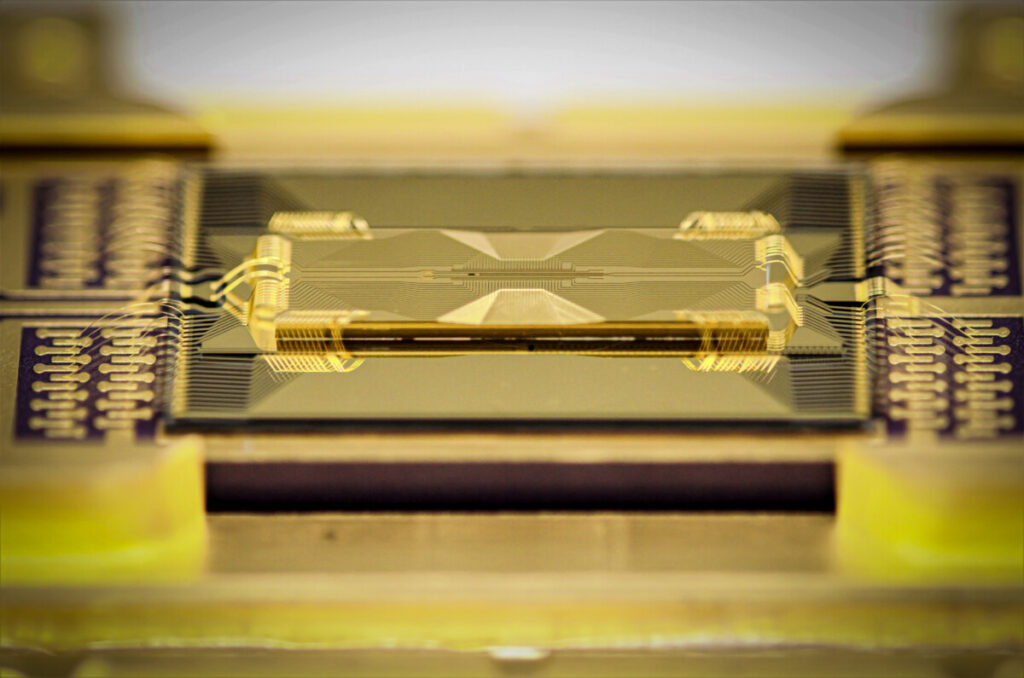
Trapped-ion computing processor. Used with permission: IonQ.
Selling full quantum systems, while scaling from the cloud to the planet
IonQ systems run on AWS Braket, Azure Quantum and Google Quantum AI Cloud. That makes at least three major public clouds. No other quantum vendor matches that reach. Through its strategic organic and inorganic expansion, IonQ operates in Asia, EU, Canada, UK and America. That global network footprint isn't experimental. The company’s commercial infrastructure leverages hyperscalers, telecom and defense-adjacent applications.
The acquired Lightsynq technology allows IonQ to provide optimized compute capabilities over thousands of kilometers. He said Lightsynq latency shifts from about 55 milliseconds to two seconds, which is a 97% improvement, letting entanglement persist long enough for even more complex real-world applications to run. That's not hypothetical puffery, it's architectural muscularity.
They also inked a $22 million deal with EPB to establish a quantum hub in Chattanooga offering Forte Enterprise and networking training for grid optimization. That marks the first U.S. quantum computing and networking center complete with a new IonQ office.
This is an acquisition spree with strategy
Add it up. They're assembling compute, memory, networking, satellite and cloud access into one commercial platform. That's a full tech stack, vertically integrated. IonQ is one of the biggest, if not the biggest, public-quantum movers by acquisition count with an IP portfolio of almost 1000 owned and controlled patents.
Understanding AQ as a quantum metric
IonQ talks algorithmic qubits, AQ, rather than inflated raw qubit counts. Their Forte and Forte Enterprise quantum systems hit AQ 36. While the next-gen Tempo quantum systems will target AQ 64 by the end of 2025.
"AQ 64 is an important milestone for our industry. Even a data center packed with classical GPUs couldn't keep up with a single AQ 64 machine when trying to exactly simulate its quantum circuits. Especially for small-scale versions of factoring, decryption, optimization or linear-algebra workloads,” explained de Masi.
AQ signals usable compute power, not just hardware specs. It integrates error rates, fidelity, connectivity and circuit depth. It's performance that users can build with. And they're already delivering.
“We’re accelerating our technology roadmap and intend to deliver the world’s most powerful quantum computers with 2 million qubits by 2030. This will accelerate innovation in drug discovery, materials science, financial modeling, logistics, cybersecurity and defense,” de Masi said.
Niccolo de Masi, IonQ CEO and Cambridge-trained physicist. Used with permission: IonQ.
Quantum networking is the subplot few are pricing in
Compute grabs headlines. Networking unlocks scale. IonQ leads here. "We are the only public quantum networking company in the world," de Masi said.
IonQ is building quantum repeaters via Lightsynq. Capella Space extends links to satellites and back to earth. EPB in Tennessee gives grid-scale metropolitan hubs. ID Quantique expands the quantum networking capabilities and backbone. That adds up to a real quantum internet. Encryption, finance, defense and satellite operations are all sectors IonQ is positioning to serve through secure networks.
"We have an exceptional opportunity to accelerate our vision for the quantum internet through our announced acquisitions of Lightsynq and Capella," de Masi said. That's ambition backed by capital and hardware.
Miniaturization and energy-efficient design
Quantum systems usually require bulky cryogenic setups. IonQ has been pushing room-temperature, vacuum-less parts that reduce weight, cost and power use. They're moving toward modular, replaceable components that match data center readiness. It's also about building a compute, networking and applications ecosystem smartly, not just building massive server farms with extreme climate controls and state-mandated, co-located power stations.
That's not theoretical. It's operational.
IonQ engineer holding a test wafer of dozens of quantum processors. Used with permission: IonQ.
Financial strength and capital to execute
While still pursuing profitability, its Q1 revenue came in above guidance. Cash sat at nearly $750 million. Hyundai, Airbus, Air Force Research Lab, EPB, University of Maryland and AWS are all paying or paid to use IonQ's tech. Based on IonQ's earnings disclosures and expansion activity, the capital appears targeted toward scaling compute, networking and commercial systems.
The entire company is its competitive moat
IonQ is unique within the pure-play quantum computing space. Acquisitions, cloud reach, engineering, hardware, networking, satellite and workforce hubs. Patent depth. Customer results. Cash. Its technical roadmap.
"Every day we get up in the morning knowing that we can impact every area of applied science," de Masi told me. "Whether it's drug discovery or defense and intelligence or logistics or material science, we impact everything."
IonQ's execution speaks louder than its pure-play quantum computing competitors. That's what sets them apart.
Do your own research, you’ll see what the “smart money” sees
The latest sale to Heights Capital Management of more than 14 million IonQ shares at a 25% markup with the seven-year option of buying another 36 million shares at $99.88 each is a resounding vote of confidence from Wall Street sharps regarding IonQ’s potential upside.
Quantum isn't five years away. It's crossing into reality with commercial contracts, live networks and satellite integration underway. IonQ is the stock that reflects that. Not early-stage theory. Not hype. Just results.
© 2026 Benzinga.com. Benzinga does not provide investment advice. All rights reserved.
To add Benzinga News as your preferred source on Google, click here.