Benzinga

España
Italia
대한민국
日本
Français
Benzinga Edge
Benzinga Research
Benzinga Pro

  • Get Benzinga Pro
  • Data & APIs
  • Events
  • Premarket
  • Advertise
Contribute
España
Italia
대한민국
日本
Français

Benzinga

  • Premium Services
  • Financial News
    Latest
    Earnings
    Guidance
    Dividends
    M&A
    Buybacks
    Interviews
    Management
    Offerings
    IPOs
    Insider Trades
    Biotech/FDA
    Politics
    Healthcare
    Small-Cap
  • Markets
    Pre-Market
    After Hours
    Movers
    ETFs
    Options
    Cryptocurrency
    Commodities
    Bonds
    Futures
    Mining
    Real Estate
    Volatility
  • Ratings
    Analyst Color
    Downgrades
    Upgrades
    Initiations
    Price Target
  • Investing Ideas
    Trade Ideas
    Long Ideas
    Short Ideas
    Technicals
    Analyst Ratings
    Analyst Color
    Latest Rumors
    Whisper Index
    Stock of the Day
    Best Stocks & ETFs
    Best Penny Stocks
    Best S&P 500 ETFs
    Best Swing Trade Stocks
    Best Blue Chip Stocks
    Best High-Volume Penny Stocks
    Best Small Cap ETFs
    Best Stocks to Day Trade
    Best REITs
  • Money
    Investing
    Cryptocurrency
    Mortgage
    Insurance
    Yield
    Personal Finance
    Forex
    Startup Investing
    Real Estate Investing
    Prop Trading
    Credit Cards
    Stock Brokers
Research
My Stocks
Tools
Free Benzinga Pro Trial
Calendars
Analyst Ratings Calendar
Conference Call Calendar
Dividend Calendar
Earnings Calendar
Economic Calendar
FDA Calendar
Guidance Calendar
IPO Calendar
M&A Calendar
Unusual Options Activity Calendar
SPAC Calendar
Stock Split Calendar
Trade Ideas
Free Stock Reports
Insider Trades
Trade Idea Feed
Analyst Ratings
Unusual Options Activity
Heatmaps
Free Newsletter
Government Trades
Perfect Stock Portfolio
Easy Income Portfolio
Short Interest
Most Shorted
Largest Increase
Largest Decrease
Calculators
Margin Calculator
Forex Profit Calculator
100x Options Profit Calculator
Screeners
Stock Screener
Top Momentum Stocks
Top Quality Stocks
Top Value Stocks
Top Growth Stocks
Compare Best Stocks
Best Momentum Stocks
Best Quality Stocks
Best Value Stocks
Best Growth Stocks
Connect With Us
facebookinstagramlinkedintwitteryoutubeblueskymastodon
About Benzinga
  • About Us
  • Careers
  • Advertise
  • Contact Us
Market Resources
  • Advanced Stock Screener Tools
  • Options Trading Chain Analysis
  • Comprehensive Earnings Calendar
  • Dividend Investor Calendar and Alerts
  • Economic Calendar and Market Events
  • IPO Calendar and New Listings
  • Market Outlook and Analysis
  • Wall Street Analyst Ratings and Targets
Trading Tools & Education
  • Benzinga Pro Trading Platform
  • Options Trading Strategies and News
  • Stock Market Trading Ideas and Analysis
  • Technical Analysis Charts and Indicators
  • Fundamental Analysis and Valuation
  • Day Trading Guides and Strategies
  • Live Investor Events
  • Pre-market Stock Analysis and News
  • Cryptocurrency Market Analysis and News
Ring the Bell

A newsletter built for market enthusiasts by market enthusiasts. Top stories, top movers, and trade ideas delivered to your inbox every weekday before and after the market closes.

  • Terms & Conditions
  • Do Not Sell My Personal Data/Privacy Policy
  • Disclaimer
  • Service Status
  • Sitemap
© 2026 Benzinga | All Rights Reserved
July 1, 2019 11:47 AM 7 min read

Turbulence Ahead: Banking Sector Might See Interest Rates Slow EPS Growth

by JJ Kinahan
Follow

ArticleFeaturedTickersList12345!!!

It doesn’t happen a lot, but sometimes an industry telegraphs a rough earnings season ahead. 

Arguably, we’re seeing that lately with the Financial sector, which continues to see fundamentals work against it in many ways heading into Q2 reporting time. Banks face a slowing economy in the U.S. and overseas, an inverted yield curve (more about that later), and a Fed widely expected to take an axe to borrowing costs. If you run a big bank, it probably seems like the whole world is ganging up on you.

That could help explain some of the language from bank executives at a conference in mid-June. In particular, Morgan Stanley’s (NYSE:MS) CFO told attendees that he’d be “surprised” if the company beat its Q1 numbers, Bloomberg reported. He added that the previous two weeks had been “very hard.”Both MS and Citigroup Inc (NYSE:C)—whose executives also attended the conference—said that trading has slowed down, according to Bloomberg. For investment banks that bring in revenue from customers who trade stocks and bonds, a slow trading environment just adds to the fundamental pressures. What we might be seeing here is companies that know most of Wall Street expects them to have a bad quarter simply getting out the news ahead of time. It’s no secret that falling interest rates have been tough on the Financial sector, so maybe there’s a little gamesmanship going on. Banks could be saying, “We know you don’t expect much from us this quarter anyway, so let’s put everything on the table.” Does this look like it’s going to be a great quarter for Financials? Probably not. Still, despite all that’s weighing against them, it’s pretty impressive how many bank CEOs are managing these tough times with expense cuts and new revenue sources. The interest rate situation could be a big blow to smaller regional banks, though. That’s something we’ll probably get a better picture of once earnings start.

When Banking Executives Talk...

When earnings season does begin in a big way the week of July 15, investors are likely to listen closely to big bank executives for their views of the latest economic developments and where they think things are headed both for the industry and the world outlook as a whole. Their words might get an even closer watch this time around, especially with rates tumbling and divisive issues like Brexit and China trade still in the headlines.

If investors needed any more proof that bank executives are concerned about the possible ramifications of trade wars, look no further than headlines from mid-June when JPMorgan Chase & Co (NYSE:JPM) CEO Jamie Dimon had a meeting with President Trump to discuss trade issues including China and the proposed new deal between the U.S., Canada, and Mexico. It’s not every day that you see a CEO having the direct ear of the president of the United States.

While big banks like JPM operate around the world and might be particularly attuned to the effects of trade, regional banks make most of their loans within the U.S., potentially shielding them from overseas turbulence. They might also benefit from a steep drop in mortgage rates that could propel the housing market. However, if trade issues really start to hurt the economy, regional banks could suffer along with the rest of the Financial sector.

Speaking of the economy, the Fed recently issued new projections for U.S. growth and inflation the rest of 2019. It cut its forecast for Personal Consumption Expenditure (PCE) inflation this year to 1.5% from 1.8%. Its 2019 gross domestic product growth (GDP) estimate was unchanged at 2.1%. That’s down from 2.9% in 2018.

Flattening yield curves have historically foreshadowed a recession ahead, according to researchers at the San Francisco Federal Reserve, who note that an inversion has preceded the last seven downturns. 
While few analysts see a recession in the works, bank executives might be asked if they’re starting to see any slowdown in lending, which might be a possible sign of the economy putting on the brakes. Softer manufacturing sector data over the last few months and falling capital investment by businesses could provide subject matter on the big bank earnings calls.

Q2 Financial Sector Earnings

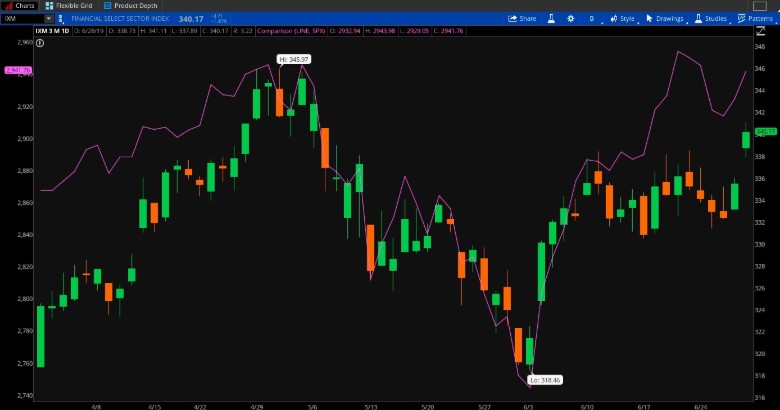
The IXM is actually outpacing the S&P 500 Index (SPX) over the last three months, with the SPX up about 5% in that time frame as of late June.

Analysts making their Q2 projections for the Financial sector expect a slowdown in earnings growth from Q1. For instance, S&P Global Market Intelligence sees Financial sector earnings per share rising 4.5% in Q2, down from 6.1% in Q1. The sector’s EPS growth was 29% for all of 2018, but the firm sees just 8.4% EPS growth in 2019.

Forecasting firm FactSet pegs Financial sector earnings growth at 0.9% in Q2, down from its 2.2% prediction back at the end of March.

Possibly more troubling for banks is the Fed’s slightly cautious predictions about the economy. In his press conference following the June Federal Open Market Committee (FOMC) meeting, Fed Chair Jerome Powell said the outlook remains favorable, but that uncertainties have increased since the early May meeting. 

Upcoming Earnings Dates

Information from TDA is not intended to be investment advice or construed as a recommendation or endorsement of any particular investment or investment strategy, and is for illustrative purposes only. Be sure to understand all risks involved with each strategy, including commission costs, before attempting to place any trade.

  • Image Sourced From Pixabay
Market News and Data brought to you by Benzinga APIs

© 2026 Benzinga.com. Benzinga does not provide investment advice. All rights reserved.

To add Benzinga News as your preferred source on Google, click here.


Posted In:
NewsGeneralbankingTDAmeritrade
BAC Logo
BACBank of America Corp
$54.970.05%
Overview
C Logo
CCitigroup Inc
$115.64-0.09%
GS Logo
GSThe Goldman Sachs Group Inc
$884.00-0.72%
JPM Logo
JPMJPMorgan Chase & Co
$310.200.01%
MS Logo
MSMorgan Stanley
$174.79-0.60%
WFC Logo
WFCWells Fargo & Co
$91.700.15%

The Fed concluded its June meeting with hints that it’s ready to cut rates if necessary to keep economic growth humming along. Other central banks around the world seem to be coordinating for possible rate easing. Lower rates generally squeeze banks’ margins. When rates rise, it often encourages consumers and businesses to deposit money in their bank accounts to collect the interest. The banks then take those funds, lend them out at higher interest rates, and potentially can ring up profits. If rates drop, banks simply can’t make as much money. 
On the other hand, lower interest rates typically mean lower borrowing costs for consumers. That’s something we’ve already seen with mortgage rates, which are now around 3.85% for a 30-year mortgage vs. last November’s high of 4.94%. 

The 10-year Treasury yield has fallen from last autumn’s high above 3.2% to the recent low below 2% amid fears of economic sluggishness and widespread predictions of central bank rate cuts. The long trade standoff between China and the U.S. has also contributed to lower yields as many investors pile into defensive investments like U.S. Treasuries as they remain cautious about the growth picture.
Another thing on many investors’ minds is the current structure of the yield curve. There’s been a pretty strong “inversion” recently, with three-month Treasuries yielding higher than 10-year Treasuries. This is typically an indication that investors believe that growth will be weak. 

Like a lot of sectors, Financials have had their ups and downs over the last three months. As of late June, the S&P Financial Select Sector Index (IXM) was up 7% overall since late March but remained down nearly 3% from its early-May high. That peak came at a time when many investors expected a quick conclusion to trade talks with China. The sector lost a lot of ground in mid-May when it became clear there wasn’t going to be a signing ceremony anytime soon but rose pretty impressively the last few weeks.

These uncertainties include the turbulent tariff situation between China and the U.S., slowing business investment, weaker overseas economies, and weakness in inflation, Powell said. He talked about how these various “cross currents” have re-emerged more strongly in the last few weeks and need to be watched carefully, but also noted that the Fed can’t risk acting on any one data point and will have to see if the uncertainties continue to weigh on the outlook.

  • Citigroup says it will report before the market opens on Monday, July 15.
  • JPMorgan Chase & Co. says it will report before the market opens on Tuesday, July 16.
  • Wells Fargo & Co (NYSE:WFC) will report before the market opens on Tuesday, July 16, with Goldman Sachs Group Inc (NYSE:GS) expected to report the same morning.
  • Bank of America Corp (NYSE:BAC) will report ahead of the market open on Wednesday, July 17, and Morgan Stanley is expected to report that morning as well.
BAC Logo
BACBank of America Corp
$54.970.05%
Overview
C Logo
CCitigroup Inc
$115.64-0.09%
GS Logo
GSThe Goldman Sachs Group Inc
$884.00-0.72%
JPM Logo
JPMJPMorgan Chase & Co
$310.200.01%
MS Logo
MSMorgan Stanley
$174.79-0.60%
WFC Logo
WFCWells Fargo & Co
$91.700.15%
Comments
Loading...