The futures markets are pointing to a lower open on Wednesday, weighed down by European markets. The uncertainty around infrastructure, stimulus, and other government spending appears to be on investor’s minds.
Goldman Sachs (NYSE:GS) downgraded its economic outlook for the U.S. due to fears of lower consumer spending and the effects of the COVID delta variant. This appears to line up with last Friday’s jobs report from the U.S. government as customer-facing jobs like education and hospitality have failed to bounce back at the same rate as other job groups.
However, St. Louis Federal Reserve Bank President James Bullard told the Financial Times that there is plenty of demand for workers and the concerns about the job market may be overblown. Bullard pushed for the Fed to start tapering the monetary stimulus sooner.
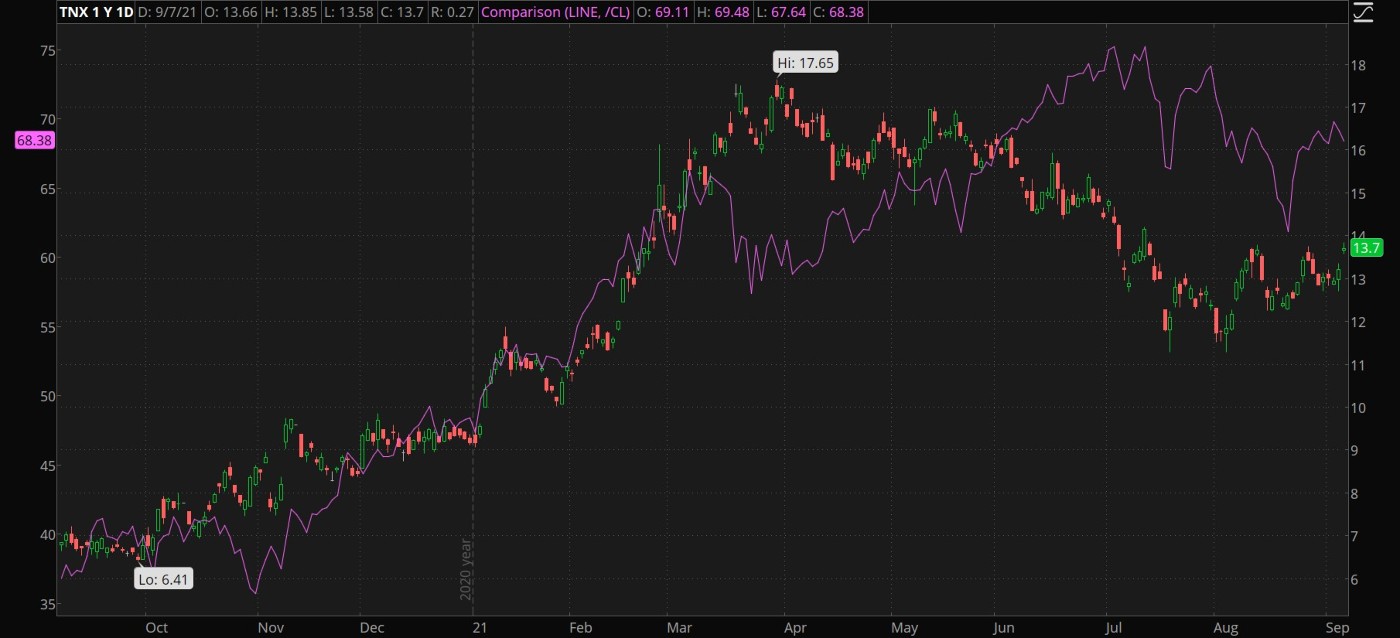
What’s The Yield Telling Us?
In addition to a stronger dollar, lower demand for oil in the U.S. and Asia could compound falling prices. The demand-side issues for oil may be greater than the supply-side issues. U.S. oil production is still lower than usual as the southeast is still reeling from Hurricane Ida. Saudi Arabia cut oil production on Sunday on fears of shrinking demand in Asia.
This coming Friday’s Producer Price Index (PPI) and next Tuesday’s Consumer Price Index (CPI) announcements could confirm or quash the recent changes in bond and commodity sentiment. Another high inflation number—if we get it—could possibly force the Fed’s hand into tapering sooner than Chairman Jerome Powell might like which may lead to higher yields, a higher dollar, and lower commodity prices.
Bitcoin’s Salvadorian Selloff
Many Bitcoin investors were surprised by Monday’s selloff in the cryptocurrency after El Salvador became the first country in the world to adopt it as legal tender. The currency can now be used to pay for everyday goods and services in that country. Despite the announcement, Bitcoin fell about 10% on the day.
This complex relationship can be thrown off by government actions. For example, many countries like China often buy U.S. Treasuries as a way to strengthen their currencies. The demand for Treasuries could push interest rates lower and make the correlation between yields and oil-less sticky.
Traders who commonly use these relationships to help determine potential buy and sell signals may be frustrated by unexpected changes. If and when the Fed begins to taper, other correlations could decouple as well.
M&A Is Taking Over: So far in 2021, U.S. companies have announced $1.8 trillion in mergers and acquisitions (M&A) and $3.6 trillion worldwide per the Wall Street Journal. This puts 2021 on track for the largest M&A year ever.
It’s likely more announcements are on their way. M&A is an odd indicator for investors because it could suggest that the ability to organically grow a business is too difficult and economic growth could be slowing. So, some see increased M&A as a bearish sign.
However, M&A commonly takes certain companies out of circulation and their shares too. This results in a greater supply of investment dollars that could be reinvested elsewhere. So, some investors see M&A as bullish.
TD Ameritrade® commentary for educational purposes only. Member SIPC.
© 2026 Benzinga.com. Benzinga does not provide investment advice. All rights reserved.
To add Benzinga News as your preferred source on Google, click here.