


Right on the money.
That’s how you can sum up today’s payrolls report from the Department of Labor, which showed job growth of 1.4 million in August. While down from around 1.7 million in July, the headline figure was exactly in line with Wall Street’s estimates.
The data appeared to provide some early support to the major indices. Maybe some of yesterday’s heavy selling reflected people worrying about a possible bad number. Growth of 1.4 million is strong by historic standards and suggests the economy continues to recover from the crisis, but there’s definitely been a slide over the last few months. Growth was more than 4 million in June.
What’s really surprising is the unemployment rate falling from double digits all the way down to 8.4%, something few if anyone had expected. An increase in government hiring for census workers might have played into that. Also, the number of people working part-time for economic reasons fell 871,000. All these numbers look pretty solid, and stock index futures started to gain ground in the minutes after the data got posted.
Looking at hiring by sector, government-led with 344,000 new hires, followed by retail trade and business and professional services. A lot of those government jobs are temporary due to the census, so it’s unlikely we’ll have a repeat in the coming months. Once those jobs go away, the overall unemployment rate might climb unless other sectors can pick up the slack.
Oddly enough, leisure and hospitality jobs rose just 174,000 in August after being a leader for several months as restaurants and hotels reopened. Some analysts might worry about the declining pace here, especially as winter looms and some restaurants might have to close their outdoor seating areas.
Employment in food and drinking establishments remains down by 2.5 million since February, the government said, which points out how tough it’s been for many service workers in these low-paid industries and for entrepreneurs trying to make a living by opening a restaurant or bar.
We’re also seeing a worrisome development with August being the second month in a row where manufacturing and construction jobs didn’t gain much traction. These tend to be higher-paying jobs that reflect growth in the economy. Transportation and warehousing positions did grow decently with a gain of 78,000, but it would be nice to see more firmness in these areas for a sense that the economy continues to pick up speed.
In a way, the report looks kind of vanilla. Except for that really big drop in the overall unemployment rate, most of the numbers checked in near expectations. Each successive report since April has shown the economy looking more and more normal, though it’s nowhere near as healthy as it was back in February.
On a final note, the government downwardly revised June and July job growth numbers and those are now 39,000 less than previously reported. While every job is important to the person who gets it or needs it, in an economy that’s adding more than one million jobs a month, these downward revisions don’t look too significant in the overall scheme of things.
Either way, the market seems to be getting some relief from the data this morning. That suggests at least some of the dramatic plunge yesterday might have reflected pre-data jitters. No guarantees we can keep the early firmness, because often when there’s a blow to the market, it reverberates for a few sessions. The Nasdaq (COMP) remained down more than 1% in pre-market trading even as other indices moved into the green, so Tech still lags.
Remember, it’s the start of a long weekend, so volume could get thin, and more choppy trading could be headed our way as people square up positions, tiptoe out, fire up the grill, and maybe head to the beach.
Thursday Rehash...
Looking back at yesterday’s 5% Tech wipeout, it’s hard to say there was any single factor leading to it. Instead of one thing to point to, a bunch of things came together.
Mainly it seemed to suddenly dawn on investors that the party couldn’t just keep going without a break. It’s a bit of a wake-up call, which isn’t the worst thing in the world. Markets go up and down. People had forgotten about the “down” part for a few weeks.
Rising volatility earlier in the week already might have hinted something was wrong, and the Cboe Volatility Index (VIX) spiked 26.5% on Thursday and settled at 33.60, which is its highest close since June 26. It was down around 22 for a while last month.
Earlier in the week, when VIX and the S&P 500 Index (SPX) were both climbing, it felt like either stocks or the VIX eventually had to fall for things to come back to an equilibrium. Yesterday just happened to be the day when that happened.
The kind of day we had Thursday happens every now and then in Tech, but often it’s been a “one and done” type of thing, at least in recent years. The market had a similar hiccup back on June 11 when the COMP fell 5% in one day (also a Thursday, oddly enough), and then hung out in flat to lower territory for the following two weeks. A month later, the COMP was up more than 9% from that day’s low close.
Past isn’t precedent, and a day like Thursday never feels good if you’re long the market. That said, if you’re a long-term investor, setbacks like yesterday—or even like the bear market in March—shouldn’t necessarily make you rethink your strategy. One day, as we often say, isn’t a trend.
Why This Time Might Be Different
Back in March when selling piled on top of more selling, the market fell more than 30% from its highs very quickly. That seems unlikely this time, especially with the Fed having so much monetary support in the mix.
The problem last March was it seemed no one was under the market wanting to buy. This time, we’re in a situation where just about every recent downturn has seen quick buying. Of course, there are no guarantees—we might see a turnaround follow-through, or somewhere in between—but it’s also arguable that there’s not a lot out there attracting investors lately beyond the stock market.
Also, if the market continues to lag, it might light a fire under Congress and the White House to order up some new stimulus. One argument some analysts made recently was that the strong stock market and mostly decent data had combined to take pressure off of Congress to do anything. If stimulus chances look more likely, the market could potentially get a boost.
Another thing to remember: Despite the overall weakness yesterday and the huge slides in Apple Inc. (NASDAQ:AAPL) and Tesla Inc (NASDAQ:TSLA), shares of beaten-down companies that would benefit from the economy reopening rose, bucking tech’s negative trend. Cruise operator Carnival Corp (NYSE:CCL) advanced 5.2%. Macy’s Inc (NYSE:M) popped nearly 8%. There’s some talk that maybe a sector shift into cyclicals might be underway, but we’ve heard that before.
Anyone looking for possible technical support for the SPX might want to think about the old all-time high of 3393 reached back in February and surpassed last month. For the Nasdaq 100 (NDX), which contains the FAANGs and many of the semiconductor stocks that got stomped on Thursday, the 25-day moving average of 11,477 seems like a potential support point.
And if you watched the overnight action, futures on the S&P 500 (/ES), which traded down to 3424 in yesterday’s session, only made it down to 3426 in the overnight downturn. Some chart watchers might see this as having “passed the test” to the downside. We’ll see.
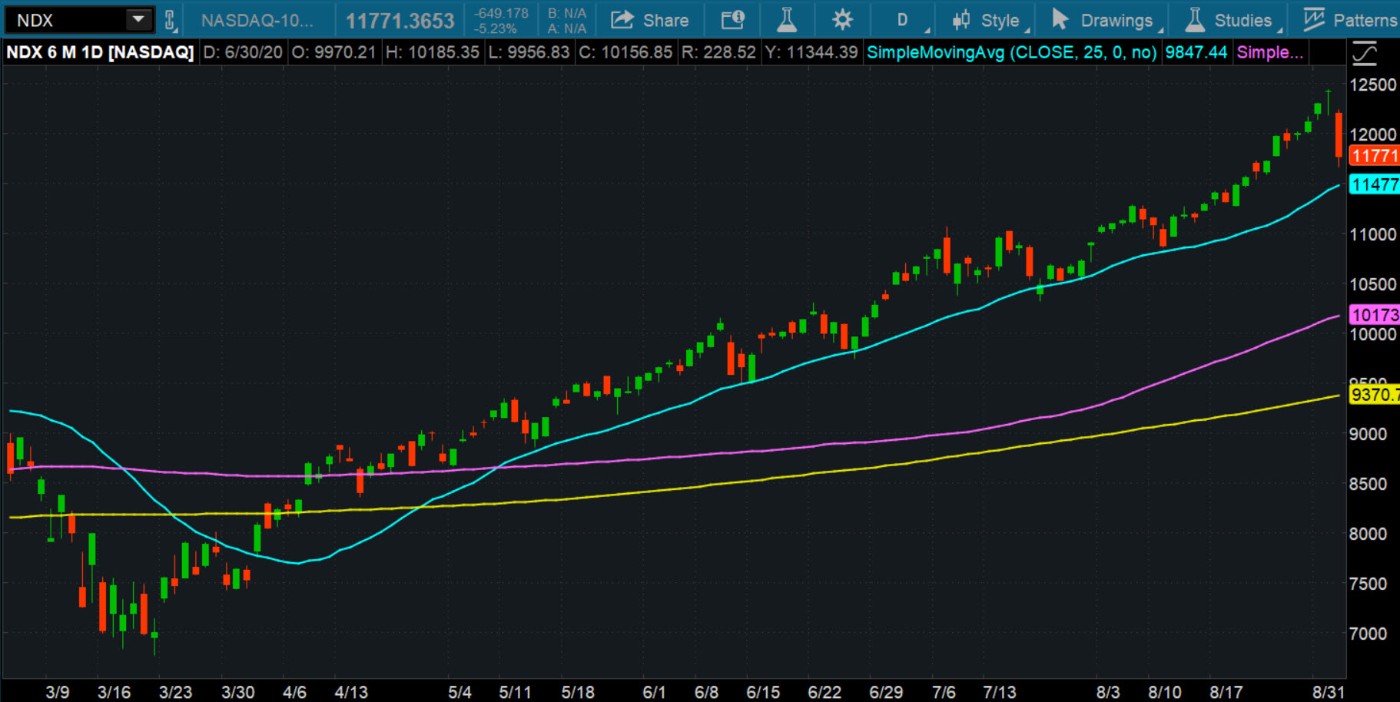
CHART OF THE DAY: TECH TANKED. The Nasdaq-100 Index (NDX—candlestick) took quite a beating today but it’s still above its 25-day moving average (blue line) which has acted as a support level since May. And keep in mind today’s close was well above the 100-day moving average (purple line) and 200-day moving average (yellow line). Data source: Nasdaq. Chart source: The thinkorswim® platform from TD Ameritrade. For illustrative purposes only. Past performance does not guarantee future results.
Sign of Hope: One ironic twist about Thursday’s meltdown is that it followed the best weekly jobless claims number in six months. The headline of 881,000 new claims wasn’t the only bullish part of the report. It’s also great to see a pretty dramatic drop in continuing claims, especially when you consider that many states still grapple with virus-related closures. The fact that continuing claims dropped by more than 1.2 million suggests employers are finding ways to bring people back, and also could back up some analysts who predict a decent uptick in Q3 economic growth. Continuing claims do remain way too high, about 8.5 times above year-ago levels. The people who said it could take a long time for the economy to digest the worst economic crisis in 12 years also appear to be right.
The Week Ahead: Next week is a short one, with Monday off for the holiday. Once everyone returns Tuesday, the data calendar has a couple key reports later next week. Those include the Producer Price Index (PPI) on Thursday and the Consumer Price Index (CPI) on Friday.
Typically, investors watch inflation very closely for hints at how it might affect Fed policy. That might not be the case this time around after Fed Chairman Jerome Powell last month indicated the Fed would likely be comfortable letting inflation go above its 2% target if that’s what helps bring unemployment down. We’ll talk more about analysts’ predictions for the inflation reports as the week goes on.
Be on the lookout for Lululemon Athletica Inc (NASDAQ:LULU) earnings, expected Tuesday. The retail segment is having a pretty good quarter, considering everything it’s up against. Oracle Corporation (NYSE:ORCL) and Kroger Co (NYSE:KR) are expected to report later in the week.
Valuable Currency? Earlier this week, we highlighted the U.S. Dollar Index ($DXY), which had dipped below 92 for the first time since April 2018. Though such a move should theoretically play well with policy aims of bolstering exports, we pointed out that policies—political and economic—don’t exist in a vacuum. As if on cue, European Central Bank chief economist Philip Lane expressed concerns Tuesday about the rise in the euro versus the dollar and other currencies, saying “If there are forces moving the [EUR/USD] rate around, that feeds into our global and European forecasts and that in turn does feed into our monetary policy setting.”
The foreign exchange market seemed to interpret that as a sign the ECB might tweak its policy aims toward a weaker euro. After touching 1.20 to the dollar Tuesday, EUR/USD dipped below the 1.18 handle briefly yesterday before finishing in the mid-1.18s. As any FX trader will tell you, a currency pair is a ratio—consisting of a numerator and denominator. A nation’s policy aims can help guide one side of that hash mark, but don’t be surprised if it leads to an equal-but-opposite response on the other side.
TD Ameritrade® commentary for educational purposes only. Member SIPC.
© 2025 Benzinga.com. Benzinga does not provide investment advice. All rights reserved.


