Key Takeaways
- Rare earth elements possess a unique set of properties that make them fundamental to hundreds of innovative technologies.
- Demand for REEs is forecast to reach nearly 240,000 tons by 2030, up from 171,300 tons in 2022, with key tailwinds from the digital and green transitions.4
- China currently dominates the REE supply chain, creating risks but also opportunities for companies in the rare earths industry.
Special Properties Make REEs Fundamental to Numerous Products
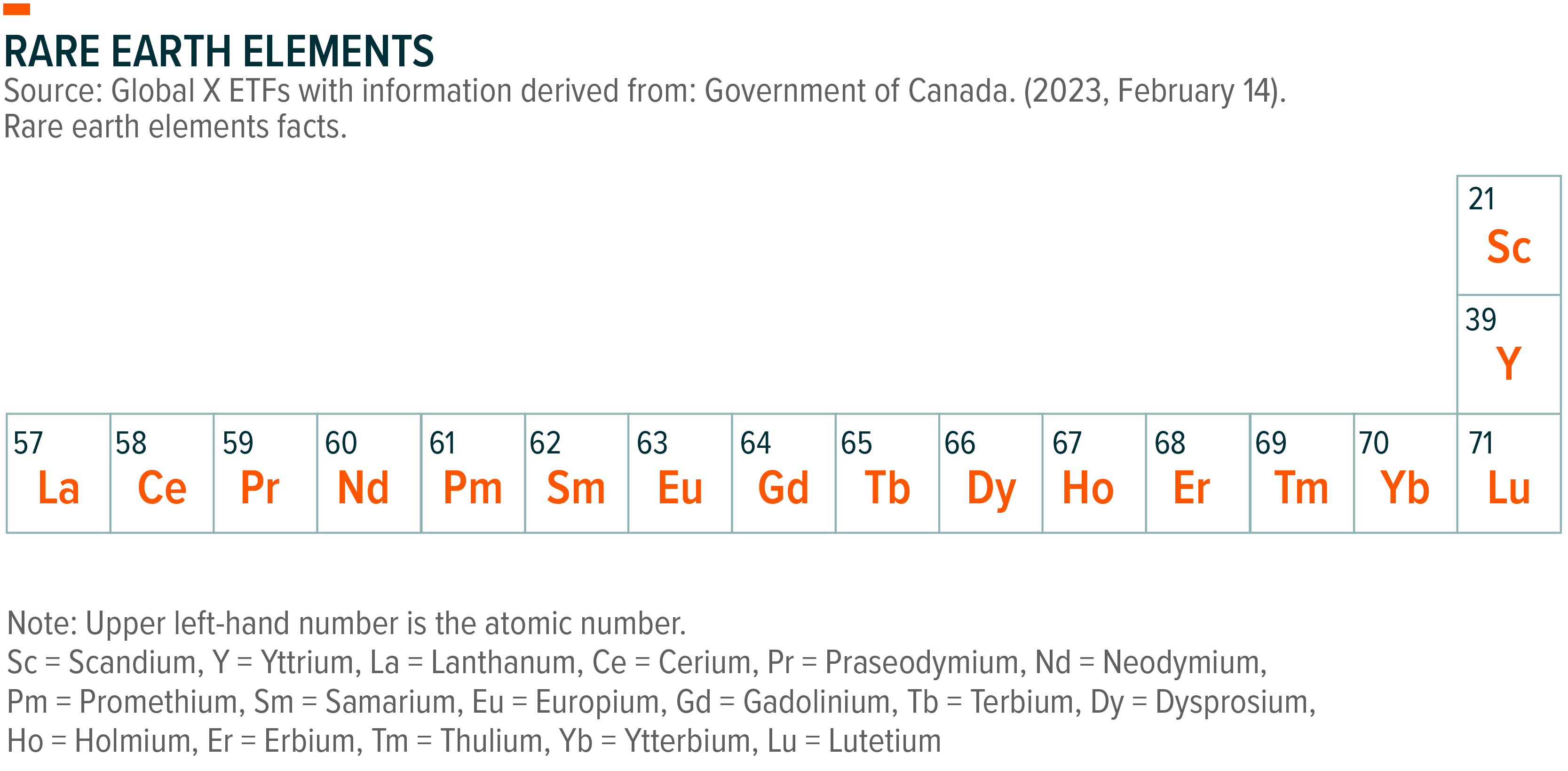
Europium, yttrium, erbium, and neodymium are four REEs that have luminescent properties, which makes them useful for consumer technologies such as TVs and smartphones.8,9 Cerium and lanthanum have catalytic and electrical properties that make them useful in chemical processes, catalysts, and battery technologies.10 In short, most people use several technologies that contain REEs every single day.
Long-Term Growth Outlook for REEs Is Strong
These transitions are likely to continue the clear shift in the REEs demand profile. Demand is moving away from REEs such as lanthanum and cerium, which are used in more traditional use cases like chemical process, and moving towards REEs used in magnets, such as neodymium and dysprosium.
In our view, if efforts to reduce REEs by Tesla and other cleantech companies prove successful, we believe it should still have a relatively limited impact on REE demand for at least the next several years. First, it is projected that reductions in the use of rare earths in wind power systems on a per megawatt of capacity basis should be outpaced by growth in overall wind power capacity through 2030.15
Second, we believe that growth in EVs could also outpace diminishing REE use in the EV industry. Non-rare earth magnets for EVs are not yet widely commercially available and generally still come at a sizeable cost in terms of weight and efficiency.16
And third, we expect that REEs’ importance in everyday electronics and other clean and digital technologies should amount to strong and diversified demand for many years to come. Currently, the entire EV industry accounts for around 12% of rare earth magnet demand, with Tesla responsible for a little over 2%.17
REE Supply Chain Dynamics Present Risks but Also Opportunities
While REEs are relatively abundant in the earth’s crust, they are often not found in large enough quantities for cost-effective mining operations. In addition, separating and processing REEs can be challenging and costly. These dynamics make the supply chain highly concentrated to only a handful of countries.
China dominates the REE supply chain, accounting for 70% of REE mining, 85% of processing, and 92% of rare earth magnet production.18,19 China is also responsible for 97% of the recycled REE supply.20 Therefore, many of the largest REE companies are China-based, including China Northern Rare Earth Group, China Rare Earths & Technology Co., and Shenghe Resources Co.
China’s REE dominance creates risks for supply disruptions and price volatility. In 2010, for example, China banned REE exports to Japan for two months and prices spiked amid the supply disruption.21 In April 2023, it was reported that China might prohibit exports of specific rare earth magnet technology, which could be highly disruptive over the short-term to the myriad industries that use REE magnets.22
Conclusion: Exposure to REEs Means Exposure to Innovation
Related ETFs
DMAT – Global X Disruptive Materials ETF
Click the fund name above to view current holdings. Holdings are subject to change. Current and future holdings are subject to risk.
Image sourced from Shutterstock
This post contains sponsored content. This content is for informational purposes only and not intended to be investing advice.
© 2026 Benzinga.com. Benzinga does not provide investment advice. All rights reserved.
To add Benzinga News as your preferred source on Google, click here.