Zinger Key Points
- Democrats proposed a bill to end hedge funds' indefinite ownership of U.S. single-family homes, aiming to improve market dynamics.
- The proposed legislation requires hedge funds to divest from single-family homes within 10 years, addressing concerns of market distortion.
- Historic Summer Setup: 3 "Power Patterns" Triggering in the next 75 Days - Get The Details Now
Democrats in Congress introduced a bill on Tuesday that could mark the end of hedge funds’ interference in the U.S. single-family home market.
First reported by the New York Times, the End Hedge Fund Control of American Homes Act of 2023, introduced by Senator (D-OR) Jeff Merkley and Representative Adam Smith (D-WA), aims to put the brakes on hedge funds — defined as corporations, partnerships, or real estate investment trusts that manage pooled funds from investors — from buying and holding single-family homes indefinitely.
What Does The Bill Entail?
The bill proposes a drastic shift in the single-family housing market. If signed into law, hedge funds and similar entities must divest from single-family homes within 10 years, eventually barring them from owning such properties in the future. This move comes amid concerns that these funds are skewing the housing market dynamics.
Read Also: Best Real Estate Crowdfunding Platforms
The Rationale Behind The Legislation
Proponents of the bill argue that hedge funds have been warping the housing market dynamics. This concern stems from the notable shift in Wall Street’s strategy following the 2008 financial crisis, where firms increasingly acquired foreclosed single-family homes and consequently expanded their influence in the rental market.
By June 2022, institutional investors accounted for 3% of all single-family rentals nationwide, a figure that has become more pronounced in more economically accessible areas.
A closer examination of specific markets, as detailed in an Urban Institute research report from April 2023, reveals this trend in sharper relief:
- In Atlanta-Sandy Springs-Alpharetta, GA, institutional investors own 10.0% of all types of rental properties. Yet, when one looks only at single-family rentals, institutional investors own 28.6% of these properties.
- For Jacksonville, FL, institutional investors own 8.5% of all rental properties and 24.2% of single-family rental properties.
- Birmingham-Hoover, AL sees 5.6% of all rentals and 15.1% of single-family rentals under institutional ownership.
- For Charlotte-Concord-Gastonia, NC-SC, the figures are 7.1% and 20.1%, respectively, in favor of institutional ownership.
REITs Involved In The Single-family Home Market
- Invitation Homes INVH: A leading player in the single-family rental sector, Invitation Homes has a significant portfolio across the U.S.
- American Homes 4 Rent AMH: This company specializes in acquiring, renovating and leasing homes, with a robust presence nationwide.
- Tricon Residential Inc. TCN: Focused on rental housing in North America, Tricon has a growing portfolio in the single-family sector.
- Zillow Group Z: Primarily a real estate marketplace, Zillow also ventured into buying and selling homes.
A Panacea For An Expensive Housing Market?
While reducing hedge fund dominance could ease some market pressures, it may not be a comprehensive solution for improving the U.S. housing market affordability.
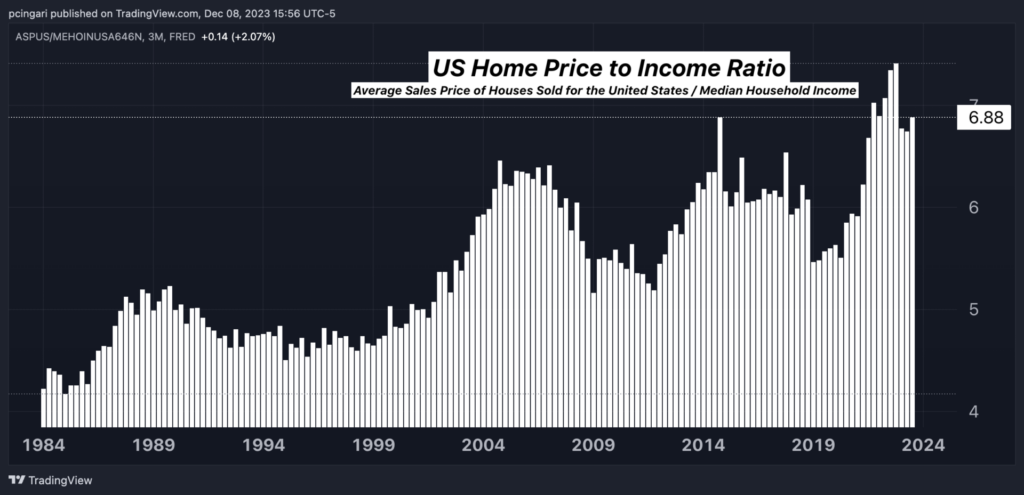
At present, the average price of a single-family home in the United States — $513,400 in Q3 2032 — is approximately seven times greater than the median annual household income in the country, which was $74,580 in 2022. This ratio markedly exceeds the long-term average, where historically, house prices have been about five times greater than household incomes.

JPMorgan Chase CEO Jamie Dimon has long advocated a different angle, emphasizing the chronic underbuilding of housing in the U.S. He has argued that, without addressing this supply-demand gap, housing prices are unlikely to drop significantly.
Latest figures from the U.S. Census Bureau highlight a continuing shortfall. Building permits in October 2023 stood at a seasonally adjusted annual rate of 1.498 million, with housing starts at 1.372 million.
These figures are substantially lower (34% and 38%, respectively) than pre-2008 crisis levels.
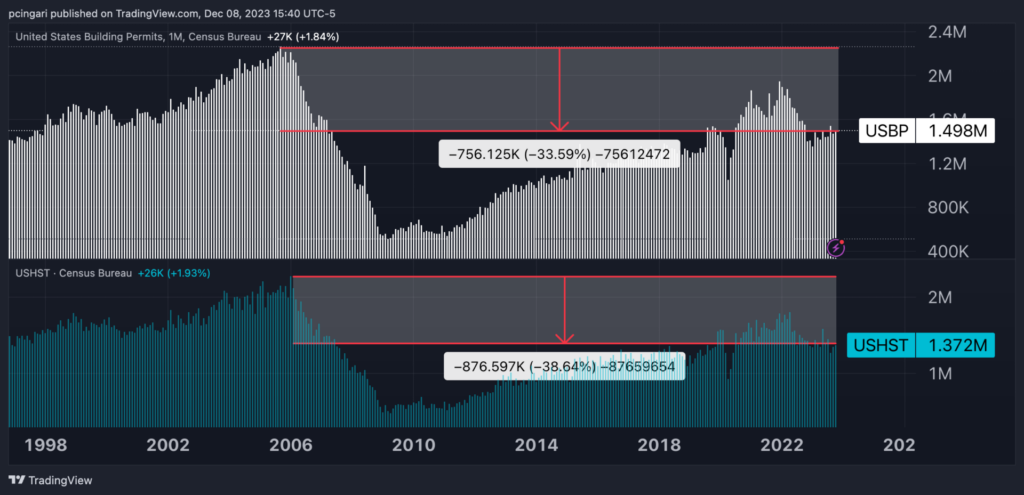
Photo: Shutterstock
Edge Rankings
Price Trend
© 2025 Benzinga.com. Benzinga does not provide investment advice. All rights reserved.
Trade confidently with insights and alerts from analyst ratings, free reports and breaking news that affects the stocks you care about.