In today's rapidly changing and highly competitive business world, it is vital for investors and industry enthusiasts to carefully assess companies. In this article, we will perform a comprehensive industry comparison, evaluating Tesla TSLA against its key competitors in the Automobiles industry. By analyzing important financial metrics, market position, and growth prospects, we aim to provide valuable insights for investors and shed light on company's performance within the industry.
Tesla Background
Founded in 2003 and based in Palo Alto, California, Tesla is a vertically integrated sustainable energy company that also aims to transition the world to electric mobility by making electric vehicles. The company sells solar panels and solar roofs for energy generation plus batteries for stationary storage for residential and commercial properties including utilities. Tesla has multiple vehicles in its fleet, which include luxury and midsize sedans and crossover SUVs. The company also plans to begin selling more affordable sedans and small SUVs, a light truck, a semi truck, and a sports car. Global deliveries in 2023 were a little over 1.8 million vehicles.
| Company | P/E | P/B | P/S | ROE | EBITDA (in billions) | Gross Profit (in billions) | Revenue Growth |
|---|---|---|---|---|---|---|---|
| Tesla Inc | 39.78 | 8.70 | 6.16 | 13.66% | $3.48 | $4.44 | 3.49% |
| Toyota Motor Corp | 11.18 | 1.54 | 1.15 | 4.21% | $2385.42 | $2685.29 | 23.44% |
| Honda Motor Co Ltd | 9.65 | 0.74 | 0.47 | 2.07% | $626.97 | $1174.13 | 21.45% |
| Ford Motor Co | 11.68 | 1.17 | 0.29 | -1.21% | $0.2 | $2.53 | 4.46% |
| General Motors Co | 5.89 | 0.77 | 0.34 | 2.99% | $4.51 | $3.31 | -0.3% |
| Li Auto Inc | 19.14 | 3.54 | 1.81 | 9.95% | $4.19 | $9.79 | 20.34% |
| Thor Industries Inc | 20.42 | 1.40 | 0.53 | 0.18% | $0.1 | $0.27 | -5.93% |
| Winnebago Industries Inc | 18.84 | 1.42 | 0.67 | -0.95% | $0.01 | $0.11 | -18.82% |
| Average | 13.83 | 1.51 | 0.75 | 2.46% | $431.63 | $553.63 | 6.38% |
Upon analyzing Tesla, the following trends can be observed:
-
At 39.78, the stock's Price to Earnings ratio significantly exceeds the industry average by 2.88x, suggesting a premium valuation relative to industry peers.
-
It could be trading at a premium in relation to its book value, as indicated by its Price to Book ratio of 8.7 which exceeds the industry average by 5.76x.
-
The stock's relatively high Price to Sales ratio of 6.16, surpassing the industry average by 8.21x, may indicate an aspect of overvaluation in terms of sales performance.
-
The Return on Equity (ROE) of 13.66% is 11.2% above the industry average, highlighting efficient use of equity to generate profits.
-
Compared to its industry, the company has lower Earnings Before Interest, Taxes, Depreciation, and Amortization (EBITDA) of $3.48 Billion, which is 0.01x below the industry average, potentially indicating lower profitability or financial challenges.
-
The gross profit of $4.44 Billion is 0.01x below that of its industry, suggesting potential lower revenue after accounting for production costs.
-
The company's revenue growth of 3.49% is significantly below the industry average of 6.38%. This suggests a potential struggle in generating increased sales volume.
Debt To Equity Ratio

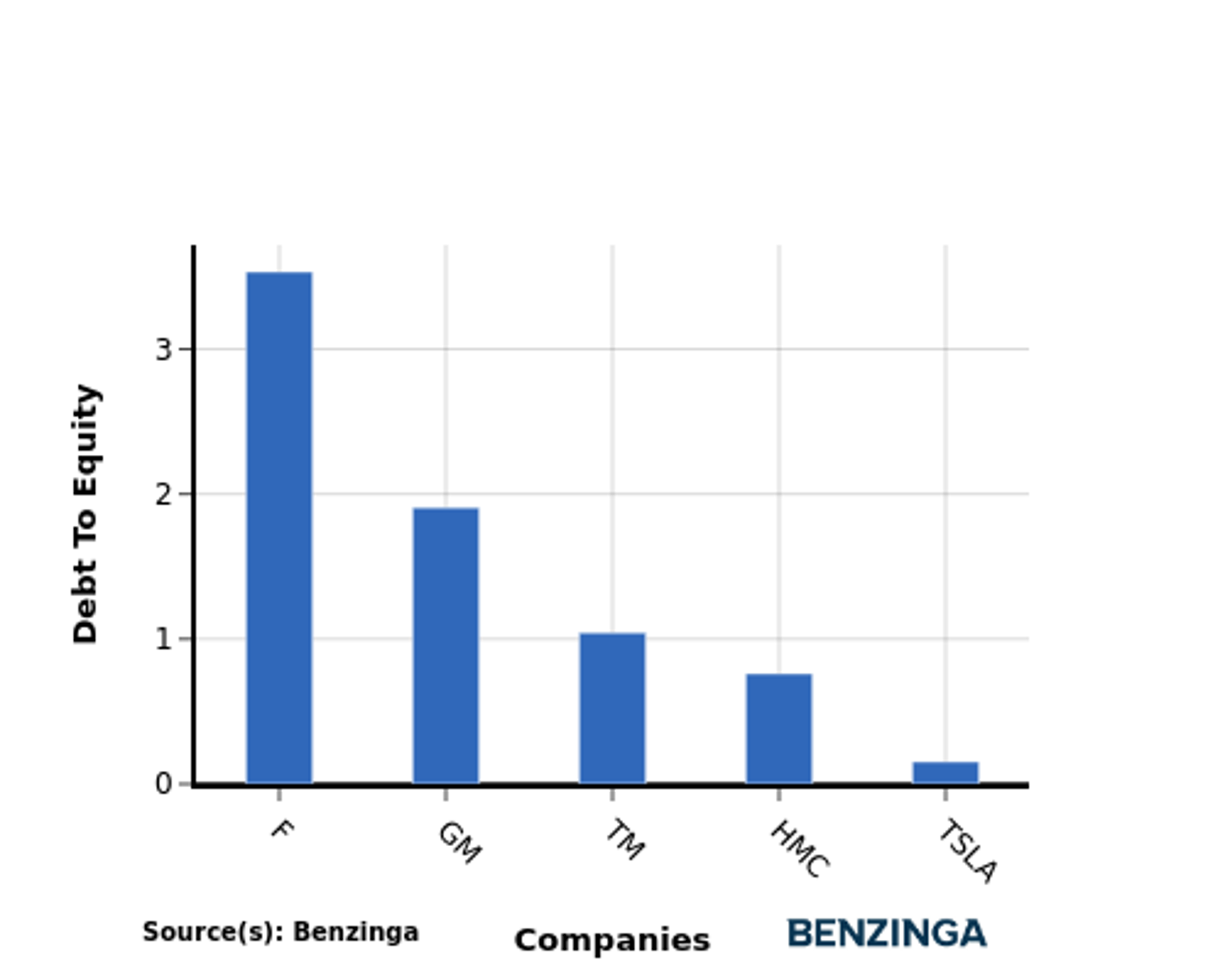
The debt-to-equity (D/E) ratio measures the financial leverage of a company by evaluating its debt relative to its equity.
Considering the debt-to-equity ratio in industry comparisons allows for a concise evaluation of a company's financial health and risk profile, aiding in informed decision-making.
By analyzing Tesla in relation to its top 4 peers based on the Debt-to-Equity ratio, the following insights can be derived:
-
Tesla exhibits a stronger financial position compared to its top 4 peers in the sector, as indicated by its lower debt-to-equity ratio of 0.15.
-
This suggests that the company has a more favorable balance between debt and equity, which can be seen as a positive aspect for investors.
Key Takeaways
The high PE, PB, and PS ratios suggest that Tesla is relatively overvalued compared to its industry peers. On the other hand, the high ROE indicates that Tesla is generating strong returns on equity. The low EBITDA, gross profit, and revenue growth figures may indicate potential challenges in profitability and growth compared to its competitors in the Automobiles industry.
This article was generated by Benzinga's automated content engine and reviewed by an editor.
© 2024 Benzinga.com. Benzinga does not provide investment advice. All rights reserved.
Trade confidently with insights and alerts from analyst ratings, free reports and breaking news that affects the stocks you care about.