Image via Enphase Energy.
From The Author Of Evils & Designs
Last month (Our Addiction Economy), we shared a thought-provoking post by our pseudonymous Twitter correspondent JC Bennett, about the addictive nature of our current economy. Below, we've shared another thought-provoking post by him that deserves wider readership. First, a quick note on a once and current top name of ours, the home solar energy company Enphase Energy, Inc. ENPH.
Enphase Energy
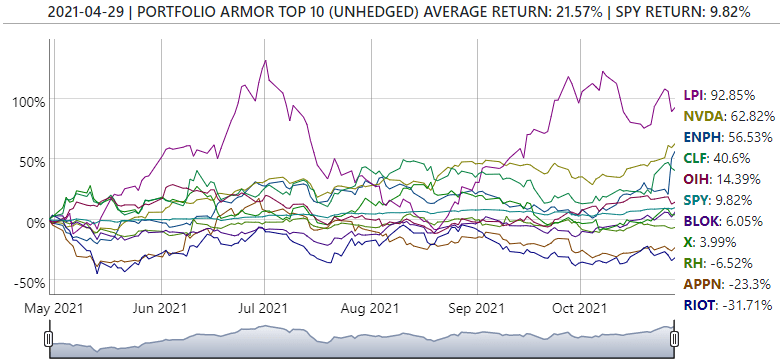
Enphase Energy was one of our system's top ten names in late April, along with a couple of conventional energy named, Laredo Petroleum, Inc. LPI and the VanEck Vectors Oil Services ETF OIH.


Screen capture via Portfolio Armor on 4/29/2021.
Since then, it was up more than 56% as of Thursday's close, thanks in part to the impressive Q3 earnings report and bullish forward guidance.
The reason we mention it now is that Enphase was one of our top ten names again on Thursday, alongside the other names listed below.


Screen capture via Portfolio Armor on 10/28/2021.
As always, if you decide to buy one of these, we recommend you consider hedging to limit your downside risk. We say that partly because we peddle a hedging app, but also because we don't want you to lose too much money in the event we are wrong.
Now on to JC Bennett's excellent post.
Authored by JC Bennett at Bennett's Phylactery
That Hideous Strength
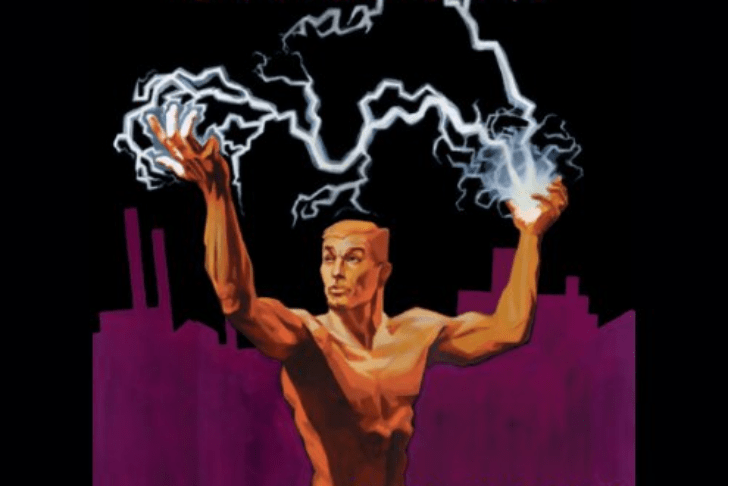
The fashionable conclusion about dystopian fiction is that Orwell got it wrong and Huxley got it right. We don’t have overt state suppression, jackboots, obvious Soviet-style centrally-planned immiseration; instead, we are enslaved by abundance.
All these books are a reaction to the same real-world people.
The early-20th-century dystopias were all responding to the chiseled art-deco Man of Science, who believed that new methods in statistics, chemistry, psychology, etc. would allow him to optimize people & societies in the same way that he was already optimizing internal combustion engines, power transmission, agriculture. 1984 is the story of that dream’s failure in the Soviet Union, but in Brave New World, the Man of Science delivers on his promise: material want & psychological distress are conquered, everyone is free in every sense that they desire to be, & the world is at peace.
(It’s not a coincidence that 1984 was published in 1949, when the West had “always been at war with Eurasia” - while Brave New World came out in 1932, when Western media was still shamelessly carrying water for our brave & well-supplied Soviet comrades. The brutality of Soviet communism is so obvious to us now that it’s hard to imagine it ever having been associated with the squeaky-clean chrome futurism of Brave New World - but that is in fact what right-thinking progressives in the 1930s expected to emerge from the Soviet experiment.)
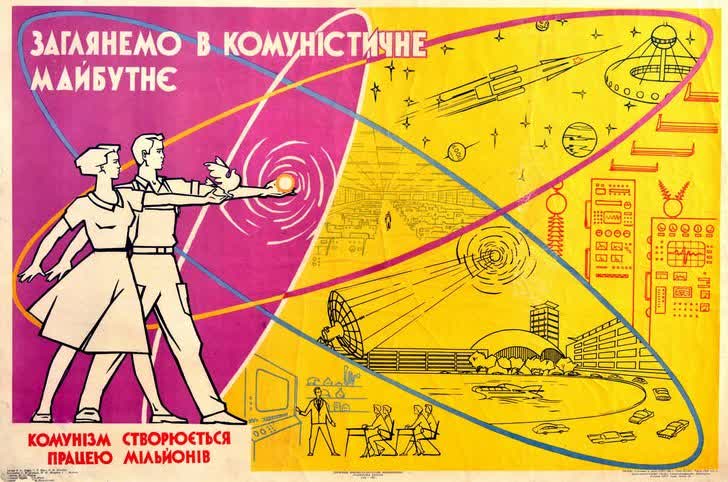
Both Huxley & Orwell were fundamentally the same type of dude as the people whose ideas they were critiquing: socialists, materialists, progressives (which, again, implied more open & naive sympathy to Marxism than it does today) - so both their dystopias are stories of shattered idealism. Orwell had the benefit of hindsight, but it’s to Huxley’s credit that he was willing to think carefully through everything “his side” wanted, & realize that even in the best case it comes up ugly & insipid.
Lewis, on the other hand, is not that type of dude.



He’s not disappointed by the shoddy implementation or the “co-opting” of the scientific ideal - he thinks the whole project is Satanic from top to bottom. In That Hideous Strength, the villainous National Institute for Coordinated Experiments (NICE) never produces any cancer cures or prison reforms, & never intended to. It’s all a flimsy excuse to torture animals & reanimate corpses & kidnap children - so flimsy that only a corrupt person would even pretend to believe it.
You can see why That Hideous Strength isn’t placed on the same pedestal as the other two dystopias. Critics then & now have called it “didactic” & “moralizing”, & so it is - but Lewis was as far ahead of Huxley, in terms of predicting the actual outcome of then-“modern” ideas, as Huxley was ahead of Orwell.
We’re now 80 years into the experiment. Progress toward the unambiguous goods that mid-century Men of Science pursued has been so slow that you’ve got to wonder how hard they’re really trying - yet the psychospiritual sterilization of the public that was supposedly justified by those humane ends happened anyway. The places where they were given the freest hand (avowed revolutionary Marxist states) were the most horrific, but everything they’ve touched has been blighted. We got the tortured animals & the reanimated corpses & the kidnapped children, but the flying cars & wonder drugs are still, as always, ten years out.


uhh do not research
On that level, Lewis was vindicated in broad terms - but he also (no other word for it) prophesied the end-game that we’ve seen unfold over the last decade: increasingly naked mass media manipulation, weaponization of non-governmental institutions (because they are not subject to traditional constraints on state power), engineered riots, anarchotyranny.
It’s a sort of empirical demonstration of what you often hear said in our corner of the internet: the people ruling our society may or may not be literally a cabal of insane murderous Satanist perverts - but what would be different if they were? Lewis started from that exact thesis 80 years ago, & it brought him exactly here.
Whenever I have tried to write fiction, I have found myself constantly embarrassed to “moralize”.
Not just to give the characters what they deserve, but to assign any kind of final consequences to their actions, because like everybody else I’ve been trained to view cosmic good & evil, & “just deserts”, as being too convenient, too obvious, too on-the-nose. So it’s interesting to me that Lewis, writing a deliberately black-and-white eschatological “fairy tale”, got so much right about the real world.
The action involves about a dozen in characters within a few miles of one particular English village, but all the characters are avatars of cosmic good & evil, & the little village is sort of loosely assumed to be the final eschatological battleground for the fate of the Earth - sort of a toy model of the cosmos, with everything scaled way down & simplified.
The agents of the conspiracy direct street thugs to start riots, & the protagonist, a junior partner in the conspiracy, must write an article justifying the subsequent crackdown. The middle manager must believe something other than the truth, but not the same lie that the plebs believe, because he sees more of the picture & more is required of him. Lewis represents each layer in a single person, as his protagonist climbs the ladder at NICE.
In the real world, hundreds of thousands of people, maybe millions, have to participate in this pyramid, with dozens of overlapping layers of deception. But fitting that phenomenon to this small, archetypal world clarifies the moral truth of it: which is that everyone involved knows on some level that they are being lied to - & they not only assent to the lie, but workshop it, & refine it, & pass it along.
And then shall that Wicked be revealed, whom the Lord shall consume with the spirit of his mouth, and shall destroy with the brightness of his coming: Even him, whose coming is after the working of Satan with all power and signs and lying wonders, And with all deceivableness of unrighteousness in them that perish; because they received not the love of the truth, that they might be saved.
At no point in the story is the protagonist (or anyone else at NICE) honestly deceived. At every level, the lies are almost childishly obvious - but the targets of these lies all believe that they’re in on the con, or in too deep to get out. This starts with cynicism, but at the highest echelons of the conspiracy, the lies are a conscious, quasi-sacramental exercise in reality manipulation, of a piece with the profanation of corpses & religious symbols.
Toward the end, NICE exposes the protagonist to various forms of “modern art”.
The goal is to break him of his sense of beauty, & thereby his sense of truth & virtue: Lewis’s villains argue that these are illusory preferences, & that Objectivity demands they be discarded - but the way this lie is told in the real world is more compelling.
Anyone can see that a beautiful thing is beautiful; it takes a sophisticate to find beauty in ugliness, or meaning in empty noise - & that’s the kind of lie you could almost believe, because it’s leavened with truth. There is beauty in unlikely places, & insight does find meaning where others can’t see it. Prophets & artists show us what isn’t obvious, what we overlooked.

When that phenomenon is genuine, the viewer sees what the prophet saw, & then decides whether to obey the truth or reject it. On the other hand, there is no such thing as being “honestly deceived” by a false prophet, or a “subversive” artist. The crowd you’re lying to has to participate in the lie. They have to squint at your sculpture of dogshit & menstrual blood (or whatever) & go “oh yes, I see it, how bold & interesting”.
Their assent strengthens the lie & compounds it. Their social stature, as much as the “artist’s”, becomes increasingly tied up with that lie, so that they not only go along with the lie, but will viciously ridicule & ostracize anyone who speaks against it. The longer the process goes on, the more painful the surgery, both for the individual & the society.
So Lewis anticipates the postmodern infection by about 30 years.
Through the NICE psychologist, Dr. Frost, Lewis explores the irony of rejecting truth in the name of objectivity - but I don’t think even he really understood how deeply it would reach into every corner of thought - how it would move on from its then-formidable enemies (moral & spiritual truths) to the most petty & innocuous & self-evident questions of fact.
(If you have ever wondered what the hell could possibly be meant by “queering mathematics” or “queering architecture” or “queering agriculture”, this is the answer. There is no direct relationship to sexuality - it’s just a lens through which to attack the idea of truth in itself, as represented in whatever discipline is being “queered”.)
It would be cool if Lewis’s prescience about the Dark Side had led him to some novel solution that could be deployed by the Light, but the whole point seems to be that there is nothing really novel about the present enemy; this is a homely moral struggle, & you are a co-conspirator as well as a victim. So you just have to stop lying - stop participating in lies, stop spending your time around liars. Give up whatever sins you have to give up, take your lumps, come clean, & join the right side - the earlier the better.
Edge Rankings
Price Trend
© 2025 Benzinga.com. Benzinga does not provide investment advice. All rights reserved.
Trade confidently with insights and alerts from analyst ratings, free reports and breaking news that affects the stocks you care about.