After a fourth-straight quarter of gains and a record intraday high for the S&P 500 Index (SPX) at just below 4000 on Wednesday, what can the market do for an encore in Q2?
We’re about to find out, but first a three-day weekend looms, which means trading today might be lighter than normal. Though the market will be closed tomorrow and we won’t be publishing our Daily Market Update, all eyes could turn toward the March payrolls report at 8:30 a.m. ET. Most of us just won’t be able to trade it until Monday. Like that old song goes, the waiting could be the hardest part.
Since today is opening day in baseball, get your pencils and scorecards ready to check where things stand now that we’re 25% of the way through 2021. The Dow Jones Industrial Average ($DJI) is up 7.8% year-to-date, the SPX is up 5.8%, and the Nasdaq Composite (COMP) is up 2.8%. That was a nice recovery for the COMP, which entered correction territory about a month ago, down 10% from highs.
Meanwhile, the Russell 2000 (RUT) small-cap index rose 12% in Q1 to outpace everyone else, and a strong RUT is often seen as a canary in the coal mine for an improving economy. The RUT bounced back nicely Tuesday and Wednesday from a really bad start to the week.
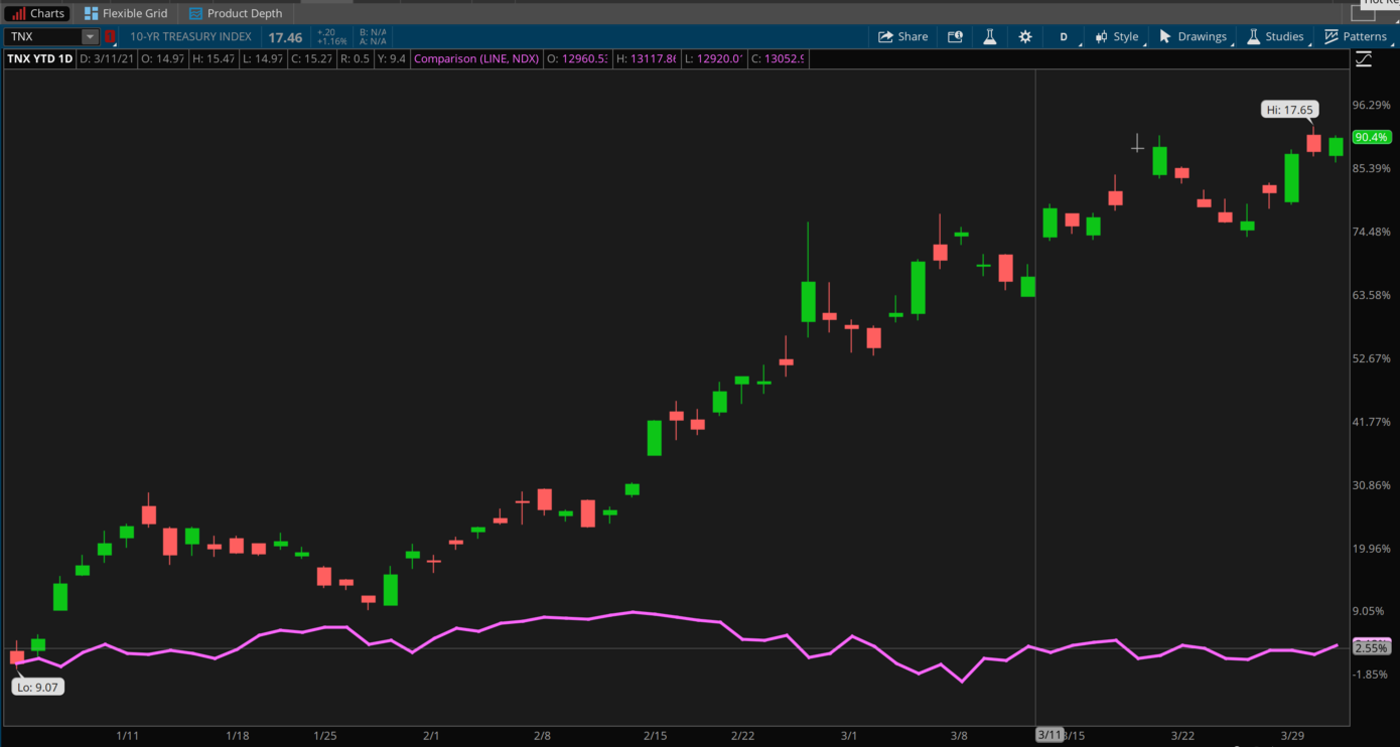
Looking back at Q1, it was an incredible time for the 10-year Treasury yield—which climbed from roughly 0.9% to 1.7%—and for the old-school large-caps found in the $DJI. You can’t write Nasdaq off. It had a bad quarter. That’s the biggest sign of a healthy market. When one area falls down, others take its place. While everyone talks about the negative impact on Tech from higher yields, those same yields didn’t derail the whole market. They helped Financials significantly.
Need a Lift? Micron, Infrastructure Plan Provide Early Support
Things look slightly stronger to start the first day of Q2, with major stock indices gaining overnight and the 10-year Treasury yield ticking down a bit to 1.7%. There’s support from the proposed Biden infrastructure spending plan we heard about yesterday, and from strong earnings delivered last night by chipmaker Micron MU. The main question about infrastructure is what does it mean for corporate taxes and whether that slows momentum down, but the answer is nearly a year away, so for now it’s being seen as positive.
Shares of MU jumped 4% in pre-market trading after its earnings beat Wall Street’s estimates. Though earnings looked good, it was arguably MU’s firm outlook that lifted the stock. As we go into earnings season later this month, the focus remains less on what happened last quarter and more on what companies expect down the road.
Tech investors in general saw a solid end to a tepid quarter. The FAANG names finally had a day in the sun, along with their cousin Microsoft MSFT, possibly reflecting a little end-of-the-quarter short covering. Semiconductors, which did better than Tech as a whole in Q1 and are sometimes called the “cyclical” sub-sector of Tech because they tend to do well when the economy exits recession, had a good finish, too. The Philadelphia Semiconductor Index SOX rose 2.6%.
Morning Roundup: Crude, Claims, and Covid
Meanwhile, crude is up just slightly after falling below $60 a barrel yesterday ahead of the OPEC+ gathering today. The question is whether they’ll decide to keep production curbs in place. Another agenda item today is the ISM manufacturing index for March, due soon after the opening bell. Analysts expect a strong reading of 61.2%, according to Briefing.com.
Weekly initial jobless claims rose just slightly to 719,000, above analysts’ estimates for around 675,000. That’s a bit disappointing, because momentum had been heading lower. On the positive side, the previous week’s claims were downwardly revised to 658,000 from 684,000.
There’s mixed news on Covid today. First, the good: Pfizer PFE and BioNTech BNTX say their vaccine remains 91% effective after six months, and appears effective against the worrisome South African variant. The bad news comes from Johnson & Johnson JNJ, whose shares fell 1% in pre-market trading after an ingredient mixup caused them to throw away 15 million vaccines.
While the quarter looks like it’s off to a strong start and there’s a nice tailwind, out on the horizon, it’s the punch you don’t see coming that knocks you out. Right now, it’s hard to see what that might be when you consider all the money in the system.
If Payrolls Get Released When Market is Closed, Plenty Will Hear It
What could Friday’s Payrolls report tell us? Economists look for 630,000 new jobs in March, according to Barron’s. That would be up from 379,000 in February and the second solid month in a row after a December and January lull. March might even see as many as a million jobs created, some analysts say, partly because winter weather across the South in February might have delayed some hires.
The wintry weather probably helped slow February job growth in some sectors where you’d like to see it, for instance in construction and mining and logging. Most of the February growth came in travel and leisure as the economy reopened. More of that is expected in March, but let’s see if it spills over into other, higher-paying sectors, too. Average hourly pay didn’t grow much in February, but hopefully the needle moved on that in March.
February’s steep employment gains put an arrow in the quiver of some people who worry about inflation, so the same scenario could be true again if the March report shows big gains. That, combined with the recent stimulus and President Biden’s rolling out an infrastructure plan yesterday, all contribute to these concerns, but the Fed has made it pretty clear it won’t be raising rates anytime soon.
That kind of takes the wind out of the sails for anyone worried that a strong economy could lead to rate hikes. Reflexively, it’s easy to think that way because it was always like that in the past. We’re in a new era here with the Fed, though you definitely could see Treasury yields rise further if investors keep focusing on inflation. The 10-year yield finished the quarter near 1.74%, up from 0.92% at the end of December. That’s the steepest quarterly gain in five years for that economic indicator, but the level it’s at is still historically very low.
Taxman Awaits? Market Seems Unworried
It felt a bit ironic yesterday to watch major indices post all-time highs despite President Biden proposing a major jump in corporate tax rates. Maybe some of this was built into prices, or maybe most investors don’t believe Biden will get everything he wants. Also, there are ways besides higher taxes to conceivably pay for the infrastructure improvements he proposed.
Still, if corporate rates rise to 28% from 21%, that would possibly cut into companies’ earnings prospects starting as soon as next year. Democrats could use budget reconciliation to get the bill through the Senate with no Republican support, political experts told the media.
The market tends to be forward looking, so you can pretty much rest assured that Wall Street analysts are picking up their calculators to see what effect, if any, a tax hike might have on their 2022 and beyond earnings estimates. The impact might hit different companies in different ways. For instance, multinationals that have been protecting some of their profits from U.S. taxes through so-called “off-shoring” might see their bills go up.
One thing to remember for anyone worried about potential tax hikes is that corporate taxes were 35% before the 2017 tax bill, and that didn’t prevent a pretty steady rally for almost a decade. Also, large corporations are pretty good at finding ways to blunt the impact of higher tax rates.
One way, potentially, would be raising prices. That might play into inflation worries if it does happen, and Kimberly Clark KMB announcing price hikes this week on some of its paper goods and diapers raised eyebrows. The company cited rising commodity prices, but down the road other companies might base price hikes on a higher tax burden. Interestingly, the Fed has gone to lengths to suggest any outsize inflationary readings would be “transitory,” but it’s hard to see a scenario where KMB would revert to lower prices at the retail level. That’s one of the differences between the Producer Price Index (PPI) and the Consumer Price Index (CPI).
New Quarter, Same Tug-of-War: As we noted in our April Outlook, the market remains in a bit of a tug-of-war between reopening and stay-at-home stocks. It’s a situation that’s very hard to read when you see so much vaccination progress but at the same time all these headlines about rising caseloads. Some medical experts say April and May are a key “bridge” to more normalcy by summer.
Word from travel-related companies like hotels and rental car agencies is that they’re seeing stronger demand for the warmer months. That would be particularly welcome for the battered travel and leisure industry, and a lot of investors seem to be hoping for that. The NYSE Arca Airline Index (XAL) rose 28% in Q1, though some weakness crept in yesterday.
Tech Licks its Q1 Wounds: Looking back at Q1, it was a tough quarter for Tech thanks in part to rising yields and a trend toward stocks that could benefit more from reopening. Apple AAPL was actually the worst-performing stock in the $DJI for Q1 going into the final session yesterday, losing 7% since Dec. 31 before Wednesday’s nice rally. The weak Q1 doesn’t mean investors will abandon Tech stocks like AAPL and Microsoft MSFT, but new sectors keep being strong. We’re just seeing strength out of different areas that we didn’t necessarily expect to see strength out of. That’s really been the story of 2021 so far—hitting new highs while still trying to figure out where to be longer term for most of the market.
That sector shift showed up in the best-performing $DJI stock of Q1, which ended up being Walgreens Boots Alliance (WBA). That company got another lift Wednesday as investors bid up shares after a strong earnings report buttressed by WBA’s participation in the Covid vaccine rollout. For the past couple years, WBA was a regular contender for “Dog of the Dow” while AAPL often led the index. Times have definitely changed, but it shows you how nimble investors need to be. And how patient. The investors who grabbed WBA shares a while back and hung on through some tough quarters are the beneficiaries of that patience now.
Hedging Risk: Some people say Wall Street dodged a bullet this week after a plunge in media stocks helped lead to the default of a major hedge fund and pressure on European banks. Some U.S. banks felt the heat, but mostly the damage was limited. For now, anyway. As seasoned investors might remember from the Long Term Capital Management collapse back in 1998, a major hedge fund getting hurt sometimes preceded past market dips, though nothing is guaranteed.
Investors have taken on a lot of risk over the last year as “TINA” (there is no alternative) and the FOMO (fear of missing out) momentum carried major indices to new all-time highs again and again. This may have led to more risk taking than necessary, and also possibly to some investors taking their eye off the ball when it comes to risk management. One hedge fund falling doesn’t mean more to come, but you can’t rule it out, and now we might see a bit of pressure, especially in Financials, as investors built in some risk that they may not have had in mind before.
As an investor, you don’t need to participate in a big hedge fund to understand the danger of taking on too big of a position in any one stock, sector, or industry. This might be a good reminder to look over your portfolio and make sure the collapse of an individual company or sector wouldn’t cause major damage to your finances. It’s that old concept, diversification, knocking on our doors again.
TD Ameritrade® commentary for educational purposes only. Member SIPC.
© 2024 Benzinga.com. Benzinga does not provide investment advice. All rights reserved.
Comments
Trade confidently with insights and alerts from analyst ratings, free reports and breaking news that affects the stocks you care about.