
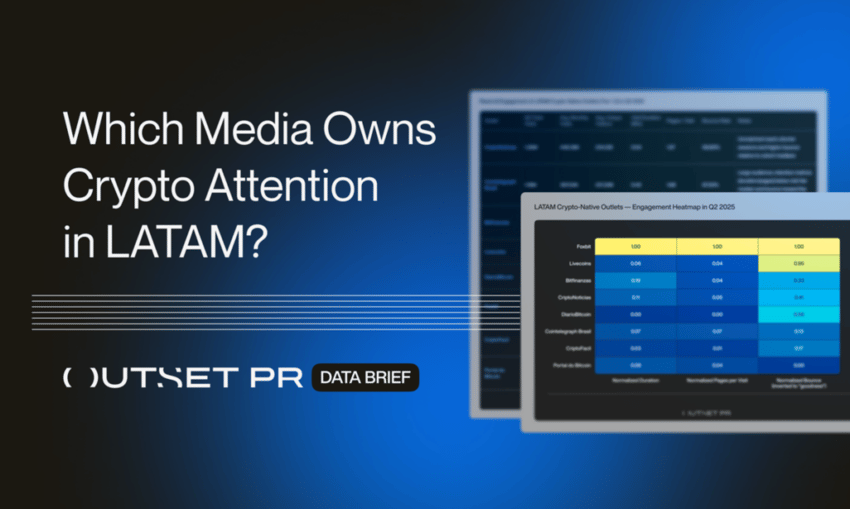
In our last Outset Data Pulse report, we talked about how Latin America's crypto media scene went through a shake-up: six top-tier outlets dropped to just one. That story was about visibility – who's being read, and who's fading out.
This time, we looked at what happens after people click in. What we found in Q2 2025 is that most of the real engagement – the kind that shows readers are actually sticking around, now lives in the middle.
To understand that, we built what we call the engagement index, a simple way to measure not just who's visible, but who's valued. It combines visit duration, pages per session, and bounce rate into a single score, showing where audiences are really spending time, not just passing through.


Engagement heatmap, comparing normalized duration, pages per visit, and bounce rate across tier-1/2 LATAM crypto outlets. Source: Outset PR analysis
Engagement Is the New Reach
The mid-tier may not have the biggest numbers, but it's where readers seem to care the most. We measured not just how many people came, but how long they stayed, how much they read, and how many left after one page.
It's a simple truth that came out of the data: bigger audiences don't always mean stronger loyalty. Some smaller sites have built habits, others just give people exactly what they're looking for.


Eight leading LATAM crypto-native outlets account for 74% of regional traffic, with engagement strength spread across the mid-tier. Source: Outset PR analysis
CriptoNoticias and Cointelegraph Brasil dominate when it comes to scale. CriptoNoticias drew about 1.35 million visits in Q2, while Cointelegraph Brasil was just behind with 1.19 million. They're the gateways for most readers, the first stop for anyone curious about crypto in Latin America.
But when we look at engagement, it's a different story. Readers stay less than a minute on average, with bounce rates between 56% and 68%. They attract enormous visibility, but the interactions are shallow, more scanning than reading. It's a reminder that visibility alone doesn't equal influence.
Foxbit is on the opposite end of the spectrum. It doesn't have the biggest audience (around 174,000 average monthly visits) but its readers are dedicated. They spend more than six minutes per session, click through six or more pages, and bounce less than 35% of the time.
Normalized metrics of other engagement leaders suggest they benefit from loyalty built by fitting neatly into readers' everyday habits or by capturing search demand well.
Connectors Shaping How LATAM Readers Find Crypto News
Still, publishers that don't see the deepest sessions thrive on discovery, meaning they're crucial entry points for new readers.
Some feel like a newswire – short, fast, and mobile-heavy. Readers scan, grab what they need, and move on. Others perform strongly in search and private sharing (especially WhatsApp), feeding stories into broader discussions.
Importantly, there are outlets that get a significant portion of their traffic from AI platforms like ChatGPT, ReadPartner, Feedly AI, Perplexity, and others, proving that discovery now begins with a question, not a keyword.
These sites might not hold readers for long, but they help drive the entire ecosystem by bringing new audiences into the funnel.
What the Numbers Actually Say and Why It Matters
When we combined all the engagement metrics: visit duration, pages per visit, and bounce rate into the aforementioned engagement index, the results were clear: attention is no longer centralized around the biggest names. Instead, it's spread across the mid-tier – outlets that have carved out specific functions in readers' daily routines.
For publishers, this means survival won't come from chasing volume alone. The outlets that win will be the ones that mean something to their readers, whether that's a trusted daily feed, a reliable search destination, or a workflow companion.
For the crypto industry at large, it's a signal to rethink how visibility works. Reaching audiences in Latin America is both about getting coverage from the biggest site and understanding where real engagement happens. Right now, that's spread across the mid-tier.
What Remains Is Smaller, But Far More Resilient
Yes, the top tier has thinned, but that doesn't mean the ecosystem is weak. It's just changed shape. The mid-tier, once considered secondary, now carries most of the region's crypto attention, and it's holding it better than anyone expected.
This story is about redistribution of traffic, loyalty, and influence. Latin America's crypto readers haven't disappeared. They've just moved down the ladder, to the places where they can find content that fits how they actually consume it.
For those who like to dig into the nitty-gritty – the charts, rankings, and data trails behind the story – the full Q2 engagement brief is up on our blog.
Benzinga Disclaimer: This article is from an unpaid external contributor. It does not represent Benzinga’s reporting and has not been edited for content or accuracy.
© 2026 Benzinga.com. Benzinga does not provide investment advice. All rights reserved.


