



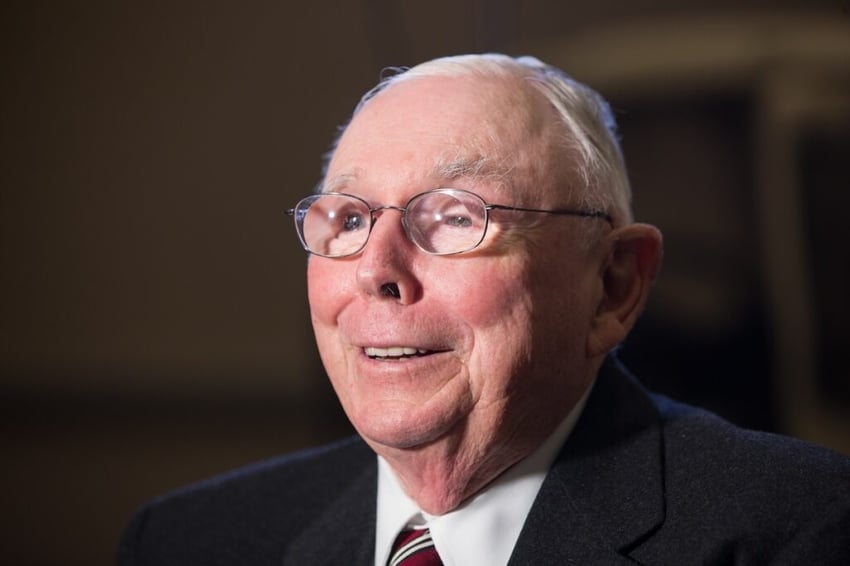
Charlie Munger said people he grew up around managed to cope with life's realities without becoming unhappy despite difficulties and lack of money.
Talking about his childhood in Omaha during an interview at the University of Michigan’s Ross School of Business in 2017, the then–Berkshire Hathaway vice chair said people were able to get by even when money was tight. He recalled his maternal uncle, an architect who prospered in the 1920s but had to move to California during the Great Depression, where he later earned just over $100 a month working for Los Angeles County.
Don't Miss:
"He could actually rent a house for $25 and feed himself and drive an old car, he could live on $109 a month, amazing how poor everybody was," Munger said. "It sounds awful but they weren’t all that unhappy. You can cope pretty well because you get used to it."
‘Pretty Damn Good Place to Grow Up'
Munger said he considered himself "privileged" to have grown up in Omaha, where he learned strong values, including a moral duty to think rationally, the importance of family, and helping others. He said the people around him believed that being reasonable mattered more than getting richer.
"All these people were educated and civilized and generous and decent and a lot of them had good sense of humor and it was a pretty damn good place to grow up," Munger said. "None of my intelligent relatives suffered terribly because they didn’t advance higher."
Trending: Americans With a Financial Plan Can 4X Their Wealth — Get Your Personalized Plan from a CFP Pro
Munger said his paternal grandfather, who had a major influence on his life, grew up in poverty as the son of two poor schoolteachers. Raised in a small town in Nebraska, he resolved to change his circumstances and improve his life. Despite having to leave school due to financial hardship, he taught himself, worked tirelessly, and eventually became a federal judge.
"He was a child of two impoverished schoolteachers," Munger said. "They'd give him a nickel to go buy the meat and he’d go to the butcher shop and he would buy the parts of the animal nobody else would eat. The very indignity of it bothered him so much that he just determined to get out of poverty and never go back."
Read Next:
Image: Shutterstock
© 2026 Benzinga.com. Benzinga does not provide investment advice. All rights reserved.
To add Benzinga News as your preferred source on Google, click here.

