Germany's parliament backed on Tuesday a plan to increase government borrowing limits as the largest economy in Europe looks to bolster its defense and infrastructure spending.
The Bundestag approved several amendments to the country’s constitution, allowing future federal and state governments to take on more debt. This will enable higher defense spend and €500 billion for infrastructure to bolster the European Union's (EU) military capabilities.
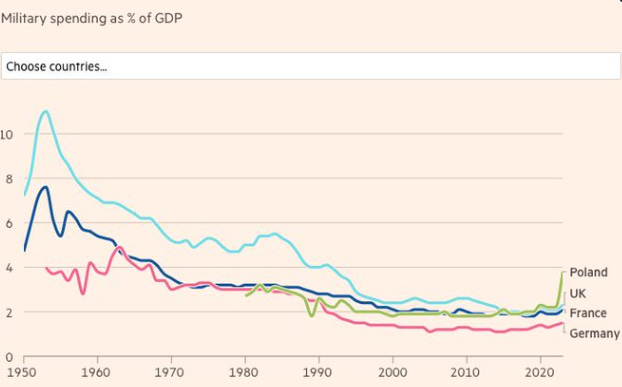
German Chancellor-in-waiting Friedrich Merz proposed defense spending as the EU grows increasingly concerned about the US commitment to Europe's security. President Donald Trump has criticized European nations for not meeting their NATO commitment of 2% of GDP per year by 2024, threatening to reassess the US commitment to the military alliance.
“We have for at least a decade felt a false sense of security,” Merz told the Bundestag lower house of parliament on Tuesday. "The post-war peace dividend had been used up long ago and a total rebuilding of Germany’s defense capabilities was needed," he added.
In an interview with public broadcaster ARD on Sunday, Merz said the "situation has worsened in recent weeks." He cited Trump's overtures to Russia to end the Ukraine war and his wavering commitment to NATO.
"That is why we have to act fast," Merz said. He has urged an amendment to the constitution to exempt defense spending beyond 1% of GDP.
German Decisions Push European Markets Higher
The pan-European Stoxx 600 closed 0.61% higher on Tuesday, with most sectors and all major bourses in positive territory. Frankfurt's DAX German corporates Rheinmetall, Bayer, ThyssenKrupp, and Continental traded higher on the news.
DAX is up 16.76% year-to-date, outperforming its American counterpart, the S&P 500, by over 20%.
Some 513 parliamentary members voted in favor of the constitutional changes, while 207 voted against them. Over two-thirds of parliament members needed to vote to change Germany’s basic law to soften the debt brake.
The decision to increase public investment and relax constitutionally enshrined borrowing rules to allow higher defense spending "sends a very clear message to Europe that Germany is determined to invest massively in defense,” EU Commission President Ursula von der Leyen said.
The center-right bloc of the Christian Democratic Union (CDU) and Christian Social Union (CSU), along with the center-left Social Democrats (SPD) and the Greens, supported the package.
The Bundesrat, a body representing the country's states, will meet on Friday to vote on the law. Only then will it become enshrined in Germany's constitution.
German Economy Constrained by ‘Debt Brake'
"The next federal government will have little choice but to make massive public investments in defense capabilities," Deutsche Bank Research Institute wrote on March 13. "This effort cannot be financed within the confines of the debt brake without impacting other core government tasks and thus risking public support."
Merz's CDU and its sister party won the election with 28.6% of the national vote on February 23. He has pledged to form a coalition government in April.
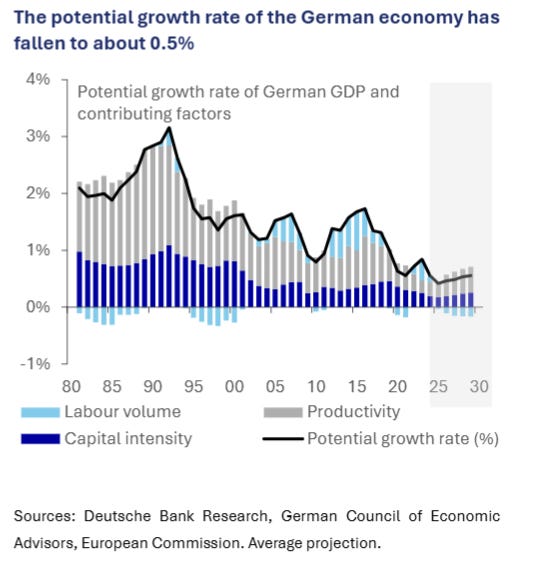
The economic starting point for the next federal government is extremely challenging, Deutsche Bank Research Institute said. "If the status quo were to persist, German economic growth would likely remain well below 1% per year until the end of the decade."
On Sunday, Germany’s parliamentary budget committee approved plans to increase state borrowing to bolster defense and revive growth massively.
The committee convened for an extraordinary session and backed the plans — agreed on Friday between the conservative CDU/CSU, the Social Democrats, and the Greens — sending them to parliament for adoption.
German Economic Sentiment Surges on Fiscal Policy
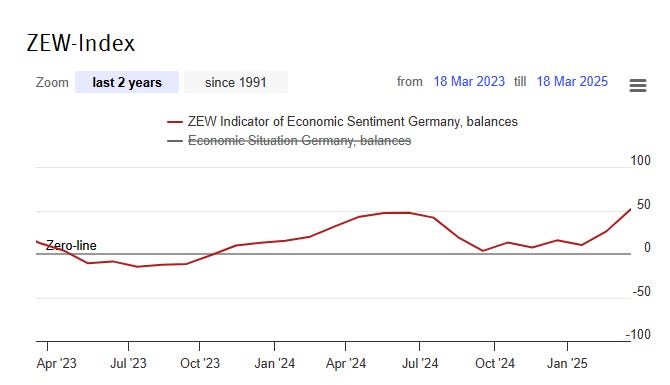
Ahead of parliament's vote, German economic sentiment expectation surged to its highest level since January 2023.
The ZEW Indicator of Economic Sentiment for March rose to 51.6 points or 25.6 points above the previous month's reading. The last time the indicator increased this substantially was in January 2023.
Source: ZEW
"The brighter mood is likely due to positive signals regarding the future German fiscal policy," including the multi-billion-euro financial package for the federal budget, ZEW President Achim Wambach said on Tuesday. "Prospects for metal and steel manufacturers as well as the mechanical engineering sector have improved"
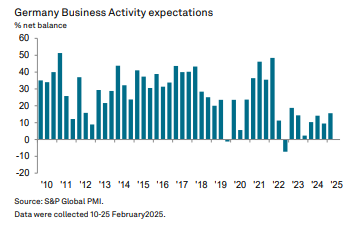
On March 12, the S&P Global Business Outlook survey showed a slight improvement in the mood among Germany’s businesses during the first quarter of the year. "Optimism has returned to the country’s manufacturers," S&P Global said.
"Still, growth forecasts were subdued, amid a backdrop of geopolitical tensions," S&P Global said. Firms predicted sustained strong cost pressures and, as such, cited plans to reduce workforces amid concerns over competitiveness, it said.
Germany Faces Strong Headwinds Despite Fiscal Change
Germany still faces considerable headwinds. These include, among other things, an aging population, high energy costs, weak productivity, and China’s emergence as an industrial rival.
Gross domestic product contracted 0.2% in 2024, according to data from the Federal Statistical Office (Destatis). Investments fell by 2.7% in the 4th quarter, compared with the same quarter a year earlier, Destatis said.
Analysts have questioned Germany's commitment to fiscal reform and defense spending. They point to the €100 billion of the €500 billion allocated to climate change rather than increasing power supplies.
"Instead of reopening its nuclear power plants, Germany will vote today to spend another €100 billion for green fairytale projects," Michael A. Arouet, an economy, politics and investing analyst, wrote on X. "One could not make it up."
After the parliament's decision, Arouet wrote: "RIP German industry."
Disclaimer:
Any opinions expressed in this article are not to be considered investment advice and are solely those of the authors. European Capital Insights is not responsible for any financial decisions made based on the contents of this article. Readers may use this article for information and educational purposes only.
This article is from an unpaid external contributor. It does not represent Benzinga’s reporting and has not been edited for content or accuracy.
© 2026 Benzinga.com. Benzinga does not provide investment advice. All rights reserved.