In today's rapidly changing and fiercely competitive business landscape, it is essential for investors and industry enthusiasts to thoroughly analyze companies. In this article, we will conduct a comprehensive industry comparison, evaluating Merck & Co MRK against its key competitors in the Pharmaceuticals industry. By examining key financial metrics, market position, and growth prospects, we aim to provide valuable insights for investors and shed light on company's performance within the industry.


Merck & Co Background
Merck makes pharmaceutical products to treat several conditions in a number of therapeutic areas, including cardiometabolic disease, cancer, and infections. Within cancer, the firm's immuno-oncology platform is growing as a major contributor to overall sales. The company also has a substantial vaccine business, with treatments to prevent pediatric diseases as well as human papillomavirus, or HPV. Additionally, Merck sells animal health-related drugs. From a geographical perspective, just under half of the company's sales are generated in the United States.
| Company | P/E | P/B | P/S | ROE | EBITDA (in billions) | Gross Profit (in billions) | Revenue Growth |
|---|---|---|---|---|---|---|---|
| Merck & Co Inc | 895.93 | 7.71 | 5.44 | 11.87% | $6.95 | $11.7 | 6.71% |
| Novo Nordisk A/S | 44.59 | 34.78 | 16.07 | 22.01% | $28.51 | $55.85 | 36.95% |
| Novartis AG | 24.16 | 4.34 | 4.44 | 19.99% | $4.18 | $8.75 | 7.39% |
| AstraZeneca PLC | 32.04 | 4.83 | 4.16 | 2.52% | $2.67 | $9.72 | 4.63% |
| Zoetis Inc | 36.19 | 16.86 | 9.93 | 12.28% | $0.9 | $1.51 | 7.44% |
| GSK PLC | 13.67 | 4.98 | 2.22 | 2.64% | $1.78 | $5.63 | -1.17% |
| Takeda Pharmaceutical Co Ltd | 38.10 | 1 | 1.62 | -0.69% | $202.28 | $699.51 | 4.07% |
| Viatris Inc | 7.92 | 0.69 | 0.94 | 1.59% | $1.22 | $1.69 | -3.34% |
| Dr Reddy's Laboratories Ltd | 19.80 | 3.86 | 3.81 | 5.29% | $22.42 | $42.2 | 6.57% |
| Jazz Pharmaceuticals PLC | 146.78 | 2.20 | 2.24 | 4.19% | $0.33 | $0.87 | 3.35% |
| Average | 40.36 | 8.17 | 5.05 | 7.76% | $29.37 | $91.75 | 7.32% |
Through an analysis of Merck & Co, we can infer the following trends:
-
Notably, the current Price to Earnings ratio for this stock, 895.93, is 22.2x above the industry norm, reflecting a higher valuation relative to the industry.
-
The current Price to Book ratio of 7.71, which is 0.94x the industry average, is substantially lower than the industry average, indicating potential undervaluation.
-
The Price to Sales ratio of 5.44, which is 1.08x the industry average, suggests the stock could potentially be overvalued in relation to its sales performance compared to its peers.
-
The company has a higher Return on Equity (ROE) of 11.87%, which is 4.11% above the industry average. This suggests efficient use of equity to generate profits and demonstrates profitability and growth potential.
-
The company has lower Earnings Before Interest, Taxes, Depreciation, and Amortization (EBITDA) of $6.95 Billion, which is 0.24x below the industry average. This potentially indicates lower profitability or financial challenges.
-
The gross profit of $11.7 Billion is 0.13x below that of its industry, suggesting potential lower revenue after accounting for production costs.
-
The company's revenue growth of 6.71% is significantly lower compared to the industry average of 7.32%. This indicates a potential fall in the company's sales performance.
Debt To Equity Ratio

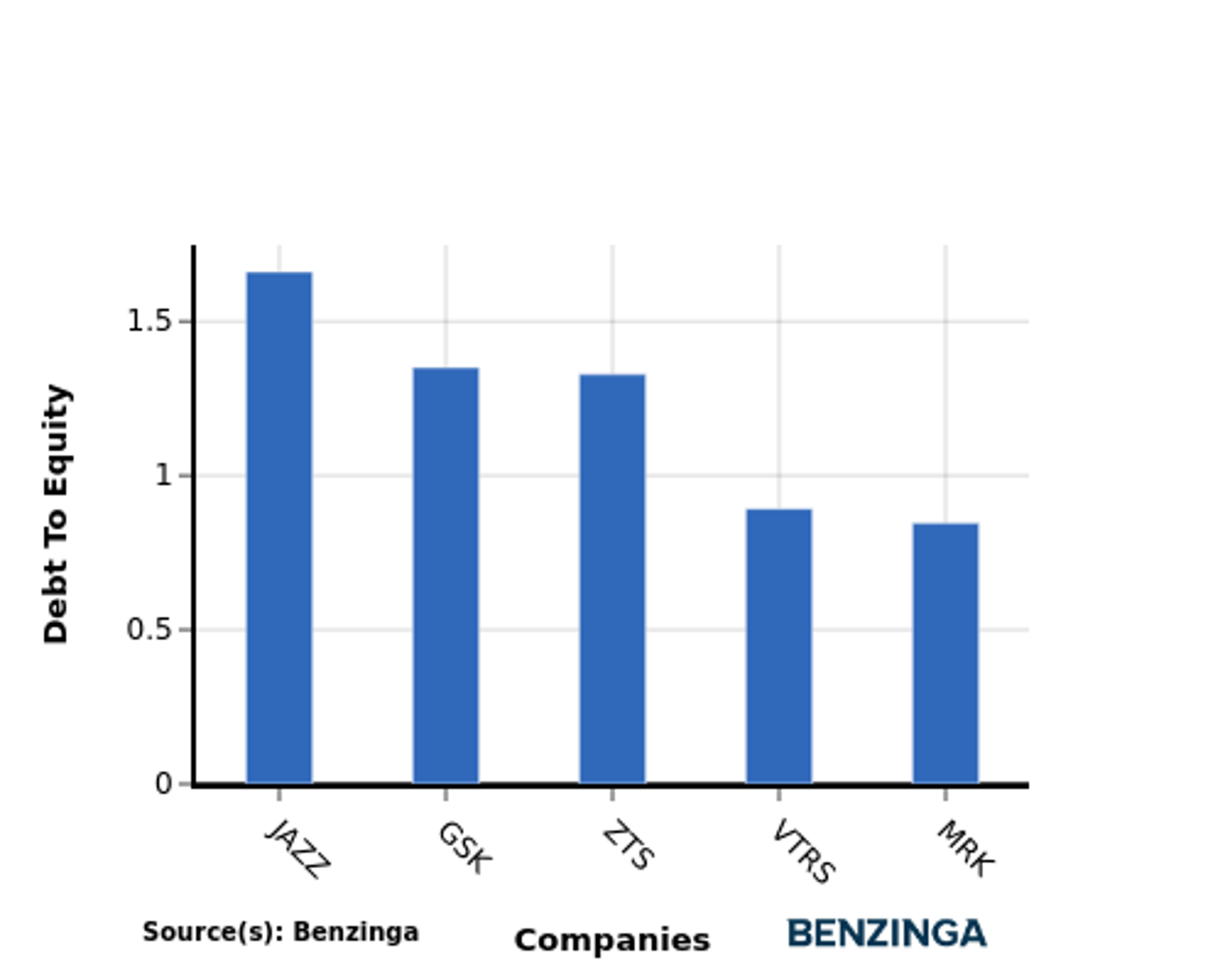
The debt-to-equity (D/E) ratio assesses the extent to which a company relies on borrowed funds compared to its equity.
Considering the debt-to-equity ratio in industry comparisons allows for a concise evaluation of a company's financial health and risk profile, aiding in informed decision-making.
In terms of the Debt-to-Equity ratio, Merck & Co stands in comparison with its top 4 peers, leading to the following comparisons:
-
Compared to its top 4 peers, Merck & Co has a stronger financial position indicated by its lower debt-to-equity ratio of 0.85.
-
This suggests that the company relies less on debt financing and has a more favorable balance between debt and equity, which can be seen as a positive attribute by investors.
Key Takeaways
The high PE ratio of Merck & Co suggests that the company is trading at a premium compared to its peers in the Pharmaceuticals industry. The low PB ratio indicates that the stock is undervalued based on its book value. The high PS ratio implies that investors are willing to pay a higher price for each dollar of sales generated by the company.
On the other hand, the high ROE suggests that Merck & Co is efficiently utilizing its shareholders' equity to generate profits. The low EBITDA indicates lower operating profitability compared to its peers. The low gross profit suggests that the company has lower profitability after deducting the cost of goods sold. The low revenue growth indicates slower growth compared to its industry peers.
This article was generated by Benzinga's automated content engine and reviewed by an editor.
Edge Rankings
Price Trend
© 2025 Benzinga.com. Benzinga does not provide investment advice. All rights reserved.
Trade confidently with insights and alerts from analyst ratings, free reports and breaking news that affects the stocks you care about.