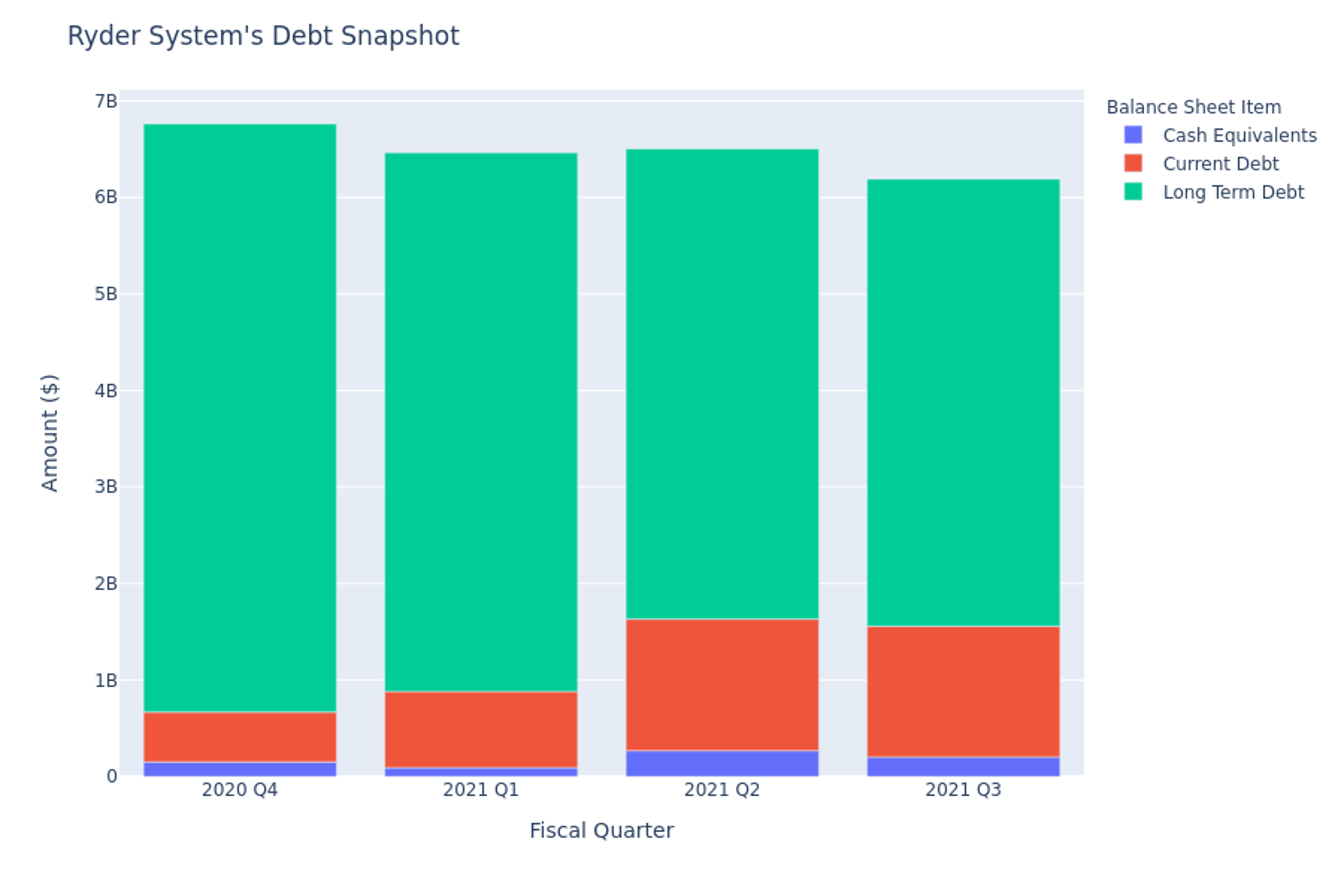
Over the past three months, shares of Ryder System (NYSE:R) rose by 3.75%. Before having a look at the importance of debt, let us look at how much debt Ryder System has.
Ryder System's Debt
According to the Ryder System's most recent balance sheet as reported on October 27, 2021, total debt is at $5.99 billion, with $4.63 billion in long-term debt and $1.35 billion in current debt. Adjusting for $202.74 million in cash-equivalents, the company has a net debt of $5.78 billion.
Let's define some of the terms we used in the paragraph above. Current debt is the portion of a company's debt which is due within 1 year, while long-term debt is the portion due in more than 1 year. Cash equivalents include cash and any liquid securities with maturity periods of 90 days or less. Total debt equals current debt plus long-term debt minus cash equivalents.
Importance Of Debt
Besides equity, debt is an important factor in the capital structure of a company, and contributes to its growth. Due to its lower financing cost compared to equity, it becomes an attractive option for executives trying to raise capital.
Interest-payment obligations can impact the cash-flow of the company. Having financial leverage also allows companies to use additional capital for business operations, allowing equity owners to retain excess profit, generated by the debt capital.
Looking for stocks with low debt-to-equity ratios? Check out Benzinga Pro, a market research platform which provides investors with near-instantaneous access to dozens of stock metrics - including debt-to-equity ratio. Click here to learn more.
© 2026 Benzinga.com. Benzinga does not provide investment advice. All rights reserved.
To add Benzinga News as your preferred source on Google, click here.