No, this isn't an exercise in irrationality. There's no question that millions of Americans are hurting, reflected in cutbacks on dining out and increased expenditures on comfort foods. Naturally, such headwinds impose downstream consequences on other sectors. Further, while clothing represents a necessity, consumers in a tough environment may not necessarily go for the highest-quality offerings (which of course tend to be pricier).
To be sure, these last points aren't going to make GAP stock the greatest investment ever. But from a contrarian trader's perspective, there's a legitimate justification for a bounce-back.
Narrowing Down a Strategy for GAP Stock
While it's possible that investors may be discounting the positives that Gap offers, it's admittedly an extraordinary claim on my part to suggest that, based on the above opinion, GAP stock is compellingly mispriced. I'm almost certainly not the first person to notice these positives, so that can't be the main reason for my bullishness. Instead, I'm relying on the quantitative argument.
Quantitative traders or quants at the core think in terms of conditional logic: What is the probability of B given that A has occurred? This statement is mathematically expressed as P(B|A) and it's the foundation of empirical analysis of the financial markets.
As powerful as this methodology is, one of the missteps (in my opinion) is that quants tend to conduct the conditional logic on either the share price or its many derivatives (such as percentage gain or loss). However, the share price is an unbounded continuous signal, meaning that it can theoretically rise forever and that there's no way to objectively categorize it (i.e. a "good" price or a "bad" price).
Given the limitations, it's arguably better to compress the price action into the first-order principles of market breadth or sequences of accumulative and distributive sessions. This answers the root question: was the market a net buyer or net seller of the security at hand? By examining the foundation of demand, we can segregate chaotic price discovery into distinct behavioral states.
Conducting the above exercise across rolling 10-week intervals for GAP stock reveals the following demand profile:
In the trailing two months, GAP stock is printing a "6-4-D" sequence: six up weeks, four down weeks, with a negative trajectory across the 10-week period. It's a relatively rare sequence, having materialized only 21 times since January 2019. Part of what makes it distinct is that the trajectory is negative despite the balance of accumulative sessions outweighing distributive.
Still, the biggest takeaway from an options trading perspective is the conditional probability. If the 6-4-D flashes, the following week's price action tends to rise 61.9% of the time. Further, the median return under this positive pathway is 3.8%.
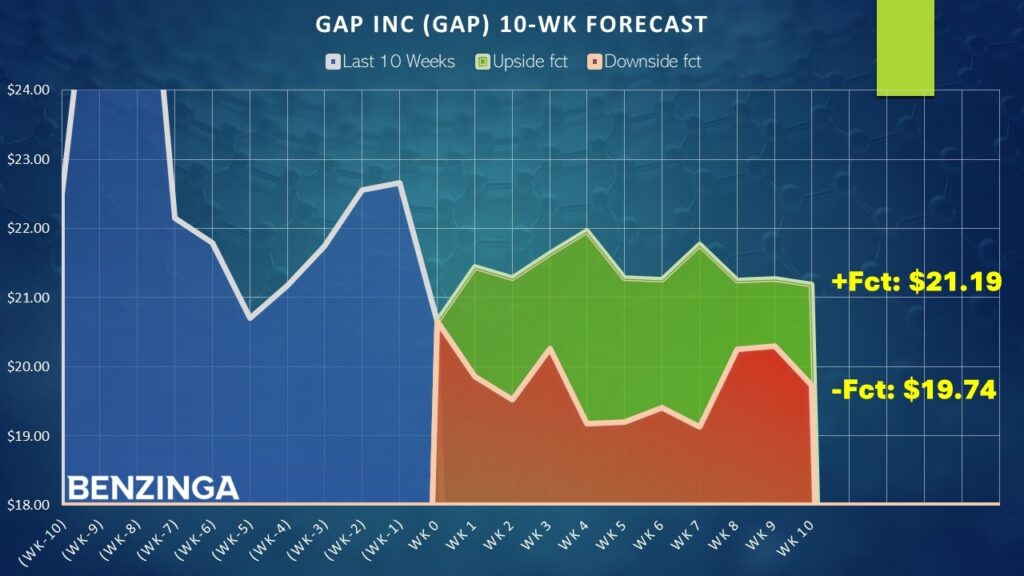
Based on the price at the time of writing, GAP stock could potentially rise to $21.45 within a week or two. Should the bulls maintain control of the market over the next four weeks, a push toward the $22 level isn't out of the question.
Playing the Contrarian Game the Smart Way
Armed with the market intelligence above, aggressive speculators may consider the 20/22 bull call spread expiring Aug. 15. This transaction involves buying the $20 call and simultaneously selling the $22 call, for a net debit paid of $$97 (the most that can be lost in the trade). Should GAP stock rise through the short strike price ($22) at expiration, the maximum reward is $103, a payout of just over 106%.
What makes this trade attractive is that market makers are unlikely to anticipate a rebound. As a baseline, GAP stock suffers from a negative bias. On any given week (since January 2019), the chance that a long position will be profitable is only 49.42%. Therefore, the statistical response to the 6-4-D sequence implies that the bullish trader is receiving 12.48 percentage points of favorable odds.
That said, it's important to realize that we're talking about probabilities, not certainties. GAP stock is historically risky. In addition, the market being an open system means that outside influences can easily disrupt the paradigm. Still, the above quantitative approach provides an empirical framework, thus helping crystallize the decision-making process.
Read Next:
Photo: Shutterstock
© 2026 Benzinga.com. Benzinga does not provide investment advice. All rights reserved.
To add Benzinga News as your preferred source on Google, click here.