In a world where most of the infrastructure behind processes, applications, and agreements relies on centralized entities, smart contracts are a novel concept that fosters trust and removes the need for an intermediary between parties. We believe that these attributes give smart contracts the ability to carve a path forward toward a new digital framework that disrupts industries like financial services, software, and many others.
Key Takeaways
Smart Contracts Expand Blockchain Technology’s Use Cases
At their core, smart contracts are programs that automate the execution of an agreement so that all participants can be immediately sure of the outcome without any intermediary’s involvement or time delay. These contracts can be deployed to the network by any user and the rules and conditions embedded in their code dictates how they run.
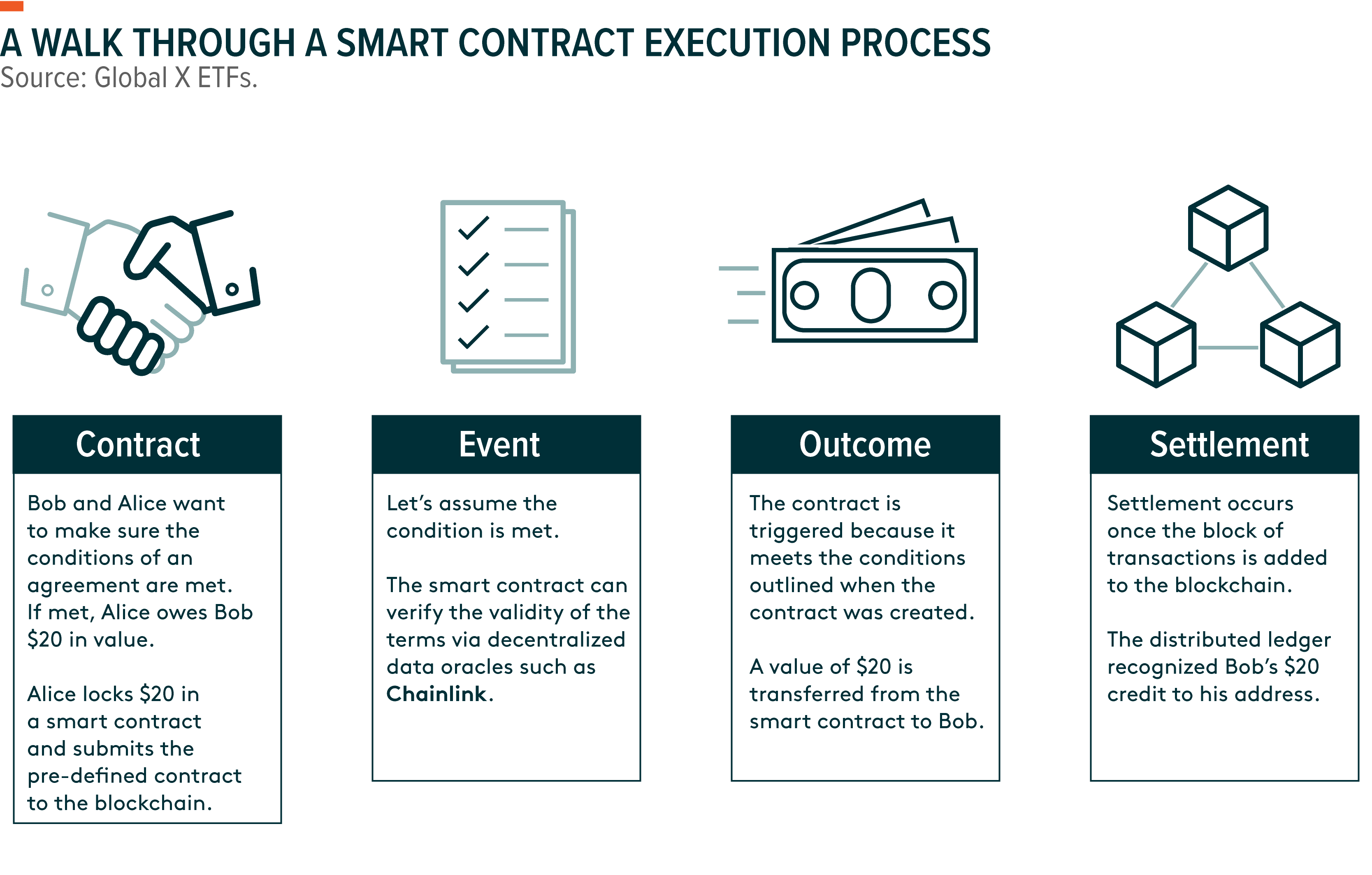
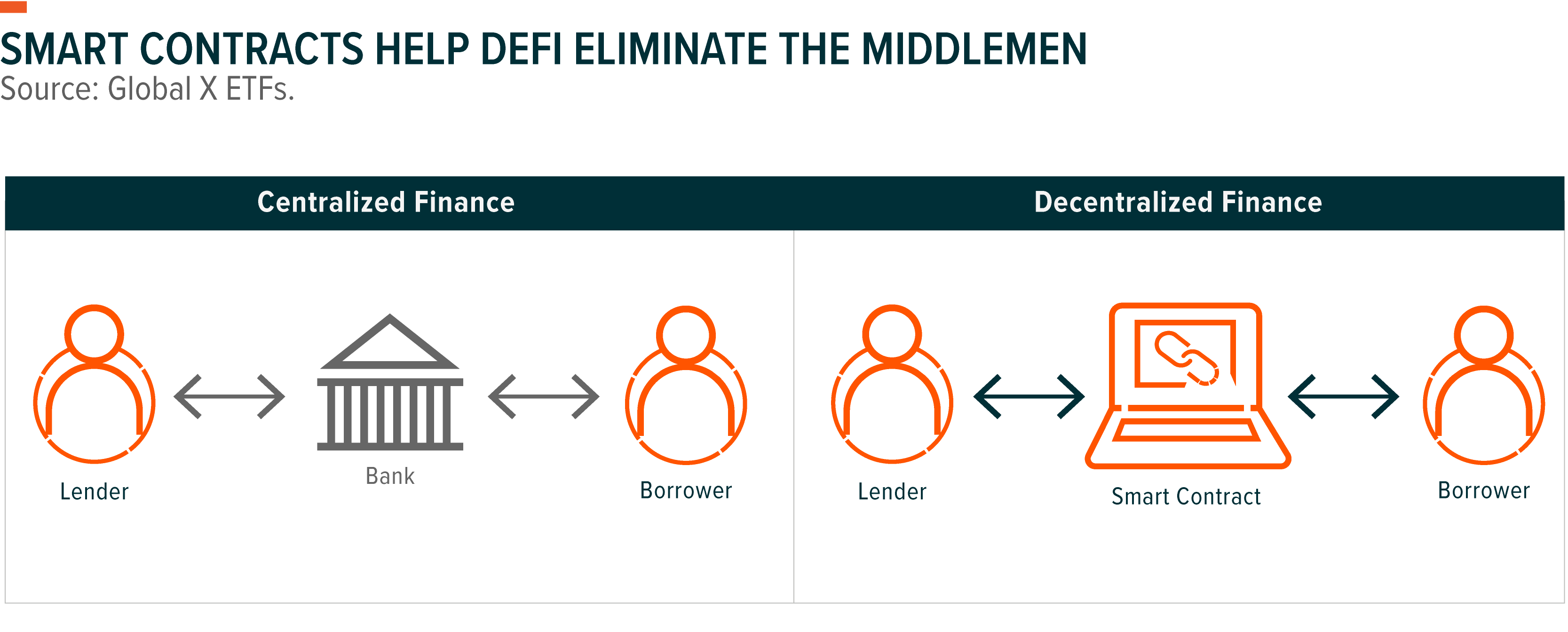
To illustrate smart contracts in action, let us assume two individuals want to make sure the conditions of an agreement are met. Historically, the participants would have to trust an outside third party to execute the terms agreed upon. Smart contracts offer a solution that ensures execution while eliminating the middlemen. In the example illustrated below, we highlight the mechanics of a smart contract using a scenario between Bob and Alice.
This scenario between Bob and Alice is a basic example, but it gets to the essence of smart contracts. A smart contract is a collection of code and data that resides on a distributed ledger network and is meant to execute pre-defined conditions. The main attributes of smart contracts hosted by blockchain ecosystems are:
Smart contracts provide a more efficient and enhanced mechanism of agreement, transaction, and general value transfer. In addition, because smart contracts can execute any special-purpose task, they comprise the foundation of a dapp movement that we view as potentially transformative.
Dapps: Where Smart Contracts and User Interface Intersect
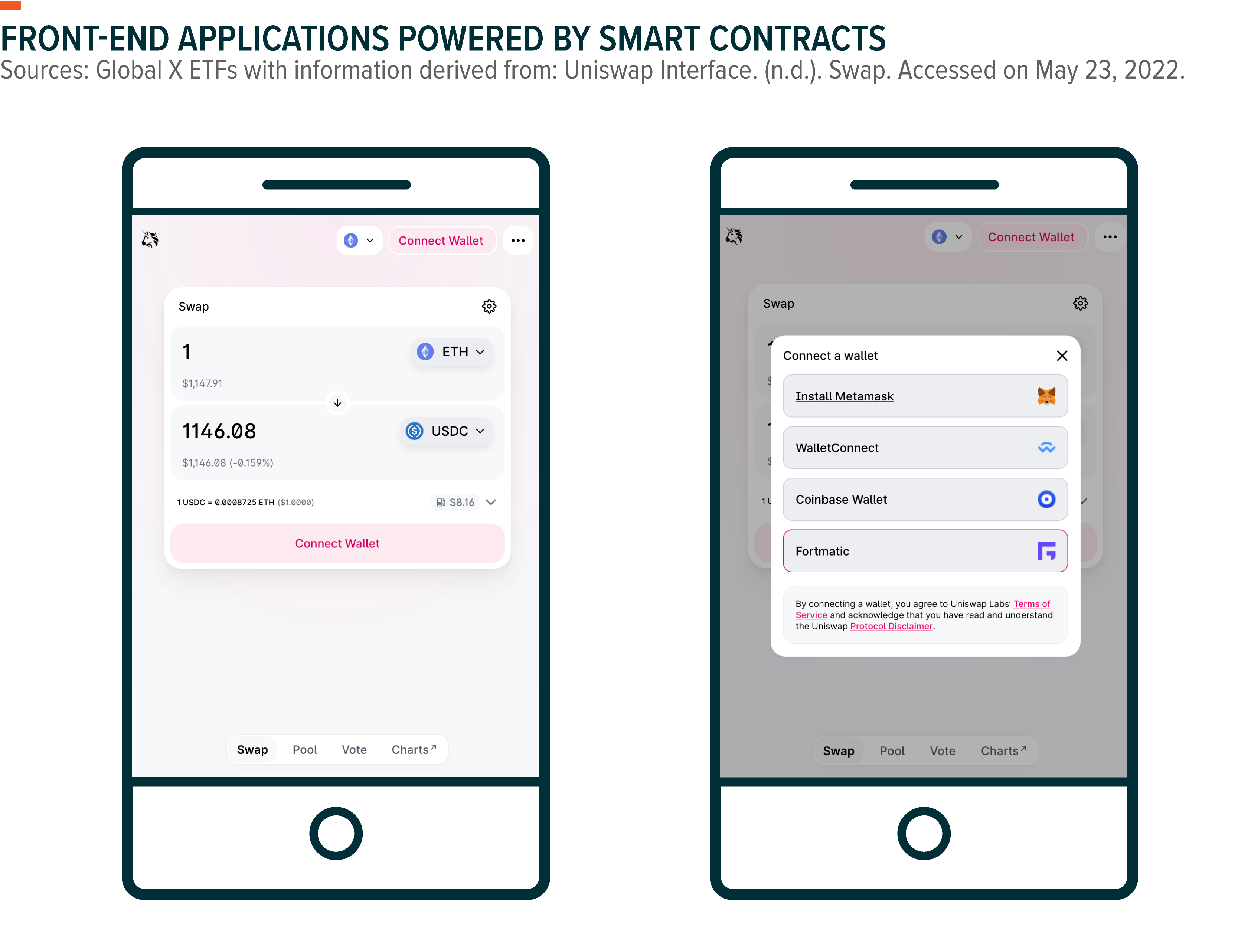
Because smart contracts live within the distributed blocks of transactions, they are completely programmable. Any developer can attach an intuitive and simplified front-end display.
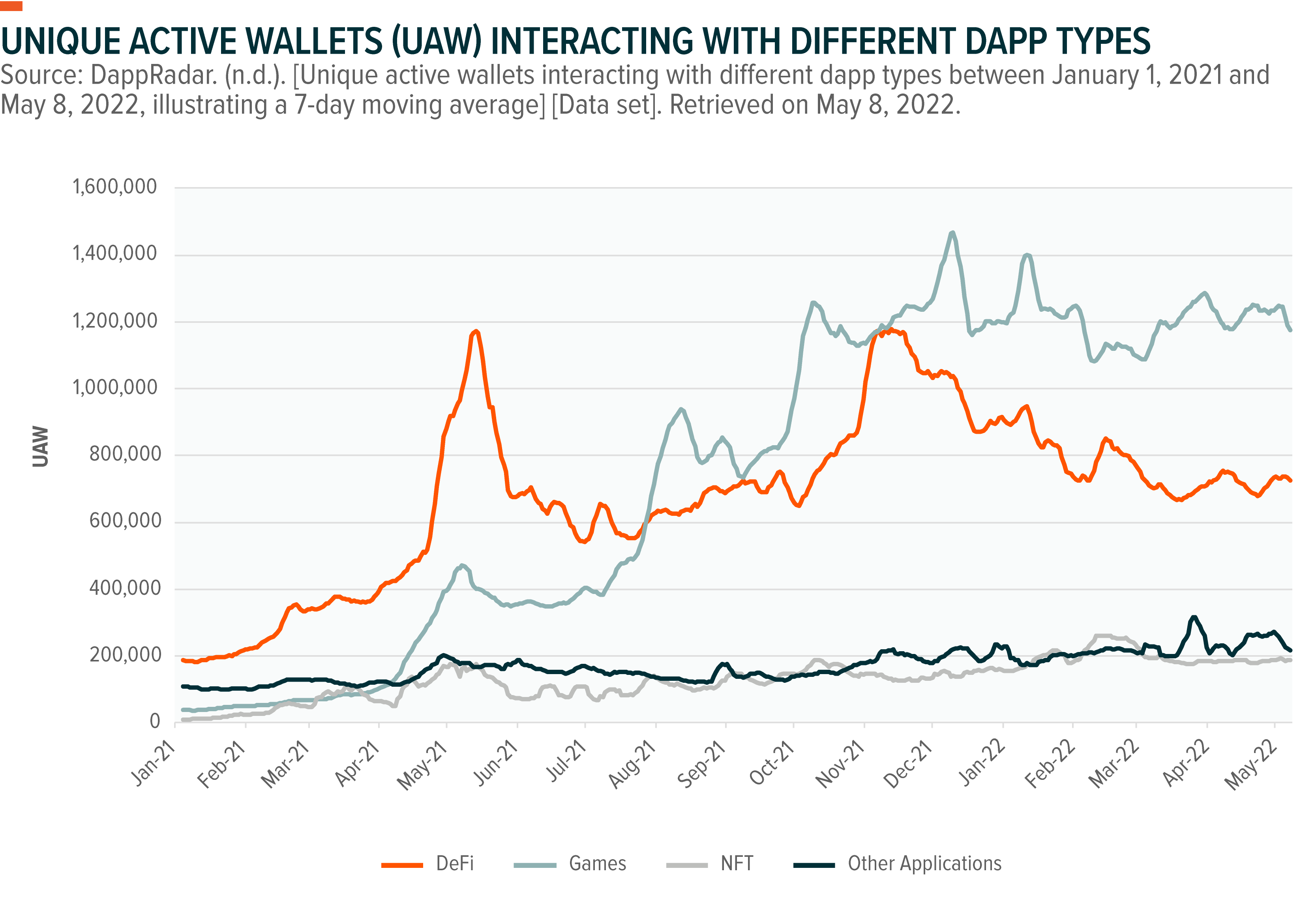
Dapps come in different shapes and sizes, with financial services applications, non-fungible trading (NFT) trading, and gaming being some of the most prominent categories.
Today, roughly 152,000 smart contracts power about 11,000 dapps. Roughly 1.7 million unique users engage with these dapps daily, executing about 28.5 million transactions with an estimated total incoming value of $6.6 billion per day.2
As dapps benefit from the robustness of distributed ledger networks and the programming flexibility and low cost of smart contracts, we believe that they could redefine the paradigm of how applications are developed, paving the way towards a user-owned Web3 ecosystem.
Smart Contracts and Their Applications Have the Potential to Disrupt Multiple Sectors
The Continued “Software-ization” of Finance
The Monetization of Gaming and E-Sports
The total gaming market is estimated to reach $257 billion by 2025.7 Today, play-and-earn applications have a total market cap of around $6.9 billion which highlights the infancy of the technology in such a growing sector.8 Due to the rise of e-sports, in-game tokenomics, and Web3’s ability to monetize digital value, we expect the space to continue to grab attention from traditional gamers and developers.
The Decentralization of the Internet & A Shift Towards Web3
The Tokenization of Everything
Smart contracts allow for the tokenization of everything, including real estate, experiences, ownership rights to real-world assets, intellectual property, content creation, and credentials. These tokens can be split into non-fungible tokens (NFTs) and fungible tokens. NFTs differ from fungible tokens in that they are not identical to each other and thus include an immutable record that links a unique asset to a specific address.
NFTs can represent the deed to a property, verifiable credentials, a sports contract, unique tickets, and exclusive passes. An NFT could also represent a medical record. Luxury items and the counterfeit market offer another use case. Manufacturers and consumers could validate the authenticity of goods through blockchain technology via unique digital identities powered by smart contracts.
Other Areas of Disruption
The beauty of smart contracts is that their programmable logic can be used to trigger disruption to traditional sectors and power many other applications. These include supply chain enhancements, on-chain data access and storage, financial auditing, cybersecurity, insurance, governance and voting systems, healthcare, and much more.
A Novel Infrastructure Starts to Carve Its Path
Related ETFs
BKCH: The Global X Blockchain ETF seeks to invest in companies positioned to benefit from the increased adoption of blockchain technology, including companies in digital asset mining, blockchain & digital asset transactions, blockchain applications, blockchain & digital asset hardware, and blockchain & digital asset integration.
Click the fund name above to view the fund’s current holdings. Holdings are subject to change. Current and future holdings are subject to risk.
Image sourced from Shutterstock
This post contains sponsored advertising content. This content is for informational purposes only and not intended to be investing advice.
© 2026 Benzinga.com. Benzinga does not provide investment advice. All rights reserved.
To add Benzinga News as your preferred source on Google, click here.