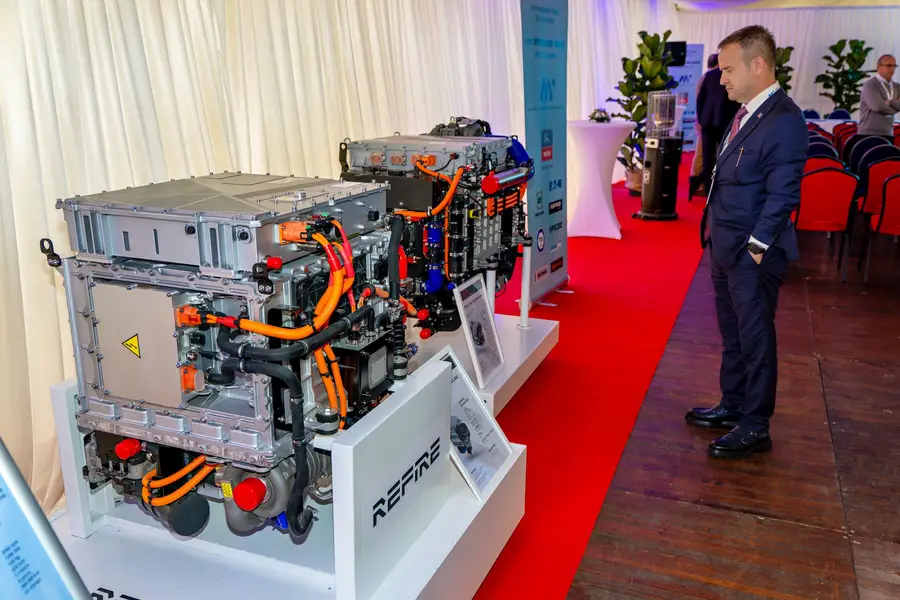
The maker of hydrogen fuel cell systems reported its revenue continued to contract in the first half of 2025, though at a lower rate than last year
Key Takeaways:
- Shanghai Refire's revenue fell about 10% in the first half of the year, improving from a 28% decline in 2024
- The company is fiscally conservative, with a gearing ratio of just 0.52 and 1 billion yuan in cash
If government policy guaranteed success, then Shanghai Refire Group Ltd. (2570.HK) would probably be among one of China's more successful companies.
But investors are growing impatient with Refire and its peers, who seem to be living off little more than China's lofty ambitions for hydrogen fuel right now.
Investors were hardly moved by Refire's latest earnings report and the wealth of hydrogen-promoting policies it contained, bidding up the stock by 1.2% on Monday. That seems to reflect rising skepticism towards the company and its peers, as investors grow impatient for some more tangible results in the form of strong revenue growth and signs of profits somewhere down the road.
None of that was present in Refire's latest report, which showed its revenue contracted by about 10% to 106.9 million yuan in the first half of this year from 118.7 million yuan a year earlier. While contraction is never good in an industry that should be expanding rapidly, we should at least point out that the latest contraction marked an improvement from last year, when the company's revenue fell 28% for all of 2024.
Within its revenue pie, sales of Refire's core hydrogen fuel cell systems more than doubled to 76.8 million yuan from 31.8 million yuan a year earlier, accounting for 72% of revenue. But again, we should point out this strong gain came after sales for that category fell by nearly half for all of 2024, showing how volatile this market is due to the experimental nature of many products.
That means if things move forward smoothly – a big "if" – perhaps we could see a larger pilot test for such buses in the next year or two. It would be several years more before anything reached the commercial phase, showing why investors may be rapidly losing patience with this technology that has been around for quite a few decades already.
Diversifying customer base
Reflecting the lack of scale for its business, Refire said its cost of sales totaled 120.4 million yuan in the first half of the year, meaning it cost more to make its products than it could sell them for. It helped to defray some of those costs with the government grants we previously mentioned, though a company can hardly depend on such largess indefinitely.
In a slightly encouraging sign, the company said that the number of individual customers accounting for 10% or more of its revenue rose to four in the first half of the year from just one a year ago. That seems to show Refire is finding more major customers for its products, which should help to stabilize its revenue going forward.
The company didn't discuss any potential for short-term revenue growth, which means we probably shouldn't expect too much for at least the next year or two. Even a return to revenue growth wouldn't be that big news, since the company's revenue base is quite small.
Instead, the company devoted copious ink in its latest report to a slew of new Beijing initiatives unveiled in the first half of the year. Those included a "Guiding Opinions on Energy Work in 2025" document issued by the National Energy Administration (NEA), emphasizing "the need to promote the establishment of comprehensive hydrogen energy management mechanisms across various regions."
Refire also pointed out that six new locations were added to the national network of fuel cell demonstration city clusters. And if that wasn't enough to excite investors, it also disclosed the formation of a new national venture capital fund targeting cutting-edge technologies like hydrogen energy storage; as well as the NEA's release of a plan to select specific projects and regions for hydrogen energy pilot programs.
"As China continues to advance its hydrogen energy industry policies, actively integrate hydrogen energy into the national energy management system, and improve the development environment, the entire ‘production, storage, transportation, and application' industrial chain is poised to enter a phase of rapid growth," the company said.
Which way these stocks go next will probably depend on progress towards commercialization rather than announcements of new government policies. Failure to deliver some solid double-digit revenue growth in the next few quarters could significantly dampen investor enthusiasm, draining more value from Refire's shares.
Benzinga Disclaimer: This article is from an unpaid external contributor. It does not represent Benzinga’s reporting and has not been edited for content or accuracy.
© 2026 Benzinga.com. Benzinga does not provide investment advice. All rights reserved.
To add Benzinga News as your preferred source on Google, click here.