Benzinga

España
Italia
대한민국
日本
Français
Benzinga Edge
Benzinga Research
Benzinga Pro

  • Get Benzinga Pro
  • Data & APIs
  • Events
  • Premarket
  • Advertise
Contribute
España
Italia
대한민국
日本
Français

Benzinga

  • Premium Services
  • Financial News
    Latest
    Earnings
    Guidance
    Dividends
    M&A
    Buybacks
    Interviews
    Management
    Offerings
    IPOs
    Insider Trades
    Biotech/FDA
    Politics
    Healthcare
    Small-Cap
  • Markets
    Pre-Market
    After Hours
    Movers
    ETFs
    Options
    Cryptocurrency
    Commodities
    Bonds
    Futures
    Mining
    Real Estate
    Volatility
  • Ratings
    Analyst Color
    Downgrades
    Upgrades
    Initiations
    Price Target
  • Investing Ideas
    Trade Ideas
    Long Ideas
    Short Ideas
    Technicals
    Analyst Ratings
    Analyst Color
    Latest Rumors
    Whisper Index
    Stock of the Day
    Best Stocks & ETFs
    Best Penny Stocks
    Best S&P 500 ETFs
    Best Swing Trade Stocks
    Best Blue Chip Stocks
    Best High-Volume Penny Stocks
    Best Small Cap ETFs
    Best Stocks to Day Trade
    Best REITs
  • Money
    Investing
    Cryptocurrency
    Mortgage
    Insurance
    Yield
    Personal Finance
    Forex
    Startup Investing
    Real Estate Investing
    Prop Trading
    Credit Cards
    Stock Brokers
Research
My Stocks
Tools
Free Benzinga Pro Trial
Calendars
Analyst Ratings Calendar
Conference Call Calendar
Dividend Calendar
Earnings Calendar
Economic Calendar
FDA Calendar
Guidance Calendar
IPO Calendar
M&A Calendar
Unusual Options Activity Calendar
SPAC Calendar
Stock Split Calendar
Trade Ideas
Stock Reports
Insider Trades
Trade Idea Feed
Analyst Ratings
Unusual Options Activity
Heatmaps
Free Newsletter
Government Trades
Perfect Stock Portfolio
Easy Income Portfolio
Short Interest
Most Shorted
Largest Increase
Largest Decrease
Calculators
Margin Calculator
Forex Profit Calculator
100x Options Profit Calculator
Screeners
Stock Screener
Top Momentum Stocks
Top Quality Stocks
Top Value Stocks
Top Growth Stocks
Compare Best Stocks
Best Momentum Stocks
Best Quality Stocks
Best Value Stocks
Best Growth Stocks
Connect With Us
facebookinstagramlinkedintwitteryoutubeblueskymastodon
About Benzinga
  • About Us
  • Careers
  • Advertise
  • Contact Us
Market Resources
  • Advanced Stock Screener Tools
  • Options Trading Chain Analysis
  • Comprehensive Earnings Calendar
  • Dividend Investor Calendar and Alerts
  • Economic Calendar and Market Events
  • IPO Calendar and New Listings
  • Market Outlook and Analysis
  • Wall Street Analyst Ratings and Targets
Trading Tools & Education
  • Benzinga Pro Trading Platform
  • Options Trading Strategies and News
  • Stock Market Trading Ideas and Analysis
  • Technical Analysis Charts and Indicators
  • Fundamental Analysis and Valuation
  • Day Trading Guides and Strategies
  • Live Investor Events
  • Pre-market Stock Analysis and News
  • Cryptocurrency Market Analysis and News
Ring the Bell

A newsletter built for market enthusiasts by market enthusiasts. Top stories, top movers, and trade ideas delivered to your inbox every weekday before and after the market closes.

  • Terms & Conditions
  • Do Not Sell My Personal Data/Privacy Policy
  • Disclaimer
  • Service Status
  • Sitemap
© 2026 Benzinga | All Rights Reserved
August 9, 2014 7:52 PM 7 min read

Micro-Structure & Exchanges: The Relationship Is "Complicated"

by Garrett Cook
Follow

This past Tuesday night news hit that BATS Global Markets was in the process of settling with the SEC on the claim that Direct Edge provided unfair perks to certain high frequency traders (HFT), a development that might set a pivotal precedent in the market structure debate. News of the possible settlement was preceded by the departure of William O’Brien who ran Direct Edge with its twin exchanges before selling it to BATS in early 2014, becoming the second-in-command of the combined entity.

In an effort to challenge Brad Katsuyama of the Flash Boys fame live on TV, O’Brien stated that his exchange’s matching engine (used to match buy and sell orders) used direct feeds provided by other exchanges. However Direct Edge’s matching system used staler data from the SIP (securities information processor) - not the direct feeds - for several important housekeeping tasks. In a spectacular public relations failure, the NY Attorney General forced BATS to publicly correct O’Brien’s statements.

One person in the mix who may have not been remembered is Haim Bodek. After coming out publicly in Scott Patterson’s Dark Pools as a critic of exchanges that cater to HFT, Haim was on a one-man crusade to save his reputation by making a convincing case against the HFT industry. In the end, he wound up triggering SEC investigations that (so far) led to an exchange head being forced to step down. For those unaware, Haim was also the real star of the VPRO film Wall Street Code. In the film Haim used the example of skipping in line while buying Metallica concert tickets:

In a phone conversation with Benzinga, Haim noted this (yet to be announced) settlement would set precedent for future concerns about abuses taking place on securities exchanges.  Direct Edge wasn’t the only exchange nor the first exchange to do what it did, which was the creation of symbiotic relationships between exchanges and HFTs.  

In light of the major events that took place over the past year, aside from announced investigations by the SEC and NYAG, the recent actions taken by US exchanges are suspect, whether they are attempts to engage in damage control or to sweep some things under the rug.
 
Select Microstructure-Related Events
 
2012 was a year riddled with HFT problems. BATS IPO failure, Facebook launch delayed, seven or eight instances of self-help declarations by several exchanges in August, Nasdaq’s three-hour outage in August, Goldman’s trading glitch, Knight’s trading glitch (affectionately known as the “Knightmare on Wall Street"), and the unprecedented $5M fine imposed on NYSE for speeding up its private data feeds vis-a-vis the SIP.  The problems with automation and the systematic issues tied to an unfair playing field couldn’t have been more evident than they were in 2012 (except for 2013 and 2014, that is).  Nasdaq’s outage specifically was driven by a message overload problem. Every time the exchanges expanded the capabilities of their systems to handle higher message rates, HFT would fill the systems back to capacity immediately.  
 
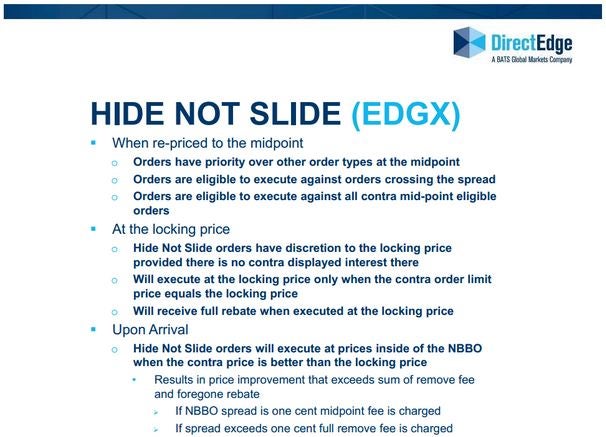
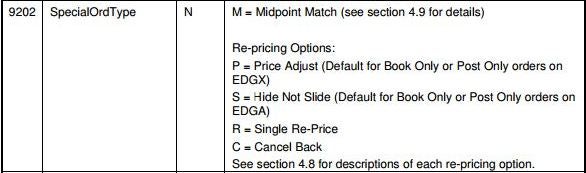
Right now, Direct Edge is in a difficult position considering that for years the exchange identified Hide-Not-Slide, Pegged and Non-Pegged, Displayed and Non-Displayed options as order types (original doc here):
 
 
From the Direct Edge Order-Type Guide (full doc here)
 
Market News and Data brought to you by Benzinga APIs

© 2026 Benzinga.com. Benzinga does not provide investment advice. All rights reserved.

To add Benzinga News as your preferred source on Google, click here.

Posted In:
EducationTopicsTop StoriesHotGeneral
Beat the Market With Our Free Pre-Market Newsletter
Enter your email to get Benzinga's ultimate morning update: The PreMarket Activity Newsletter

Month

Year

Event

August 1

2012

Knight Capital $440M loss

August

2012

Goldman $100M options trading glitch with trades eventually busted

August 22

2012

Nasdaq goes dark for 3 hours (NASDARK)

September

2012

Hold Brothers Brokerage fined for "spoofing"

September

2012

The Wall Street Journal runs an in-depth article on Hide-Not-Slide order type

September

2012

NYSE sued $5M for seller faster data access to special clients

January

2013

The Problem Of HFT is released by Haim Bodek highlighting "special order types" and exchange abuses

August

2013

BATS & Direct Edge merger talks surface - Deal takes place so quickly it finishes ahead of schedule

October

2013

Direct Edge publishes its "Order Type Guide"

November

2013

Wall Street Code is released

February

2013

O'Brien misinforms the public about what Direct Edge uses to match orders

July

2014

O'Brien steps down as President of BATS Global Markets

July 28-29

2014

All US equity exchanges adopt rules on the usage of SIP and direct feeds

August 1

2014

Euronext CEO steps down

August 5

2014

Information about a possible settlement with BATS relating to special order types is reported
 
In the 114-page document the exchange wants those orders redefined to be “characteristics”. That’s a major change, and, interestingly, the announcement about William O’Brien stepping down as President at BATS came less than a week after this proposal was filed with the regulators.  It is odd that his exchange would wait so long to clarify what order-types are and what characteristics are. But there’s more.
 
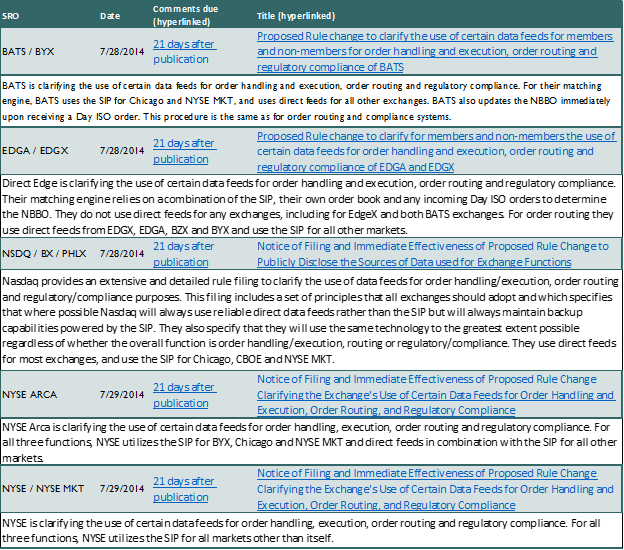
Just a few days later, the SEC approved the rules submitted by all eleven equity exchanges chiefly addressing the usage of data feeds, a pivotal issue that is exemplified by the televised clash between Katsuyama and O’Brien. The regulators explicitly requested these rules in the first place, which explains this flurry of filings and their immediate approval via the “immediate effectiveness” option, but the fact that this ambiguity had lingered on for so long is significant.
 
KOR Trading Visualization of Filings With Descriptions
 
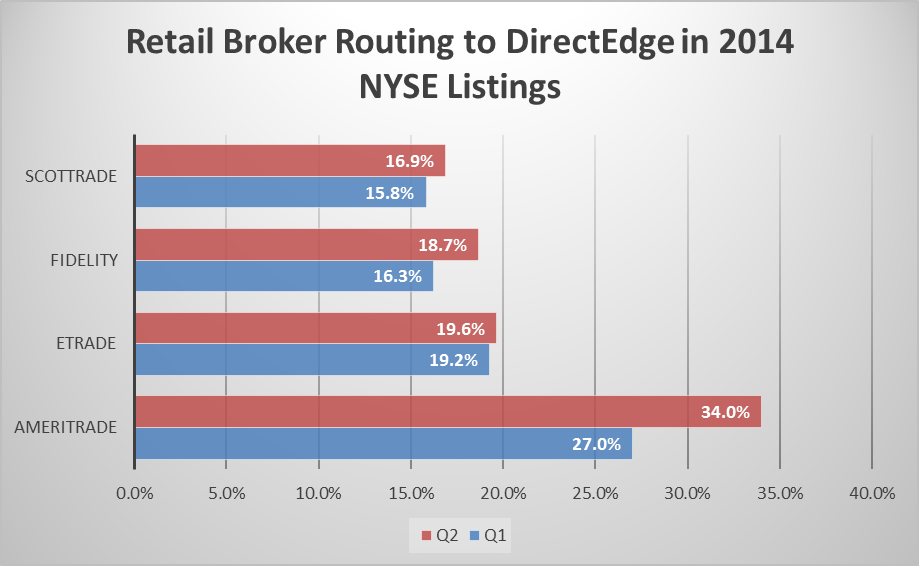
Kor Trading offers statistical analysis an visualized breakdown of key filings from exchanges and brokerages.  The Group covered the complexity of Direct Edge’s routing structure in an article published on August 7. KOR addresses the retail broker routing growth to Direct Edge for NYSE listings in Q1 and Q2 of 2014:
 
 
In 2012, while appearing on Pimm Foxx’s show, O’Brien said he “actively embraced greater government regulation”.  One must wonder how many other exchanges went - and to what extent - to please their HFT clients only to file documentation clarifying what goes on their exchanges only months after Flash Boys made headlines.  Something smells fishy.  
 
Comments
Loading...