In today's rapidly changing and highly competitive business world, it is vital for investors and industry enthusiasts to carefully assess companies. In this article, we will perform a comprehensive industry comparison, evaluating Salesforce (NYSE:CRM) against its key competitors in the Software industry. By analyzing important financial metrics, market position, and growth prospects, we aim to provide valuable insights for investors and shed light on company's performance within the industry.
Salesforce Background
Salesforce Inc provides enterprise cloud computing solutions. The company offers customer relationship management technology that brings companies and customers together. Its Customer 360 platform helps the group to deliver a single source of truth, connecting customer data across systems, apps, and devices to help companies sell, service, market, and conduct commerce. It also offers Service Cloud for customer support, Marketing Cloud for digital marketing campaigns, Commerce Cloud as an e-commerce engine, the Salesforce Platform, which allows enterprises to build applications, and other solutions, such as MuleSoft for data integration.
| Company | P/E | P/B | P/S | ROE | EBITDA (in billions) | Gross Profit (in billions) | Revenue Growth |
|---|---|---|---|---|---|---|---|
| Salesforce Inc | 66.05 | 4.51 | 7.83 | 2.46% | $2.75 | $7.14 | 10.77% |
| Adobe Inc | 45.49 | 13.80 | 10.94 | 3.88% | $1.21 | $4.59 | 11.32% |
| SAP SE | 55.06 | 4.59 | 6.41 | 3.05% | $2.32 | $6.2 | 5.02% |
| Intuit Inc | 62.46 | 10.13 | 11.49 | 2.08% | $0.6 | $2.53 | 11.34% |
| Synopsys Inc | 59.70 | 12.37 | 13.70 | 7.01% | $0.53 | $1.32 | 21.15% |
| Cadence Design Systems Inc | 78.75 | 24.09 | 20.06 | 9.94% | $0.41 | $0.96 | 18.75% |
| Workday Inc | 49.44 | 8.42 | 9.41 | 16.16% | $0.24 | $1.46 | 16.75% |
| Roper Technologies Inc | 41.36 | 3.23 | 9.16 | 2.26% | $0.72 | $1.13 | 12.76% |
| Autodesk Inc | 54.47 | 26.32 | 8.97 | 16.9% | $0.35 | $1.34 | 3.89% |
| Palantir Technologies Inc | 243.11 | 13.93 | 22.60 | 2.8% | $0.11 | $0.5 | 19.61% |
| Datadog Inc | 906.64 | 20.80 | 20.89 | 2.82% | $0.07 | $0.48 | 25.62% |
| Ansys Inc | 57.03 | 5.29 | 12.58 | 5.29% | $0.37 | $0.74 | 15.99% |
| AppLovin Corp | 73.80 | 19.08 | 7.99 | 14.58% | $0.37 | $0.68 | 35.73% |
| MicroStrategy Inc | 47.53 | 10.23 | 41.92 | 5.93% | $-0.04 | $0.1 | -6.09% |
| PTC Inc | 90.27 | 7.61 | 9.81 | 2.42% | $0.16 | $0.44 | 18.09% |
| Zoom Video Communications Inc | 28.64 | 2.27 | 4.04 | 3.87% | $0.2 | $0.87 | 2.56% |
| Tyler Technologies Inc | 102.89 | 5.77 | 8.75 | 1.34% | $0.09 | $0.21 | 6.35% |
| Bentley Systems Inc | 48.91 | 16.61 | 13.24 | 22.81% | $0.05 | $0.24 | 8.26% |
| NICE Ltd | 45.30 | 4.37 | 6.45 | 2.49% | $0.19 | $0.42 | 9.61% |
| Manhattan Associates Inc | 81.91 | 51.11 | 15.57 | 19.96% | $0.06 | $0.13 | 20.27% |
| Dynatrace Inc | 67.45 | 6.89 | 9.70 | 2.3% | $0.05 | $0.3 | 22.74% |
| Average | 112.01 | 13.35 | 13.18 | 7.39% | $0.4 | $1.23 | 13.99% |
By conducting an in-depth analysis of Salesforce, we can identify the following trends:
-
At 66.05, the stock's Price to Earnings ratio is 0.59x less than the industry average, suggesting favorable growth potential.
-
With a Price to Book ratio of 4.51, significantly falling below the industry average by 0.34x, it suggests undervaluation and the possibility of untapped growth prospects.
-
With a relatively low Price to Sales ratio of 7.83, which is 0.59x the industry average, the stock might be considered undervalued based on sales performance.
-
With a Return on Equity (ROE) of 2.46% that is 4.93% below the industry average, it appears that the company exhibits potential inefficiency in utilizing equity to generate profits.
-
The company has higher Earnings Before Interest, Taxes, Depreciation, and Amortization (EBITDA) of $2.75 Billion, which is 6.88x above the industry average, indicating stronger profitability and robust cash flow generation.
-
Compared to its industry, the company has higher gross profit of $7.14 Billion, which indicates 5.8x above the industry average, indicating stronger profitability and higher earnings from its core operations.
-
The company's revenue growth of 10.77% is significantly below the industry average of 13.99%. This suggests a potential struggle in generating increased sales volume.
Debt To Equity Ratio
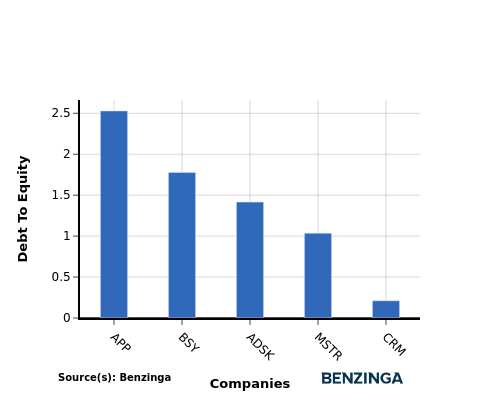
The debt-to-equity (D/E) ratio provides insights into the proportion of debt a company has in relation to its equity and asset value.
Considering the debt-to-equity ratio in industry comparisons allows for a concise evaluation of a company's financial health and risk profile, aiding in informed decision-making.
When comparing Salesforce with its top 4 peers based on the Debt-to-Equity ratio, the following insights can be observed:
-
Among its top 4 peers, Salesforce has a stronger financial position with a lower debt-to-equity ratio of 0.21.
-
This indicates that the company relies less on debt financing and maintains a more favorable balance between debt and equity, which can be viewed positively by investors.
Key Takeaways
For Salesforce, the PE, PB, and PS ratios are all low compared to its peers in the Software industry, indicating potential undervaluation. However, the low ROE suggests lower profitability compared to industry peers. On the other hand, the high EBITDA and gross profit figures reflect strong operational performance. The low revenue growth rate may be a concern for future prospects compared to industry peers.
This article was generated by Benzinga's automated content engine and reviewed by an editor.
© 2026 Benzinga.com. Benzinga does not provide investment advice. All rights reserved.
To add Benzinga News as your preferred source on Google, click here.