Editor’s note: This article was updated to add more detail and context.
U.S. producer prices jumped 1.3% month over month in September, more than double the 0.5% pace economists expected, according to Bureau of Labor Statistics data released Thursday.
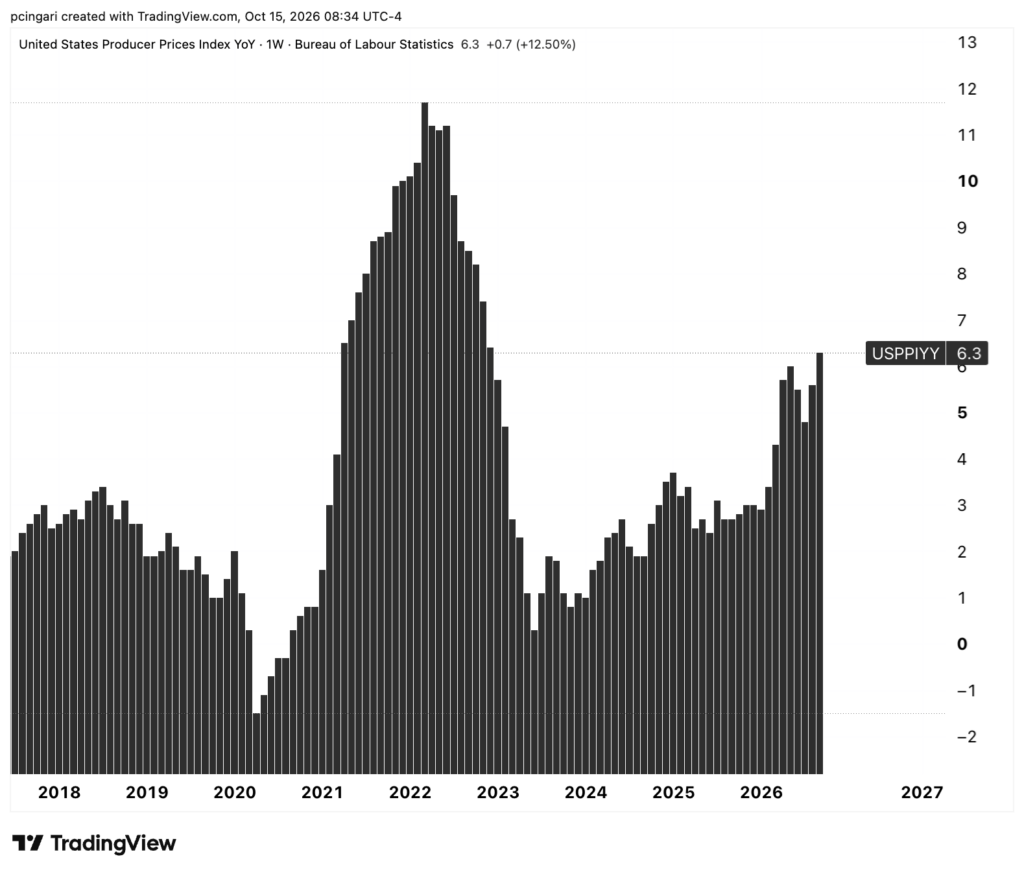
On an annual basis, headline producer inflation came in at 6.3%, sharply above the consensus estimate of 5.3% and accelerating from August’s upwardly revised 5.6%.
The outcome marks the highest annual producer inflation rate since December 2022.
Core producer prices, which exclude food and energy, rose 0.7% on the month versus 0.3% expected, while the annual core rate came in at 5%, well above the 4.4% forecast.
A narrower PPI gauge that strips out food, energy and trade services rose 0.5% on the month and 5% on the year.
The data follows Wednesday’s September consumer price index report, which showed headline inflation accelerating to 3.7% from 3.4%, above the expected 3.6%, while core consumer prices rose 0.3% on the month and 2.6% on the year, both a tenth above forecasts.
Energy Drives a Record Jump in Goods Prices
Prices for final demand goods rose 2.6% in September, the largest increase since the series began in December 2009.
More than 80% of that advance came from energy, which jumped 10.8% on the month. Gasoline prices at the producer level surged 20.3%, while diesel fuel climbed 21%.
Over the past 12 months, wholesale gasoline prices are up 64.3% and diesel prices have more than doubled, rising 115.2%.
Services prices rose 0.8%, the biggest gain since April, with trade margins up 1.4% and transportation and warehousing costs up 3.4%.
A narrower gauge that strips out food, energy and trade services rose 0.5% on the month and 5% on the year.
Retail Sales Beat, Jobless Claims Stay Low
Separately, retail sales rose 0.8% in September, well above the 0.3% expected, after an upwardly revised 1.3% gain in August.
Sales excluding autos rose 0.9%, beating the 0.5% forecast.
The control group, which feeds into GDP calculations, rose just 0.1%, below the 0.3% expected, and August’s gain was revised down to 1.2% from 1.4%.
Initial jobless claims rose to 199,000 in the week ended Oct. 10, slightly below the 200,000 expected, from an upwardly revised 198,000.
Continuing claims came in at 1.71 million, in line with forecasts, down from 1.714 million.
The four-week average was little changed at 198,500.
Market Reaction
Markets barely moved after the data, with the tech-heavy indices holding onto premarket losses.
By 8:50 a.m. ET, Nasdaq 100 futures were down 1.22% to around 29,586, S&P 500 futures slipped 0.28% to near 7,697, and Dow futures rose 0.40% to about 51,829.
Memory chip makers led the decline among Nasdaq 100 components. SanDisk Corp. (NASDAQ:SNDK), Western Digital Corp. (NASDAQ:WDC) and Seagate Technology Holdings plc (NASDAQ:STX) were down between 5% and 6% in premarket trading.
Micron Technology Inc. (NASDAQ:MU) was 4.6% lower.
The 2-year Treasury yield briefly spiked toward 4.79% after the release before easing to 4.76%.
The U.S. dollar index was flat near 101.79, gold held near $4,150 an ounce and Bitcoin (CRYPTO: BTC) traded near $80,825.
Fed futures currently assign a 33% chance of a 25-basis-point hike at Oct. 28 FOMC meeting.
Image: Shutterstock
© 2026 Benzinga.com. Benzinga does not provide investment advice. All rights reserved.
To add Benzinga News as your preferred source on Google, click here.