
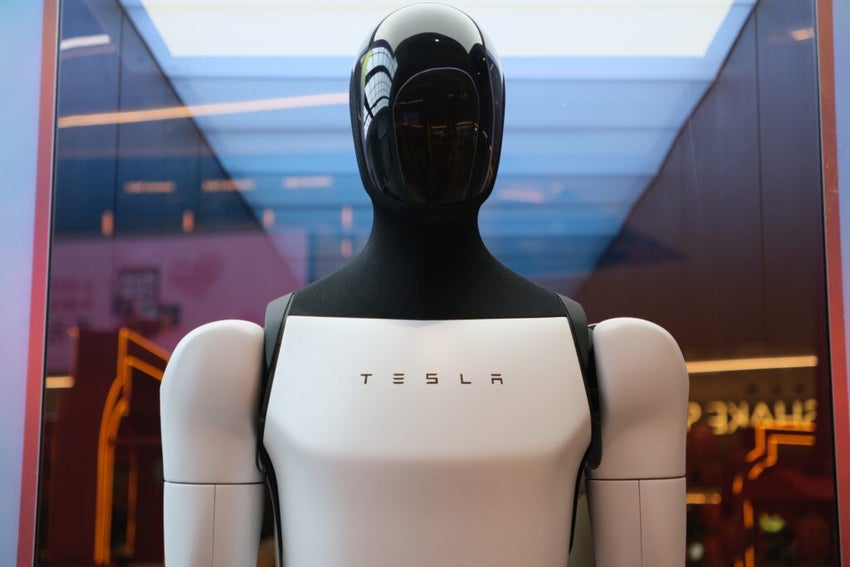
Forget Robocop. Elon Musk's vision for the future of law enforcement skips the guns and courtroom drama and jumps straight into the uncanny valley of artificial intelligence. His pitch? Give everyone a Tesla Optimus robot—not to help fold laundry, but to quietly shadow you and make sure you don't commit crimes. That's it. No prison bars, just persistent, AI-powered accountability.
"If you say, like, you now get a free Optimus and it's just gonna follow you around and stop you from doing crime, but other than that you get to do anything. It's just gonna stop you from committing crime, that's really it," Musk said at Tesla's annual shareholder meeting last month.
And he meant it.
Don't Miss:
- Missed Nvidia and Tesla? RAD Intel Could Be the Next AI Powerhouse — Just $0.85 a Share
- Deloitte's #1 Fastest-Growing Software Company Lets Users Earn Money Just by Scrolling — Accredited Investors Can Still Get In at $0.50/Share.
Before launching into the more out-there ideas, Musk acknowledged what many were already thinking: this stuff sounds wild—and yes, he knows people will clip it, spin it, and take it out of context. "Some of these things I say will obviously be taken out of context and using snippets and, you know, sitting around, but whatever. I'm still going to say them."
Musk wasn't just tossing around ideas about robot butlers or AI-powered chefs. He was floating a radical replacement for incarceration—arguably one of society's most entrenched institutions—with a walking, talking, never-blinking robot that enforces behavior in real-time.
"You don't have to put people in prisons," he added. "It's pretty wild to think of all the possibilities, but I think it's clearly the future."
Trending: An EA Co-Founder Shapes This VC Backed Marketplace—Now You Can Invest in Gaming's Next Big Platform
Let that settle in for a second. In Musk's world, the criminal justice system could shift from physical confinement to continuous digital oversight. Everyone gets their own robotic parole officer—but instead of restricting freedom, it grants nearly all of it. "You get to do anything," Musk said, "except commit crimes."
Optimus, first unveiled in 2022, is designed as a general-purpose, bi-pedal humanoid robot with autonomous capabilities. Musk has said the robot could eventually become more precise than the best human surgeon. "Optimus will ultimately be better than the best human surgeon with a level of precision that is beyond human," he claimed. But that's just one chapter in his broader sci-fi playbook.
The Tesla CEO suggested that Optimus might even help eliminate poverty by providing affordable medical care and services, all without human error. "Optimus will actually eliminate poverty. Optimus will actually give people incredible medical care."
See Also: GM-Backed EnergyX Is Solving the Lithium Supply Crisis — Invest Before They Scale Global Production
So where's this all going? Musk described his vision as "Banksian," referencing author Iain M. Banks and his "Culture" series, where AI and robots exist in a mostly utopian future. "If you're curious, like, what do I think the future is probably like? I think it's probably a bit like that," Musk said, also giving a nod to sci-fi legends Isaac Asimov and Robert Heinlein.
For those watching the bleeding edge of tech—or looking to invest in what's next—this isn't just a random off-the-cuff Musk statement. It's a signal. A world where robots serve as doctors, caretakers, and even mobile crime prevention units is no longer confined to science fiction. From AI precision in surgery to robot-assisted law enforcement, Tesla's Optimus hints at a future where entire industries could be rewritten.
Read Next: Wall Street's $12B Real Estate Manager Is Opening Its Doors to Individual Investors — Without the Crowdfunding Middlemen
Image: Shutterstock
© 2025 Benzinga.com. Benzinga does not provide investment advice. All rights reserved.


