Benzinga

España
Italia
대한민국
日本
Français
Benzinga Edge
Benzinga Research
Benzinga Pro

  • Get Benzinga Pro
  • Data & APIs
  • Events
  • Premarket
  • Advertise
Contribute
España
Italia
대한민국
日本
Français

Benzinga

  • Premium Services
  • Financial News
    Latest
    Earnings
    Guidance
    Dividends
    M&A
    Buybacks
    Interviews
    Management
    Offerings
    IPOs
    Insider Trades
    Biotech/FDA
    Politics
    Healthcare
    Small-Cap
  • Markets
    Pre-Market
    After Hours
    Movers
    ETFs
    Options
    Cryptocurrency
    Commodities
    Bonds
    Futures
    Mining
    Real Estate
    Volatility
  • Ratings
    Analyst Color
    Downgrades
    Upgrades
    Initiations
    Price Target
  • Investing Ideas
    Trade Ideas
    Long Ideas
    Short Ideas
    Technicals
    Analyst Ratings
    Analyst Color
    Latest Rumors
    Whisper Index
    Stock of the Day
    Best Stocks & ETFs
    Best Penny Stocks
    Best S&P 500 ETFs
    Best Swing Trade Stocks
    Best Blue Chip Stocks
    Best High-Volume Penny Stocks
    Best Small Cap ETFs
    Best Stocks to Day Trade
    Best REITs
  • Money
    Investing
    Cryptocurrency
    Mortgage
    Insurance
    Yield
    Personal Finance
    Forex
    Startup Investing
    Real Estate Investing
    Prop Trading
    Credit Cards
    Stock Brokers
Research
My Stocks
Tools
Free Benzinga Pro Trial
Calendars
Analyst Ratings Calendar
Conference Call Calendar
Dividend Calendar
Earnings Calendar
Economic Calendar
FDA Calendar
Guidance Calendar
IPO Calendar
M&A Calendar
Unusual Options Activity Calendar
SPAC Calendar
Stock Split Calendar
Trade Ideas
Free Stock Reports
Insider Trades
Trade Idea Feed
Analyst Ratings
Unusual Options Activity
Heatmaps
Free Newsletter
Government Trades
Perfect Stock Portfolio
Easy Income Portfolio
Short Interest
Most Shorted
Largest Increase
Largest Decrease
Calculators
Margin Calculator
Forex Profit Calculator
100x Options Profit Calculator
Screeners
Stock Screener
Top Momentum Stocks
Top Quality Stocks
Top Value Stocks
Top Growth Stocks
Compare Best Stocks
Best Momentum Stocks
Best Quality Stocks
Best Value Stocks
Best Growth Stocks
Connect With Us
facebookinstagramlinkedintwitteryoutubeblueskymastodon
About Benzinga
  • About Us
  • Careers
  • Advertise
  • Contact Us
Market Resources
  • Advanced Stock Screener Tools
  • Options Trading Chain Analysis
  • Comprehensive Earnings Calendar
  • Dividend Investor Calendar and Alerts
  • Economic Calendar and Market Events
  • IPO Calendar and New Listings
  • Market Outlook and Analysis
  • Wall Street Analyst Ratings and Targets
Trading Tools & Education
  • Benzinga Pro Trading Platform
  • Options Trading Strategies and News
  • Stock Market Trading Ideas and Analysis
  • Technical Analysis Charts and Indicators
  • Fundamental Analysis and Valuation
  • Day Trading Guides and Strategies
  • Live Investors Events
  • Pre market Stock Analysis and News
  • Cryptocurrency Market Analysis and News
Ring the Bell

A newsletter built for market enthusiasts by market enthusiasts. Top stories, top movers, and trade ideas delivered to your inbox every weekday before and after the market closes.

  • Terms & Conditions
  • Do Not Sell My Personal Data/Privacy Policy
  • Disclaimer
  • Service Status
  • Sitemap
© 2026 Benzinga | All Rights Reserved
August 6, 2010 11:51 PM 6 min read

Top 5 Economic Graphs of the Week: The easy part is over

by Econ Grapher
Follow

This week we look at the faltering PMI stats from China, and a relatively stable but mixed PMI result from the US for July. We then review the monetary policy decisions this week from the RBA, BoE, and ECB, then we analyze the employment reports from the US and New Zealand.

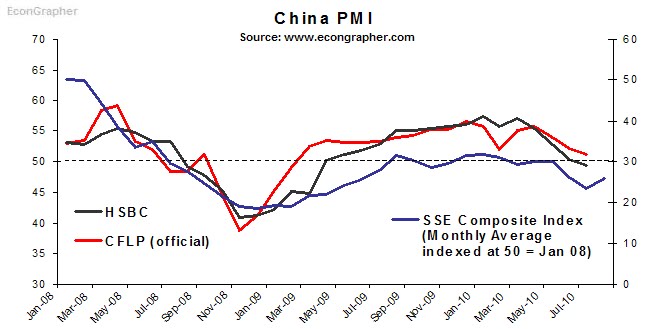
1. China PMI

The Chinese PMI indexes both fell in the July reading, with the official CFLP index falling to 51.2 from 52.1, and the HSBC index dipping below 50 for the first time since March 2009, at 49.4 vs 50.4 in June. The PMI numbers are showing an easing of industrial activity in China, but the numbers are still above the low point reached late 2008 to early 2009. The July industrial production result is likely to come in lower again next week when the monthly data release comes out (which also includes CPI, fixed asset investment, PPI, and retail sales). The biggest question around the PMI result is whether or not it's temporary; is it a seasonal movement? is it the result of artificial tightening moves? or is it a more fundamentally driven decline? Next week will surely bring extra pieces to the puzzle.
Market News and Data brought to you by Benzinga APIs

© 2026 Benzinga.com. Benzinga does not provide investment advice. All rights reserved.

Posted In:
GlobalEconomics
Comments
Loading...
Beat the Market With Our Free Pre-Market Newsletter
Enter your email to get Benzinga's ultimate morning update: The PreMarket Activity Newsletter


2. US PMI
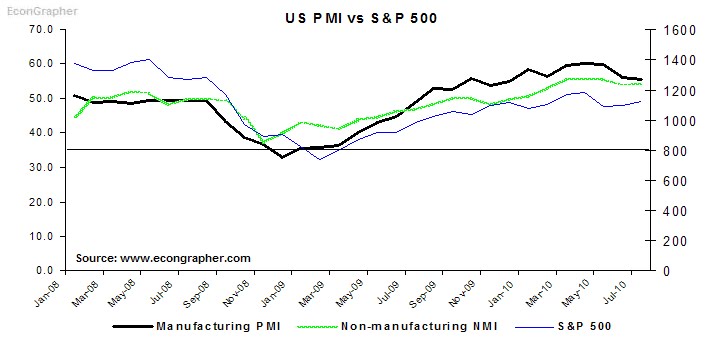
In the US the PMI results also softened slightly, but the standout was the non-manufacturing PMI which came in at 54.3 vs 53.8 in the previous month, driven by new orders, and new export orders. The manufacturing PMI on the other hand dropped to 55.5 from 56.2 with the largest falls in new orders and production. The results are symptomatic of where the US economy is tracking; signs of slowing down, but still riding relatively high from the bounce-back - but remember the bounce-back was brought on by the stimulus measures and the inventory cycle. What we're seeing now is the part where the engine is spinning and the clutch is about to engage - but will it stall? the risks are certainly there.

3. Monetary Policy review
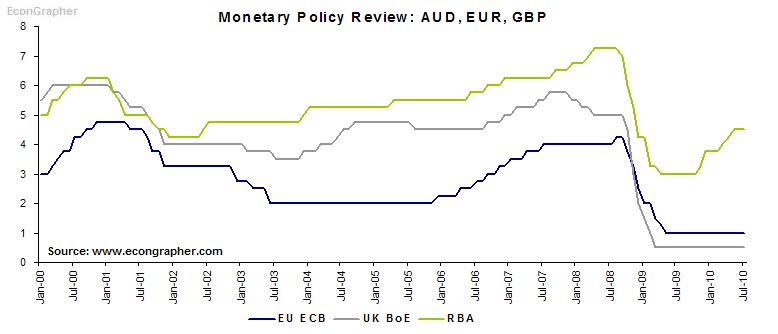
This week we saw monetary policy decisions from Australia, Europe, and the UK. The Reserve Bank of Australia held again at 4.50%, which will probably be the new neutral for now; the RBA is basically taking a wait and see approach at this point to gauge how the recovery is tracking in Australia and around the world. The European Central Bank also held steady at the record low 1.00% which was no surprise, likewise the Bank of England help its key rate at 0.50% and held the Asset Purchase Program unchanged at GBP 200 billion. The ECB and BoE are both unlikely to make any substantive tightening moves before the year is out, but of course this depends on how the recovery at home and abroad continues (or otherwise).

4. New Zealand unemployment
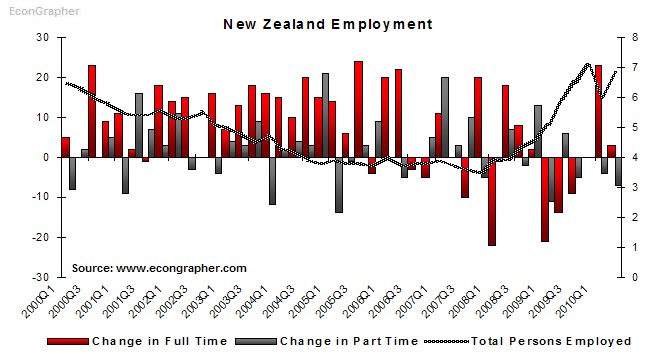
Over in New Zealand the quarterly employment report was released for Q2 2010, with the progress made in Q1 almost all lost as the unemployment rate bounced back to 6.8% from 6% in Q1 (but below the high of 7%). Within the results the number of unemployed persons rose 13.9% to 159k, and the number not in the labour force grew 0.6% to 1,094k, while the number of persons employed dropped -0.3% to 2,170k. But within the employment numbers the number of full time employees increased 3k, while the number of part time employees dropped by 7k; which is a relatively positive sign from the perspective that during a recovery its better to see full time jobs growing rather than part-time jobs. The employment situation will likely improve during the second quarter as the economy limps forward on its recovery.

5. US nonfarm payrolls
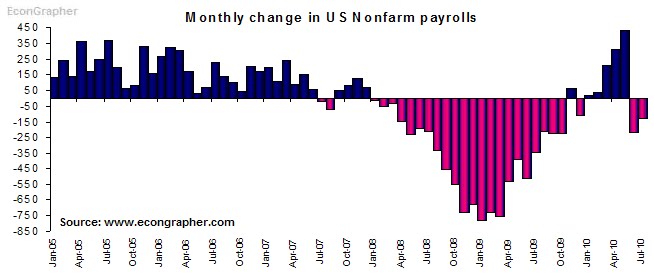
US nonfarm payrolls fell -131k in July (vs consensus -70k), after falling an adjusted -221k in June. In the detail, 202 government jobs were cut (with 143k being census related), however private payrolls increased by 71k (83k in June). Also in the detail, average hourly earnings increased 0.2% and the average work week increased to 34.2 hours from 34.1 in June. So there are some positives in the payrolls employment report, it is a positive signs to see both hours and earnings on the rise, as well as some growth in the private sector. Of course there's a long way to go to recover the losses made during the crisis, but data like this at least slightly improve the mixed picture of where the US economy is headed.

Summary

So we had China's PMI falling, with the HSBC index tracking into the sub-50 territory, but it remains to be seen whether this is the start of a significant slowdown, or just a temporary pullback. It's likely to be the latter unless any catalysts trigger a more systemic slowdown.

In the US, the PMI's are sending mixed signals, with the non-manufacturing sector improving on the back of increased orders, while the manufacturing sector is slowing as orders fall. Taken together with the employment results it shows a picture of an economy that is muddling its way along out of the recession, with the training wheels of stimulus and the inventory cycle close to falling off...

On the monetary policy front, the theme is simply wait and see. More and more countries are seeing more stop-start activity, with the mixed signals, and slow progress; as we saw with New Zealand's employment figures. More and more the course of domestic monetary policy is looking outwards to the course of the global economy, the easy part of the recovery is officially over - now comes the hard part!

Sources
1. CFLP www.chinawuliu.com.cn & Markit/HSBC www.markiteconomics.com & Yahoo Finance finance.yahoo.com
2. US Institute for Supply Management www.ism.ws
3. Reserve Bank of Australia www.rba.gov.au & European Central Bank www.ecb.int & Bank of England www.bankofengland.co.uk
4. Statistics New Zealand www.stats.govt.nz
5. Bureau of Labour Statistics www.bls.gov


Article Source: http://www.econgrapher.com/top5graphs7aug.html