
The United Kingdom's real gross domestic product (GDP) unexpectedly contracted by 0.1% in October, representing the fourth straight month without growth. Economic activity suffered in the run-up to Chancellor of the Exchequer Rachel Reeves' autumn budget.
That follows the 0.1% contraction in September, and no growth in August, the Office for National Statistics (ONS) said today. Month-on-month services fell by 0.3% and construction fell by 0.6%, while production grew by 1.1%.
Analysts had forecast 0.1% growth for the month. On a rolling three-month basis, GDP contracted 0.1% in October, with a 17.7% fall in the production of motor vehicles, trailers, and semi-trailers due to a major cyber-attack on Jaguar Land Rover. It halted manufacturing and delayed a hoped-for rebound in car output.
"There was continued weakness in car manufacturing, with the industry only making a slight recovery in October from the substantial fall in output seen in the previous month," Liz McKeown, director of economic statistics at the ONS, said. "The economy contracted slightly in the latest three months, as production fell again and services growth stalled. Overall services showed no growth in the latest three months, continuing the recent trend of slowing in this sector."
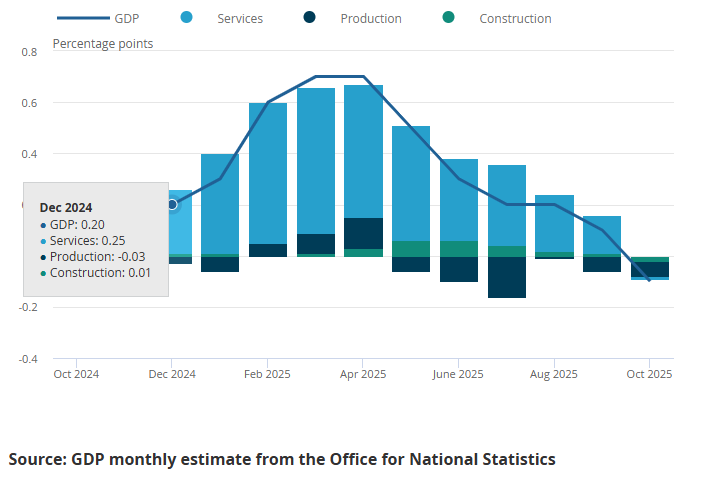
The ONS surveys revealed widespread caution. Companies in manufacturing, construction, wholesale, real estate, and employment agencies citing budget speculation as a drag on activity. This showed a broader ‘wait-and-see' slowdown across the economy.
For the three months to October, construction output fell by 0.3%. Services output showed no growth over this period, according to ONS. This continued the recent trend of slowing service-sector growth since March 2025.
Policymakers Struggle to Revive GDP
After leading G7 growth in the first half of the year, British policymakers are now struggling to sustain momentum.
"We are determined to defy the forecasts on growth and create good jobs, so everyone is better off, while also helping us invest in better public services," a Treasury spokesperson said today. "That is why the Chancellor is taking £150 off energy bills, protecting record investment in our infrastructure, and we are backing major planning reforms."
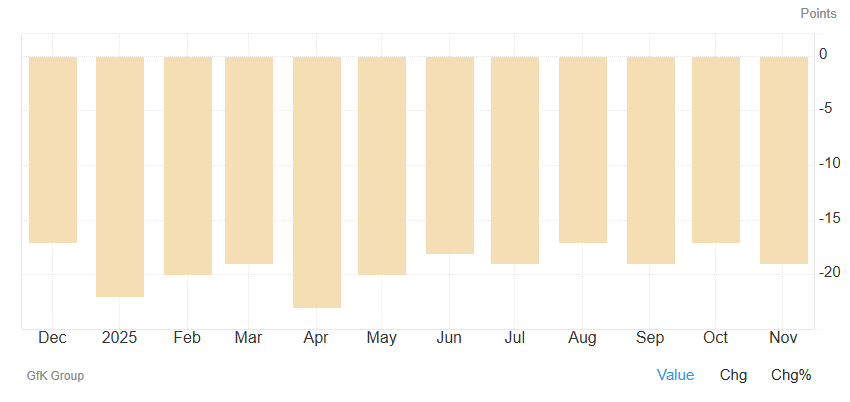
Despite the government's efforts, UK GfK Consumer Confidence fell to -19 in November from -17 in October. The reading fell short of expectations of -18 as households braced for Reeves' budget announcement last month.
Reeves announced on November 26 a budget that will extract more money workers, savings, and investors to meet deficit-reduction targets. Reeves increased tax rates on savings, dividends, and property income by two percentage points. She raised national insurance contributions on employer pensions.
The Office for Budget Responsibility (OBR) said the tax hikes would amount to an annual £26.1 billion. OBR cut its forecasts for economic growth for the coming years.
OBR Cuts GDP Forecasts
The OBR cut its forecasts for economic growth. It now sees GDP averaging 1.5% over the five-year forecast period, 0.3 percentage points slower than it expected in March. This is a setback for struggling Prime Minister Keir Starmer. He promised voters last year he would speed up the economy.
The worsening outlook has taken a political toll, undermining support for Starmer's Labour Party. Reform UK leads in polling with around 33% of the vote to Labour's 18%, according to an Ipsos poll.
"Activity in November is likely to have been constrained," Yael Selfin, chief economist at KPMG UK, said. "Overall, we expect GDP growth to be flat in the final quarter of this year."
The pound edged lower after today’s data, dropping 0.1% to $1.3381. Economists see the contraction as cementing a December rate cut. Market odds are over 90% amid fears of unemployment and GDP.
Deutsche Bank warned of a potential full-quarter contraction, while Panmure Liberum's Simon French predicted an even weaker November print. The BOE meets for its final meeting of the year on December 18.
Forecast For UK GDP to Slow Further in 2026
ING Think forecasts that GDP will slow to 0.9% next year from 1.4% this year. It points to three reasons for the slowdown:
- First, spending power is expected to stagnate: real household disposable incomes are projected to grow by 0.5% in 2026, down from 1.5% this year. Wage growth is falling quickly, while employment growth is likely to be negligible.
- Second, the public sector – having been a key offset to private sector weakness in 2025 – will be less supportive. Real departmental spending will grow at half the rate seen in 2024 and 2025, while income tax is rising as a share of GDP.
- Finally, business investment is likely to weaken, at least in the first half of the year. Confidence has waned amid uncertainty over future tax hikes. Global headwinds add further drag.
In contrast, the Confederation of British Industry (CBI) upgraded today its 2026 GDP growth projection from 1.0% to 1.3%,. The upward revision was primarily driven by a temporary boost to government expenditure following the Autumn Budget. However, solid headline GDP growth masks persistent weakness in private sector demand, as CBI chief economist Louise Hellem underscored.
"The mood music reads more ‘cautious optimism' than ‘cause for celebration,'" Hellem said. "Demand is fragile, domestic and global uncertainty is keeping a lid on business investment, and the cumulative burden of rising employment costs…is hitting firms' profits and hiring plans. With businesses facing these combined pressures, we're unlikely to achieve the jump in activity needed to lift the UK's long-term growth ceiling."
Disclaimer: Any opinions expressed in this article are not to be considered investment advice and are solely those of the authors. European Capital Insights is not responsible for any financial decisions made based on the contents of this article. Readers may use this article for information and educational purposes only.
Benzinga Disclaimer: This article is from an unpaid external contributor. It does not represent Benzinga’s reporting and has not been edited for content or accuracy.
© 2025 Benzinga.com. Benzinga does not provide investment advice. All rights reserved.


