I commented in a previous article that “if you think that Fed Chairman Ben Bernanke is unpopular, consider the tragic case of Takahashi Korekiyo, who served as Bank of Japan governor from 1911-1913 and as finance minister and prime minister in the 1920s and 1930s.”
Mr. Takahashi helped to pull Japan out of the Great Depression with aggressive monetary stimulus (or “quantitative easing,” in the popular jargon of today) and deficit spending. Unfortunately, like a man who joins the mafia, he found that he couldn't get out. The Japanese economy had become dependent on stimulus, and when Mr. Takahashi finally decided to risk it by tightening monetary policy and cutting government spending, he was assassinated by a group of rogue army officers.
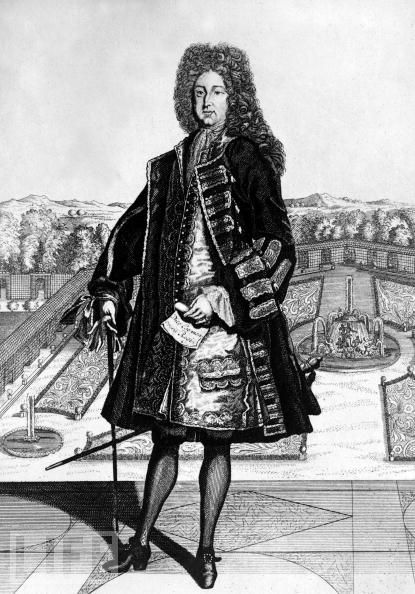
Ben Bernanke is at little risk of meeting such a fate, though there are certainly plenty in Congress who would love to assassinate his career. If certain members of the Tea Party had their way, the Chairman might meet the fate of John Law, the Scottish adventurer who, as France's first central banker, became the most powerful man in international finance—and the wealthiest man in the world—before having to flee penniless into exile and obscurity.
Law presided over one of the great financial spectacles in history: the Mississippi Land Scheme, which was aided and abetted by the creation of the first modern central bank in Europe, the French Banque Generale (later re-christened the Banque Royale). Law was an interesting character; a gentleman gambler with a taste for wealth, wine, women and power. His financial career began in the gaming halls of Europe after escaping a death sentence in England for killing a man in 1694, allegedly over the affections of a woman.
One might ask, how did this murdering degenerate come to control the financial destiny of France, then the most powerful nation in Europe? It was a long, circuitous path.
John Law was born in 1671 to an Edinburgh goldsmith. Goldsmiths were the foundation of the early European banking system, performing basic deposit and lending functions; they would take deposits of gold specie and issue paper certificates which could be redeemed at any time for the gold they represented.
Learning the basic tricks of the trade from his father—and having a gift for calculating odds that made him dangerous in Europe's casinos—Law was exceptionally well positioned for a career in finance.
Unfortunately, paper money can also be printed at will. More on that later.
The interest payments on the debt took up 120 million of the 145 livres in revenues—leaving a mere 25 million to finance the rest of the French government's expenses. Given that annual expenses were 142 million livres, the French crown depended on further access to credit to keep afloat. Suffice it to say that France was a bad credit risk.
Then along came a certain Scotsman.
As Bill Bonner and Addison Wiggin recount in their telling of the story,
On May 5, 1716, the Banque Generale was founded with 6 million Iivres in capital and was assured success from the beginning. The Duc declared all taxes must henceforth be paid with notes issued by Law's bank [making Law's notes legal tender]…
The French national debt at the time would, today, have already been seriously downgraded by Moody's. The billets d'etat—government bonds issued under Louis XIV to pay for his extravagance—were essentially junk bonds…
The challenge for Law was to buy back the outstanding government debt at the market rate of 21.50 without driving up the price. If investors discovered the government was reclaiming their billets d'etat and that Philip II could effectively save the royal finances, they would certainly begin asking more than 21.50 per billet. Law solved the problem by offering the bank shares exclusively in exchange for the government bonds.
This initial move only retired a small fraction of the national debt, but Law was far from finished.
Law built trust in his new paper money by making it redeemable for the full par value in gold coin and went so far as to say that any banker unable to meet redemptions on demand “deserved death.” His rhetoric worked. The French bought into the scheme hook, line, and sinker.
In a truly unusual sign of the times, Law's paper currency actually traded at a 15% premium to comparable gold coins one year into the scheme. As Law anticipated, the jolt in both the money supply and the velocity of money jump-started the French economy.
France might have prospered had Law stopped there, gradually paying off its debts through a mixture of economic growth and mild inflation, but alas he got cocky. To pay of the country's remaining debts in one grand swoop, Law launched the next phase of his scheme. As Bonner and Wiggin continue,
Law convinced Philip II to back a trading company with monopoly trading rights over the Mississippi River and France's land claim in Louisiana. Shares in the new company would he offered to the public, and investors would only be allowed to buy them with the remaining billets d'etat on the market [i.e. the existing French Crown junk bonds]. So begins the famed Mississippi Scheme.
The Compagnie des Indes—popularly called the Mississippi Company—was France's answer to the Dutch East India Company, but with one critical difference: the Dutch company actually had profitable trading routes. The French trading company had the mosquito-infested bog we today call Louisiana and little else.
Impressed with the success of the original paper banknotes, Phillip II decided to expand Law's operation. He renamed the Banque Generale the Banque Royale, made it an official organ of the Crown, and proceeded to expand the money supply by 16 times its previous amount—by literally printing money—and later increasing it by even more. Suddenly, Ben Bernanke's much maligned “QE2” would seem tame by comparison!
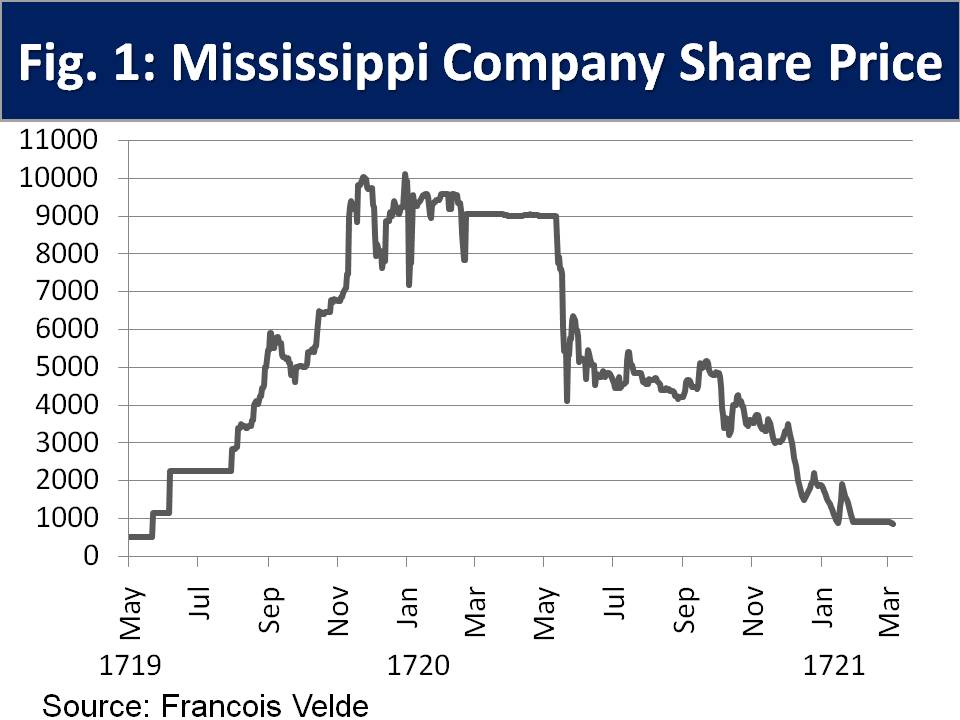
Much of the new money went directly into shares of the Mississippi Company. In a matter of months, the share price rose from 500 livres to 10,000 livres (see Figure 1), creating a new class of nouveau riche dubbed “millionaires.” A cycle developed whereby demand for the Mississippi shares would create demand for new paper currency with which to buy them. And Philip and Law were only too happy to oblige.
Law's central bank allowed investors to borrow money at low interest rates using their Mississippi shares as collateral. This would be like the Federal Reserve lending you money directly to buy shares of a new, unproven technology start-up company…using your existing shares of the company as collateral, creating something of a self-contained Ponzi scheme.
In the later stages of the scheme, the Banque and Mississippi Company were effectively merged and there was no discernable difference between bank notes, Mississippi shares, and the old government debt. The system evolved from a paper system backed by a gold standard to paper system backed by Mississippi shares which were in turn “backed” by land in Louisiana. (How the currency would be redeemed for land was, again, never really explained.)
The French bubble was roughly twice the size of the British, measured by the share price appreciation of the Mississippi Company relative to the South Sea Company. Law's company rose by a factor of 20, whereas the South Sea Company rose by “only” a factor of ten. For this, we can credit John Law's willingness to liberally offer central bank credit for the purchase of shares!
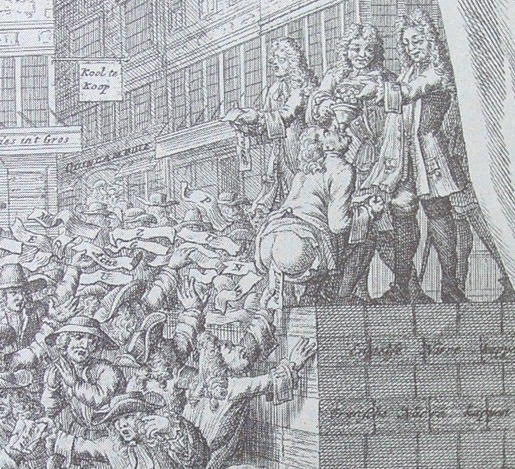
(The image above is a contemporary parody of John Law's scheme, whereby Law eats gold…and paper fiat currency comes out the other end. The image comes from an article written by Bob Landis.)
When French investors attempted to redeem their banknotes for gold, it quickly became obvious that there was not enough metal coinage to back the banknotes in circulation. The bank stopped payment on it notes, and Law was forced to flee the country in disgrace. Shares in the Mississippi Company fell all the way back to their issue price, destroying both the newly rich and the established order alike.
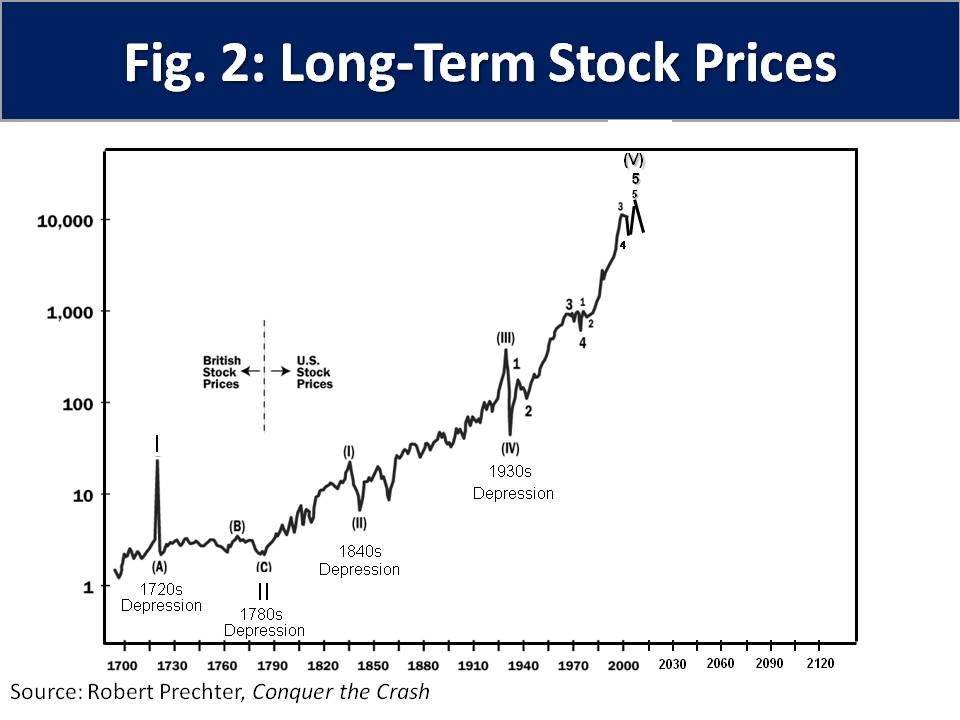
As for the investors, they endured a bear market that would make modern investors shudder. Take a look at Figure 2. Though reliable French stock market data is hard to come by, we can use British data as a proxy. The South Sea and Mississippi Bubbles were similar enough to make the comparison a fair one.
The sharp spike you see in the chart around the year 1720 is the South Sea Bubble. What followed was 70 years of secular bear market conditions. Stocks did not meaningfully rise again until the 1790s. So much for “stocks for the long run” or “buy and hold” investing!
Perhaps the most important lesson would be that credit-fueled bubbled always end badly. This was certainly the case with the spectacular collapse of the U.S. housing bubble—which led to the destruction of the banking system—and to the collapse of the Japanese “miracle economy” at the beginning of the 1990s, to give two recent examples.
It is popular these days to lay all blame at the feet of the Fed for keeping interest rates artificially low. In the U.S. housing bubble, this is not really accurate or fair. The Fed played its part, of course, but so did irresponsible bankers, mortgage brokers, real estate agents, and even the home buyers themselves.
Not too shockingly, this has given credence to “gold bug” hyperinflationary views that have been in the closet since the end of the 1970s. The gold bugs have been “wrong” in the sense that the inflation they feared has not yet materialized (and likely never will for demographic and deleveraging reasons I've discussed in prior articles). But their fears were enough to send gold to new all-time highs.
The question on everyone's minds is “what happens when the Fed eventually has to reverse course?” When the Fed takes the punchbowl away, bond yields should rise and most risky assets—like stocks—should fall. But when? And by how much?
The volatile stock correction that started in late spring coincided with a lull in the Fed's easing. Given that stocks have had an unusually good run in recent months, we might expect a similar decline once the effects of QE2 wear off, or perhaps something much worse.
Charles Lewis Sizemore, CFA
Notes:
This article first appeared in the HS Dent Forecast newsletter.
This blog is a free service of Sizemore Financial Publishing LLC, publisher of the Sizemore Investment Letter.
If you're not reading the Sizemore Investment Letter, then you are missing out on rock-solid investment recommendations designed to profit from the major macro trends shaping the world today.
SUBSCRIBE TODAY and get access to information that is simply not available anywhere else.
© 2026 Benzinga.com. Benzinga does not provide investment advice. All rights reserved.