


The European Union (EU) hMP) and USA Rare Earth, Inc. (NASDAQ:USAR) have benefited from Washington's geopolitical pivot. Both stocks have significantly outperformed in July. MP rallied nearly 87% on a multi-billion-dollar deal with the US Department of Defense. This will help secure supply chain independence for rare earth magnets. USA Rare Earth rose 21.24% MP's total US rare earth magnet manufacturing capacity is expected to reach an estimated 10,000 metric tons by 2028. MP operates the only rare earth mine in the US, located at Mountain Pass, California, and a magnet plant in Fort Worth, Texas. The Las Vegas-based company signed a $500 million deal with Apple (NASDAQ:AAPL) about a week later to develop a recycling line for rare earth materials, which will enable MP to reprocess rare earth elements for use in Apple products. "Rare earth materials are essential for making advanced technology, and this partnership will help strengthen the supply of these vital materials here in the United States," Apple CEO Tim Cook said in a statement.">as fallen behind China and the US in the competitive race in chip manufacturing and rare earth materials despite efforts to reverse the trend.
Europe's share of global fabrication capacity fell below 10%, according to 2022 data from the European Parliamentary Research Service. The European Court of Auditors (ECA) has questioned the EU's plans to more than double its share of the global semiconductor market to 20% by 2030.
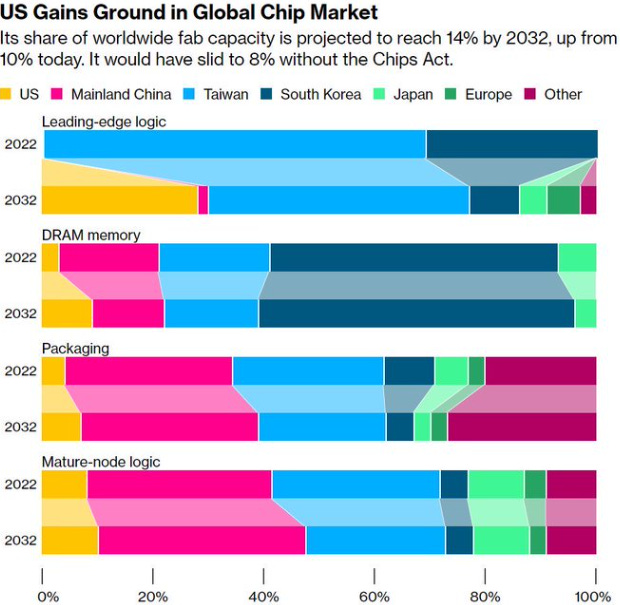
The US share of worldwide fabrication capacity will reach 14% by 2032, up from 10% today, according to data from DSV. The percentage would have slipped to 8% without the US Chips Act passed under the Biden administration.
"Should there be a geopolitical event in Asia, the European economy would come to full stop," Michael A. Arouet, an investor with a background in corporate finance and mergers & acquisitions, wrote X on Tuesday. "The naivety & complacency of European governments is stunning. But hey, build some more wind turbines."
Unlike China and the US under the Trump administration, the EU has prioritized climate change policies over industrial production.
The European Green Deal aims to make Europe the first climate-neutral continent by 2050. A key target includes reducing greenhouse gas emissions by 55% by 2030 by 2030.
EU Aims to Increase Semiconductor Competitiveness
The EU, though, has taken steps to improve its competitiveness in the semiconductor sector. Artificial Intelligence, automated cars, space exploration, defense, and supercomputers are fueling a surge in the need for advanced chips.
The European Chips Act will mobilise more than €43 billion of public and private investments to bolster Europe's competitiveness. The act will help the EU "prepare, anticipate and swiftly respond to any future supply chain disruptions," the European Commission (EC) said.
"Europe must uphold its tradition of openness and cooperation while securing also resilient access to the chips that power our economies and societies," Henna Virkkunen, EC vice-president, told the International Technology Forum World conference in May.
The European Court of Auditors (ECA) said the EU remained "far off the pace" needed to reach its objectives. It is currently on track for a market share of 11.7% by 2030, it said.
"The EU urgently needs a reality check in its strategy for the microchips sector," Annemie Turtelboom, the ECA Member in charge of the audit, said in a press release. "The 20 % target was essentially aspirational – meeting it would require us to approximately quadruple our production capacity by 2030, but we are nowhere close to that with our current rate of progress."
Since the bipartisan 2022 CHIPS Act, the US private sector has announced $540 billion in investment for the semiconductor and electronics industries, according to the Information Technology & Innovation Foundation. Companies have announced more than 100 projects across 28 states, including plans to launch 17 new semiconductor fabs in the US.
EU Tries to Limit Imports of CRM
The EU is also attempting to reduce its reliance on imports for critical raw materials, including rare earths. The EU's Critical Raw Materials (CRM) Act aims to extract 10% of the EU's annual CRM consumption domestically and process 40% within the EU by 2030.
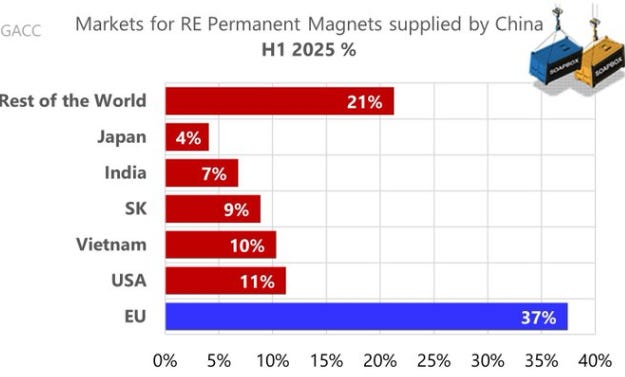
Solvay SA began efforts in April to revive rare earth processing, the company stated in a press release at its La Rochelle plant in France. It began commercial production of rare earths for permanent magnets, which are essential components in electric vehicle motors, renewable energy systems, advanced electronics, and defense systems.
This phase is the first step toward meeting the objective of satisfying 30% of European demand by 2030, the company said. The facility will source rare earths and recycled materials from a diverse range of suppliers and mining partners, as mandated by the CRM Act.
"Solvay is partnering with emerging mining and recycling players to accelerate the establishment of a robust, reliable, and sustainable supply chain, crucial for Europe's competitiveness and industrial and technological sovereignty," it said in the statement.
Solvay stock is down 2.91% year-to-date.
Europe Isn't Tapping Its Rare Earth Deposits
Europe has not used its rare earth deposits.
In early 2023, Sweden’s state-owned mining company LKAB identified significant deposits near the northern town of Kiruna. A resource estimate exceeded 1.7 million tons of rare earth oxides, which is the largest deposit of its kind in Europe.
Despite plans to start production by 2027, according to current estimates, an 800 million SEK (€71 million) demonstration plant in Luleå won't be operational before the end of 2026. Commercial production should start in 2030.
The EU doesn't have one publicly listed company that is primarily focused on rare earth element mining as its core business.
US Taps Private Sector to Expand Rare Earths Mining
The US private sector is also making progress in rare earth mining as it seeks to reduce its dependence on Chinese imports. China accounted for 70% of US rare earth imports in 2023, according to the US Geological Survey.
President Trump has recognized that an overreliance on foreign critical minerals and their derivative products could jeopardize US defense capabilities, infrastructure development, and technological innovation.
"The US remains heavily dependent on foreign sources, particularly adversarial nations, for these essential materials," the White House said in April. This has exposed "the economy and defense sector to supply chain disruptions and economic coercion."
Rare earths are used in US military applications, including the F-35 warplane, drones, and submarines, among other platforms.
US Rare Earth Miners Rally on Washington's Shift
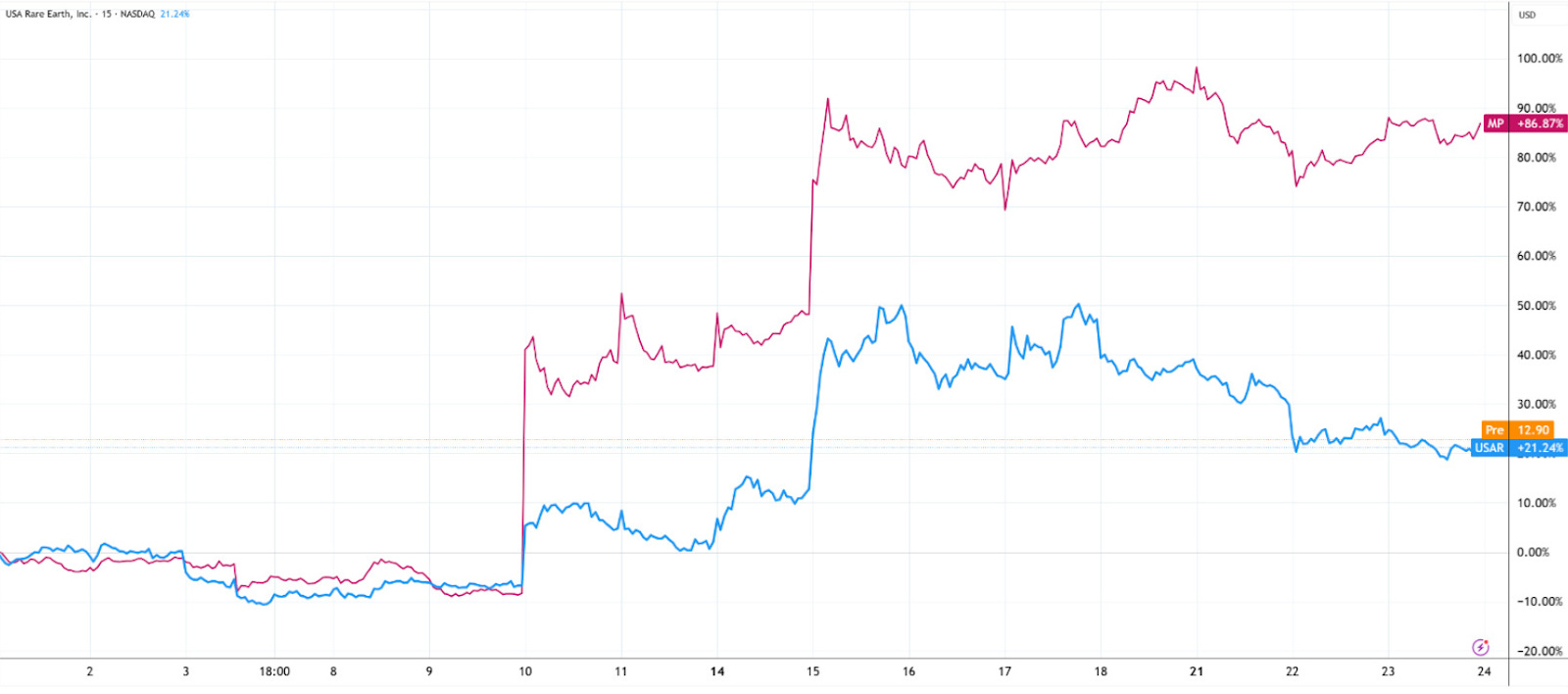
Share prices of MP Materials Corp. (NYSE:MP) and USA Rare Earth, Inc. (NASDAQ:USAR) have benefited from Washington's geopolitical pivot. Both stocks have significantly outperformed in July.
MP rallied nearly 87% on a multi-billion-dollar deal with the US Department of Defense. This will help secure supply chain independence for rare earth magnets. USA Rare Earth rose 21.24%
Source: TradingView
MP's total US rare earth magnet manufacturing capacity is expected to reach an estimated 10,000 metric tons by 2028. MP operates the only rare earth mine in the US, located at Mountain Pass, California, and a magnet plant in Fort Worth, Texas.
The Las Vegas-based company signed a $500 million deal with Apple (NASDAQ:AAPL) about a week later to develop a recycling line for rare earth materials, which will enable MP to reprocess rare earth elements for use in Apple products.
“Rare earth materials are essential for making advanced technology, and this partnership will help strengthen the supply of these vital materials here in the United States,” Apple CEO Tim Cook said in a statement.
Disclaimer:
Any opinions expressed in this article are not to be considered investment advice and are solely those of the authors. European Capital Insights is not responsible for any financial decisions made based on the contents of this article. Readers may use this article for information and educational purposes only.
Benzinga Disclaimer: This article is from an unpaid external contributor. It does not represent Benzinga’s reporting and has not been edited for content or accuracy.
© 2025 Benzinga.com. Benzinga does not provide investment advice. All rights reserved.


