The following post was written and/or published as a collaboration between Benzinga’s in-house sponsored content team and a financial partner of Benzinga.
Speculation is at the heart of the cryptocurrency market. Obviously, price speculation is present across all assets, but most thriving cryptocurrencies have survived largely thanks to speculation about their anticipated applications and promised potential.
Of course, this speculative quality has also been at the heart of the volatility in the crypto market. Bad actors and shady token schemes flood the space, new blockchain or contract technology is overhyped or undelivered, financial markets struggle to figure out what crypto means for them, all lead to the kinds of massive spikes and dips that the market has come to be known for.
While 2020 might not calm the crypto market down, it does promise to deliver some important developments that will help the new asset mature and provide a sense of how it might become a core feature in the future of finance.
The Halvening
At its face, halving introduces new scarcity to the market and bitcoin traders are already anticipating similar supply-side price growth as the past two halvings. However, traders shouldn’t forget that demand is also necessary in driving price. As bitcoin mining becomes less lucrative, the number of miners competing for a block will fall as will the hash rate necessary for mining until an equilibrium is reached.
Of course, expectations might be all that’s required to see an effect. “There are arguments for and against a price increase, the main argument against it being that the majority of people are expecting it,” said Alex. “What I know for certain is that there will be a lot of volatility due to speculation.”
Enter Libra
However, the one certainty around libra is that it will have a potential user base of nearly 170 million in the U.S. alone. Thanks to Facebook’s omnipresence, their adoption of libra and its associated Calibra wallet will mean that users of the social network, many of whom have never touched a cryptocurrency, might suddenly be paying their Uber drivers with the stuff.
Depending on how well this model is adopted—and pending the already massive scrutiny from government regulators—libra could well mark the point at which cryptocurrency goes mainstream, and other tech and finance companies will certainly follow.
The Feds Step In
Now with one of the biggest and most controversial tech companies in the world getting in on the cryptocurrency game, the cryptocurrency industry will likely see local and national governments pay closer attention to the digital currencies, for good or ill. For his part, Alex sees the current outlook on guidance and regulations in cryptocurrency as mostly benign.
“If you look at tax rulings overall, they haven’t been terribly against crypto [...] they are being extremely progressive, with countries like Singapore, Switzerland, and Portugal making great strides for crypto.” said Alex, “Their policy is undefined, but the government still wants us to pay taxes. I’m just hopeful that next year we will get a lot more clear guidance, specifically on airdrops, and staking,”
The Market Consolidates
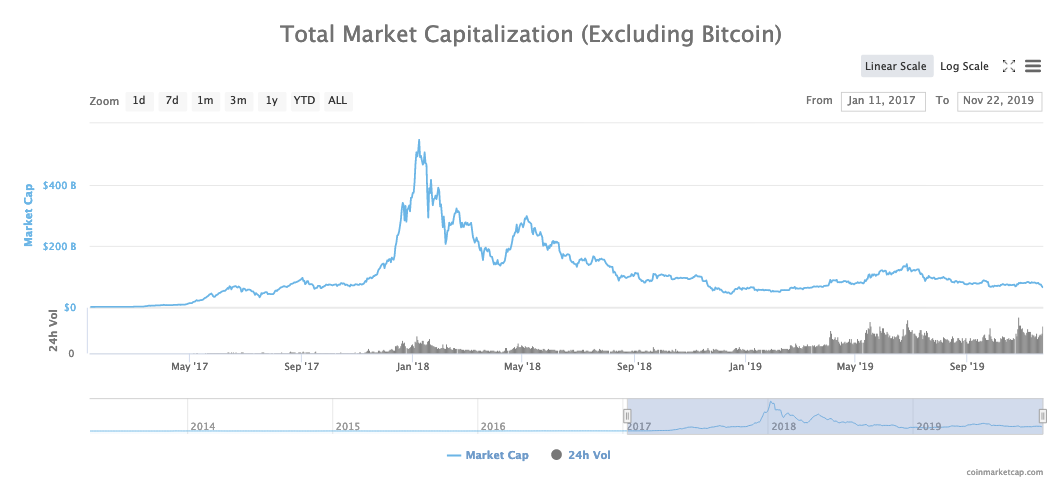
Turmoil might be a characteristic feature lower on the cryptocurrency food chain. Because, despite flattening in 2018 as the price of bitcoin fell, the number of cryptocurrencies in the market surged to more than 2300 through 2019, according to the latest account from CoinMarketCap.
Unfortunately, fewer than a third of coins trade more than $100,000 of volume in a day. Meanwhile, more than a third are valued at less than a tenth of a penny. The result is that there are more coins in the cryptocurrency market now than ever before, but the total amount of capital has flatlined throughout 2019.
Crypto And Fintech Hook Up
The overarching theme of all of these trends is that cryptocurrency is growing up, becoming mainstream and finally finding actual use cases, rather than just hypothetical ones. With the introduction of libra, the problem isn’t explaining why cryptocurrency will be valuable and necessary soon but making it valuable and necessary now—do or die.
There are obviously questions about how transactions will be implemented across an array of ledgers or how anonymized transactions can be regulated. Part of this will come in the consolidation of the industry and the continued struggle for interoperability between wallets and ledgers. However, most of these questions will likely be answered by whoever tries first, and financial technology companies are by far the most eager to fill that role.
Explaining how he stated Accointing, Alex said bluntly, “Honestly, the answer is quite simple: there was a need for it and the current tools didn’t cut it for us. The crypto ecosystem needed a platform that can be an investor’s backend system—tracking, management and taxes all in one.”
The point is, 2020 will be a put-up-or-shut-up moment for cryptocurrency. Either coins start to prove their merit, or they will start to disappear.
© 2026 Benzinga.com. Benzinga does not provide investment advice. All rights reserved.
To add Benzinga News as your preferred source on Google, click here.